Habitat fragmentation can lead directly to all of the following except
edge effects.
environmental stochasticity.
metapopulation dynamics.
faunal relaxation within patches.
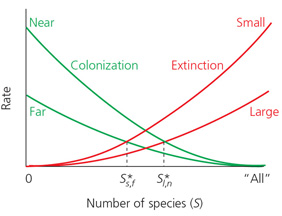
According to the figure below, the rate of colonization increases as
the number of species present on the island grows.
island size grows.
distance from the mainland grows.
distance from the mainland decreases.
According to the figure below, the rate of extinction increases as
the number of species present on the island grows.
island size grows.
distance from the mainland grows.
distance from the mainland decreases.
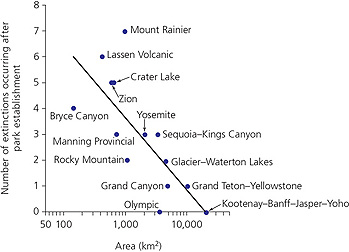
According to the figure below,
only Olympic and Grand Teton–Yellowstone National Parks continue to harbor an intact mammalian fauna.
Yosemite and Sequoia–Kings Canyon National Parks are the same size, but Sequoia–Kings Canyon has lost more mammal species than Yosemite.
Mount Rainier is larger than Yosemite and has lost a greater number of mammal species than Yosemite.
Bryce Canyon is smaller than Olympic National Park and has lost a greater number of mammal species than Olympic.
The answer to the single large or several small (SLOSS) debate concerning optimal reserve design is
a single large reserve is the best choice because a large reserve will harbor more distinct species.
a collection of several small reserves is the best choice because more distinct species will be protected when reserves are more widely dispersed across the landscape.
either a single large or several small reserves could harbor a greater number of species, depending on the degree of species nestedness across areas of different sizes.
None of the above
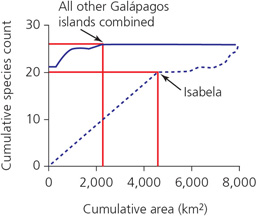
According to the figure below, the island Isabela
harbors more native land-bird species than all the other Galápagos Islands combined.
is smaller than the cumulative area of all the other Galápagos Islands combined.
harbors fewer native land-bird species than all the other Galápagos Islands combined, but this can be explained by the larger cumulative area of the other islands.
harbors fewer native land-bird species than all the other Galápagos Islands combined, despite the fact that Isabela is larger than the cumulative area of the other islands.
Which of the following would be not be expected near the edge of a forest patch compared to the patch interior?
Warmer temperatures
Lower abundance and diversity of nonnative species
Greater mortality of animals due to interaction with humans
Greater abundance and diversity of habitat generalist species
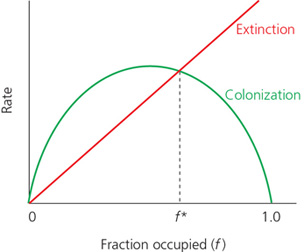
All of the following statements are consistent with the simple metapopulation model shown in the figure below, except the rate of
colonization is greater than the rate of extinction when the fraction of patches occupied is above f*.
colonization is highest when half of the habitat patches are occupied.
extinction increases linearly with patch occupancy.
extinction is equal to the rate of colonization at two points: f* and when the metapopulation is extinct ( f = 0).
Which of the following is a key lesson learned from metapopulation models?
Sites that are currently unoccupied are not essential for the long-term persistence of the metapopulation.
Reduced dispersal success can cause a metapopulation to become extinct.
A metapopulation will not become extinct until all of the habitat patches are destroyed.
The arrangement and connectivity of patches is never as important as the absolute amount of habitat.
Dispersal corridors can benefit a species by
facilitating recolonization of an area following local extirpation.
facilitating gene flow that can alleviate inbreeding depression.
facilitating the movement of disease among habitat patches.
A and B
Critics of dispersal corridors worry that corridors may
function as an ecological trap.
cause outbreeding depression or disrupt the evolutionary divergence of isolated populations.
facilitate the movement of nonnative among habitat patches.
All of the above
A large value of FST (the inbreeding coefficient) relative to FST values calculated for similar types of species indicates that
the populations under examination are well connected by migration.
a dispersal corridor may be a good investment because migration between subpopulations is currently limited.
outbreeding depression is likely occurring.
this species is unlikely to use a dispersal corridor, so there is no point in creating one.
Imagine two populations have allele frequencies p1 = 0.3, q1 = 0.7, and p2 = 0.8, q2 = 0.2. What is the value of FST for this scenario?