Which of the following statements is not consistent with the tens rule?
Roughly 10% of imported species escape cultivation or captivity.
Roughly 10% of escaped species become invasive.
Roughly 10% of naturalized species become invasive.
Roughly 1 % of escaped species become invasive.
Which of the following definitions is incorrect?
Species moved by people beyond their native range are invasive.
Species that are introduced and threaten habitats, ecosystem services, or species are invasive.
Species moved by people beyond their native range are introduced.
Introduced species that establish self-sustaining populations are naturalized.
According to the natural enemy release hypothesis, species become more abundant in their introduced range than in their native range because they
have more resources to exploit in the introduced range.
have fewer predators and pathogens in the introduced range.
fill empty niches within the introduced range.
None of the above
Which of the following statements about species introductions is false?
Some introduced species have been of enormous economic value to people.
Some introduced species have disrupted natural disturbance regimes.
Some introduced species are beneficial to native species of conservation concern.
Few of the nonnative plant species classified as weeds in the United States were introduced intentionally.
The likelihood that an introduced species will establish a self-sustaining population is increased by higher
propagule pressure.
biotic homogenization.
biological control.
None of the above
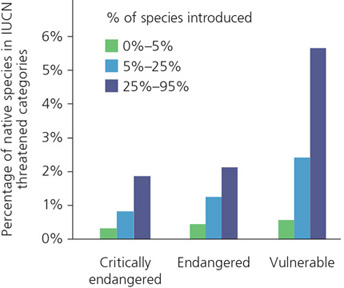
The following figure explores the relationship between introductions and endangerment for freshwater fishes. Which of the following statements correctly describes the main point of the figure?
A greater percentage of fish species are listed by the IUCN in the vulnerable category compared to the endangered and critically endangered categories.
High levels of fish introductions cause a high-level threat among native fish species.
Locations in which a high percentage of fish species are introduced also have a higher percentage of native fish species listed as vulnerable, endangered, and critically endangered.
None of the above
Biological control is the intentional introduction of a species with the goal of controlling the abundance of some other species. Which of the following is an example of biological control gone awry?
The introduction of the European honeybee to the United States
The introduction of the European rabbit to Australia
The introduction of the cane toad to Australia
The introduction of the Burmese python to Florida
Which of the following statements about tamarisk shrubs is false?
Tamarisk is the target of extensive and expensive eradication efforts.
Tamarisk was accidentally introduced to the United States.
Tamarisk provides habitat for pollinators and birds, including the endangered southwestern willow flycatcher.
Where tamarisk occurs, the water table is usually lower.
Which of the following statements about eradication efforts is false?
Eradication is generally more likely to succeed on islands compared to mainland locations.
There have been successful eradications of vertebrate species, but as yet there are no examples of successful eradication of invertebrate animal species.
The more time an invasive species has to become established, the higher the cost of its control or eradication.
None of the above
Which of the following is an important route by which nonnative species are introduced into freshwater ecosystems?
Inadvertent introduction of species that may stick to boat bottoms or be expelled with ballast water
Intentional releases of prized game fish
Releases from home aquaria or escapes from aquaculture
All of the above
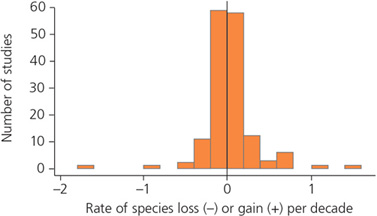
The figure below summarizes data from 168 published studies that recorded the number of plant species at the same sites but at two different times. The main point of the graph is that
introduced species have not contributed to the extinction of native species.
the distinctiveness of the floras and faunas found in different locations has, on average, been reduced.
the number of species in local communities has, on average, remained rather constant over time.
the number of species in local communities has, on average, declined over time.
Which of these hypotheses concerning the invasibility of ecological communities predicts that species should be less able to establish a self-sustaining population if another species of the same genus is native to the area?
Natural enemy release hypothesis
Darwin’s naturalization hypothesis
Biotic resistance hypothesis
Biotic acceptance hypothesis
Which of these hypotheses concerning the invasibility of ecological communities predicts that the number of introduced species in an area will be positively correlated with the number of native species present in that same area?