Efforts to recover populations of the red wolf, Canis rufus, are controversial because
it appears red wolves were going extinct due to natural rather than human-made causes.
the red wolf may be the result of gray wolf-coyote hybridization rather than a true species.
recovery efforts have been unsuccessful to date.
None of the above.
Under which species concept is the total number of recognized species likely to be largest?
Biological species concept
Morphological species concept
Phylogenetic species concept
None of the above
A species that is geographically limited to only one defined area is referred to as
extirpated.
extinct.
endemic.
endangered.
Which of the following is NOT a plausible explanation for the mismatch between the predicted number of extinctions and the number of extinctions actually observed in historic times?
Most species are unknown to science, and so their disappearance could not have been documented.
It is difficult to be certain that every last individual of a species is dead, and scientists try to be relatively certain before making the call.
Extinctions of highly sensitive species occur shortly after human colonization, so the remaining species tend to be more tolerant of human disturbance and less extinction prone.
No one has bothered to try to document actual extinctions.
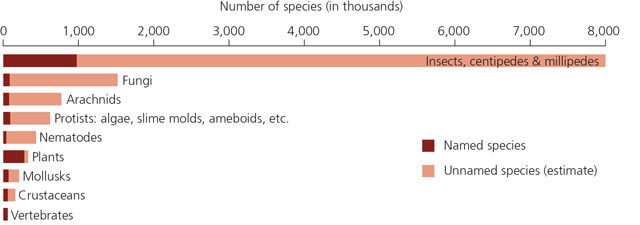
Which of the following statements regarding the diversity of life is NOT supported by the data shown in the figure below?
To date there are more identified species of plants than fungi, but fungi are the more diverse of these two groups.
Insects, centipedes, and millipedes are by far the most species-diverse group of eukaryotes.
Crustaceans are more diverse than arachnids.
Vertebrates are the least diverse of the groups shown, and nearly all vertebrate species have been named.
Which of the following statements is NOT consistent with the patterns revealed by the fossil record?
During relatively short periods (on the order of several million years), extinction has greatly outpaced speciation.
Humans are currently causing a sixth mass extinction event.
Averaging across the history of life on Earth, speciation has outpaced extinction.
None of the above
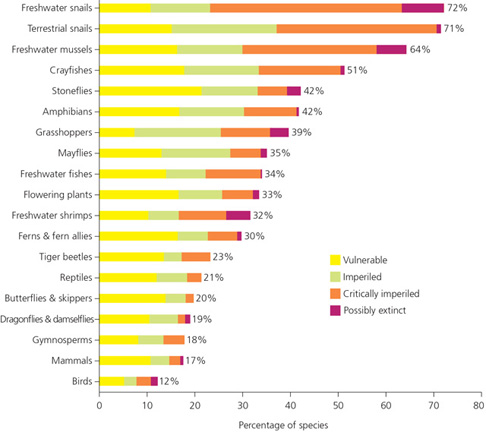
Which of the following groups has the greatest rate of extinction risk (measured as the percentage of species considered vulnerable, imperiled, critically imperiled, or possibly extinct)?
Mammals
Butterflies and skippers
Animals (both vertebrates and invertebrates) associated with freshwater habitats
Birds
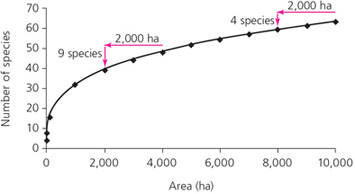
Which of the following statements best describes the species-area relationship?
The number of species present in an area is independent of its size.
Larger areas tend to harbor more species than smaller areas, and the rate at which new species accumulate with area is constant across area size.
Larger areas tend to harbor more species than smaller areas, but the rate at which new species accumulate decreases when moving from very small to larger and larger areas.
Larger areas tend to harbor more species than smaller areas, and the rate at which new species accumulate increases as when moving from very small to larger and larger areas.
Imagine that the starting point is 3,000 hectares (ha) and a landowner decides to convert 2,000 ha of that remaining area to a giant soybean field. According to this graph, approximately how many of the original species are predicted to become extinct as a result?
About 4 species will become extinct.
About 12 species will become extinct.
About 23 species will become extinct.
All of the remaining species will become extinct.
Although widely used, the species-area approach to predicting extinctions is likely to overestimate the actual extinction rate, because
there is no empirical data to support the hypothesis that the number of species increases with area.
no species has such specialized habitat needs that it could not survive elsewhere.
the amount of area that must be destroyed to kill the last individual of a species is almost always much greater than the amount of area that would have to be destroyed to encounter the first individual of a species.
of all of the above reasons.
Based on the data presented here, which species exhibit greater genetic diversity than humans?
House cats (Felis catus) and mice (Mus musculus)
Rats (Rattus norvegicus) and pigs (Sus scrofa)
Rats (Rattus norvegicus) and Syrian hamsters (Mesocricetus auratus)