Which of the following risks is the result of random variation in the survival and production of offspring and is especially of concern for a small population?
demographic stochasticity
environmental stochasticity
inbreeding depression
genetic drift
Which of the following risks is due to random variation in the survival and production of offspring due to fluctuating weather conditions or species interactions?
environmental stochasticity
inbreeding depression
genetic drift
Allee effect
Which of the following risks might be the result of a disruption to group behaviors such as hunting or communal rearing of young?
demographic stochasticity
environmental stochasticity
genetic drift
Allee effect
Which of the following risks is due to the reduction in survival and birth rates that sometimes results when an individual’s mother and father are closely related?
demographic stochasticity
inbreeding depression
genetic drift
Allee effect
Why does allelic diversity (the number of different forms of genes) tend to decline in small, isolated populations?
Because the probability of inbreeding increases as population size declines.
Because there are few individuals, possibly carrying new alleles, moving into an isolated population.
Because the loss of alleles due to genetic drift will likely outpace the rate of mutation.
B and C
Why is an individual whose parents are closely related likely to suffer reduced fitness?
Because inbreeding increases homozygosity, and homozygous individuals can sometimes produce only one version of a protein, the offspring of closely related parents can be at a disadvantage relative to heterozygotes.
Because inbreeding increases the chance that an individual will carry two copies of a rare harmful recessive allele.
Because inbreeding increases heterozygosity, and heterozygous individuals can sometimes produce two versions of a protein, the offspring of closely related parents can be at a disadvantage relative to homozygotes.
A and B
Which of the following is an assumption of an ideal population?
Equal numbers of breeding males and females
Highly uneven production of offspring
Fluctuating population size
None of the above
Which of these statements about population bottlenecks is NOT true?
A population will generally have lower genetic diversity after rather than before a population bottleneck.
A population bottleneck is a pronounced drop in population size followed by a population recovery.
A population bottleneck will lower the effective population size.
None of the above
Which of these factors will make a population LESS prone to lose genetic diversity due to genetic drift?
Small population size
Uneven sex ratio
Stable population size
Highly variable production of offspring across individuals
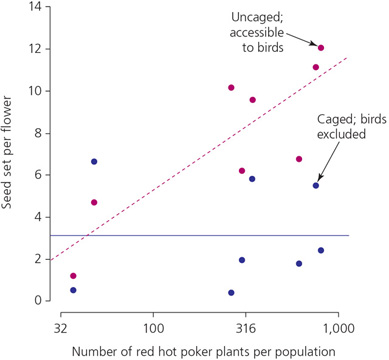
The figure below shows that red hot poker plants planted in small groups (with few other red hot poker individuals) did not produce as many seeds per plant compared to individuals planted in large patches.
This happened
regardless of whether birds were able to access the plants.
only when birds were excluded from the plants.
only when birds were able to access the plants.
None of the above is correct.
Which of these statements is consistent with the patterns shown in the figure below?
Heterozygosity is lost more quickly in populations with relatively smaller effective population size.
The more generations that a population remains at a small effective population size, the more genetic diversity it will lose.
Both statements A and B
Neither statement A nor B
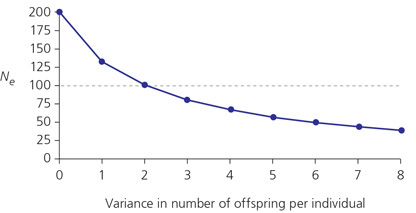
The figure below shows the relationship between the effective population size and the variance in offspring production for a population consisting of N = 100 individuals. Which of these statements is consistent with the patterns shown in this graph?
Effective population size can never be greater than the raw count of individuals (N).
Effective population size is positively related to the variance among individuals in the number of offspring produced.
Effective population size can equal the raw count of individuals (N).
Effective population size can never be less than the raw count of individuals (N).