A well-designed manipulative experiment has all of the following features, except
multiple independent replications of each experimental condition.
random assignment of individual replicates to the various experimental conditions.
background variability that masks any clear signal that might be attributed to the experimental conditions.
efforts to control, or hold constant, any potentially confounding variables.
If a species is very rare, a manipulative experiment may not be feasible because
the manipulation may be illegal if it could jeopardize the future of the species.
there may be so few individuals or populations remaining that it isn’t possible to achieve a sufficient level of replication.
the experiment might require ethically questionable manipulations, such as intentionally introducing a nonnative species to see what impact it has on the rare species.
All of the above reasons could make a manipulative experiment unfeasible.
A population of biennial plants (composed of seeds, one-year-old plants, and two-year-old plants) is affected by deer that graze off some of the flowering stems and thereby reduce the average number of seeds produced per plant. If the demographic matrix for this population is, what value would you change to assess how much conservation benefit could be gained by fencing out the deer?
0.7
0.2
0.6
10
A population of biennial plants (composed of seeds, one-year-old plants, and two-year-old plants) is affected by a fungal disease that causes mortality of some one-year-old plants. If the demographic matrix for this population is, what value would you change to assess how much conservation benefit could be gained by applying a fungicide to the plants?
0.7
0.2
0.6
10
You suspect that mortality of the little brown bat (Myotis lucifugus) is related to the mean daytime temperature in February. Based on your fieldwork, you have estimates of the mortality rate for little brown bats in 15 locations widely dispersed across North America. Which kind of observational study would probably be best suited to this scenario?
Control-impact study
BACI (before-after control-impact) study
Regression study
Any of the above
You suspect that mortality of the little brown bat (Myotis lucifugus) is related to the presence of a fungal pathogen that causes a disease known as white nose syndrome. Based on a single year of fieldwork, you have estimates of mortality rate for six populations where the fungal pathogen is present and five populations where it is absent. Which kind of observational study would probably be best suited to this scenario?
Control-impact study
BACI (before-after control-impact) study
Regression study
Any of the above
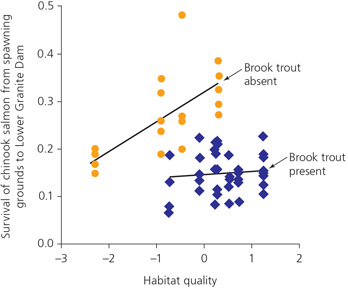
Which of these statements regarding the survival of Snake River spring/summer Chinook salmon from their spawning grounds to the Lower Granite Dam is supported by the data shown in the figure below?
The presence of brook trout reduces salmon survival regardless of habitat quality.
Salmon survival improves with habitat quality, regardless of whether brook trout are present.
The presence of brook trout reduces salmon survival, but this effect is evident only in high-quality habitat.
Salmon survival improves with habitat quality, but only if brook trout are present.
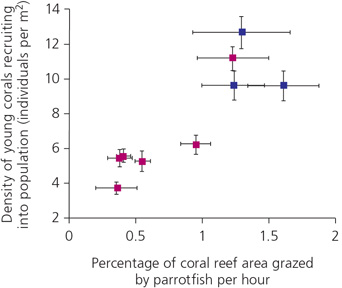
The figure below shows a positive relationship between the amount of parrotfish grazing and the recruitment of young corals. The explanation for this relationship is that parrotfish
prune back the corals, which stimulates coral growth.
fertilize the corals with their waste products, thereby stimulating coral growth.
eat algae off the surface of the corals that might otherwise interfere with coral growth.
scare away other fish that would eat corals if they were present.
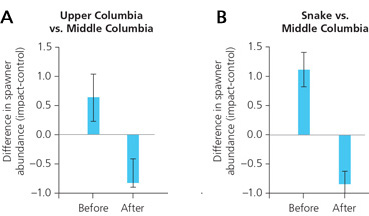
Keeping in mind that the Middle Columbia River is the control site and the Snake and Upper Columbia Rivers are the impact sites, which of these statements is NOT consistent with the patterns shown in the figure below?
Before dam construction, the Middle Columbia River had more spawners than the Snake River.
After dam construction, the Middle Columbia River had more spawners than the Upper Columbia River.
After dam construction, the Middle Columbia River had more spawners than the Snake River.
Before dam construction, the Middle Columbia River had fewer spawners than the Upper Columbia River.
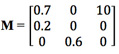 , what value would you change to assess how much conservation benefit could be gained by fencing out the deer?