


Page 9 - \2023-bfw-APES-TE-4e.indd
P. 9
Features of the Teacher’s Edition
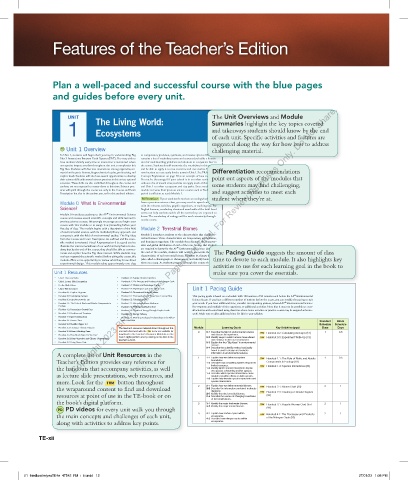
Plan a well-paced and successful course with the blue pages
and guides before every unit.
Copyright 2023 BFW Publishers. Pages Not Final. For Review Purposes Only. Do Not Share.
UNIT The Living World: The Unit Overviews and Module
1 Ecosystems Summaries highlight the key topics covered
and takeaways students should know by the end
of each unit. Specific activities and features are
suggested along the way for how best to address
Unit 1 Overview
PD challenging material.
In Unit 1, students will begin their journey in understanding Big as competition, predation, symbiosis, and invasive species. Module 1
t
da
pr
e
s
ym
,
i
on
,
m
p
co
a
s
io
n
t
et
i
b
sp
e
c
e
a
v
v
si
ie
u
d
1
le
.
s
Mo
in
,
s
n
a
os
d
i
i
Idea 3 Interactions Between Earth Systems (ERT). You may wish to contains a lot of vocabulary terms and content that builds a founda-
contains a lot of vocabulary terms and content that builds a founda-
ob
tion for understanding problems and solutions in ecosystems later in
tion for under
have students identify every time an interaction is mentioned where tion for understanding problems and solutions in ecosystems later in
standing pr
lems and solutions in ecosystems later in
the course. Students should memorize the vocabulary in this module
one species impacts another throughout the unit to emphasize this the course. Students should memorize the vocabulary in this module
Big Idea. Students will dive into interactions among organisms, ter- and be able to apply it to new scenarios and case studies. Use your
and be able to apply it to new scenarios and case studies. Use your
own location as a case study for the terms in Unit 1. See PRACTICE: Differentiation recommendations
restrial and aquatic biomes, biogeochemical cycles, productivity, and own location as a case study for the terms in Unit 1. See PRACTICE:
Concept Explanation on page 20 as an example of how to do this.
trophic levels. Students will also have several opportunities to develop Concept Explanation on page 20 as an example of how to do this.
Do not be discouraged if your school is in an urban environment
their science skills with several science practices in this unit as optional Do not be discouraged if your school is in an urban environment point out aspects of the modules that
without a lot of natural areas; students can apply much of this module
without a lot of natural areas; students can apply much of this module
activities. These skills are also scaffolded throughout the course and and Unit 1 to urban ecosystems and city parks. Since much of this some students may find challenging,
students are not expected to master them at this time. Science prac- and Unit 1 to urban ecosystems and city parks. Since much of this
module is review from previous science courses such as Biology, one
tices will spiral through the course not only in the Course and Exam module is review from previous science courses such as Biology, one
and suggest activities to meet each
Description but also in the student text and in this teacher’s edition. period is sufficient to teach Module 1.
Differentiate: If your students do not have an ecology background student where they’re at.
If your students do not have an ecology background
Module 0 What Is Environmental from a previous science class, you may need to spend extra time
from a previous science class, you may need to spend extra time
with the relevant activities, graphic organizers, or teaching tips. For
with the relevant activities, graphic organizers, or teaching tips. For
Science? English learners, vocabulary charts and word walls of the bold-faced
English learners, vocabulary charts and word walls of the bold-faced
5 5-1 Explain how phosphorus cycles within TRM Handout 5.2: Hydrologic Cycle and Carbon 1 0.5
terms can help students tackle all the terms they are expected to
ecosystems.
Cycle (63)
Module 0 introduces students to the AP ® Environmental Science know. The vocabulary of ecology will be used extensively through-
5-2 Describe how water cycles within
Do the Math: Raising Mangoes (64)
ecosystems.
course and reviews several scientific concepts and skills learned in
6-1 Describe how photosynthesis
6 previous science courses. We strongly encourage you to begin your out the course. 1 0.5
TRM Handout 6.1: Photosynthesis and
and respiration affect energy flow.
Respiration Concept Map (66)
course with this module or to assign it as prereading before your
6-2 Calculate gross primary
productivity and net primary productivity.
first day of class. The module begins with a description of the field Module 2 Terrestrial Biomes
TRM Handout 6.2: Calculating GPP (69)
6-3 Explain why primary productivity has a low
efficiency.
of environmental science with its multidisciplinary approach and
6-4 Explain why some ecosystems are much
more productive than others.
compares it with the field of environmental studies. The Big Ideas Module 2 introduces students to the characteristics that classify ter- able to calculate energy loss and efficiency from one trophic level to
Module 7
7-1 Describe how energy and matter move
2
7 from the Course and Exam Description are outlined and the scien- restrial biomes. These characteristics are temperature, precipitation, Trophic Levels, Energy another. Students also need to identify producers, primary consumers,
1
TRM Handout 7.2: Feeding Classification
through trophic levels in an ecosystem.
Flow and the 10% Rule, Food
Sort (74)
tific method is reviewed. Visual Representation 0 is a good tool to and dominant organisms. The module then discusses the character- secondary consumers, tertiary consumers from food webs, biomass
7-2 Explain how low ecological efficiency causes
istics and global distribution of each of the nine biomes that students
energy to decrease at higher trophic levels.
TRM Handout 7.3: Transfer of Energy Through
illustrate the interconnectedness of our world and emphasize to stu- istics and global distribution of each of the nine biomes that students pyramids, and energy pyramid diagrams. In addition, students need
Chains, and Food Webs
7-3 Explain why food webs experience feedback
Trophic Levels (76)
dents that by the end of the course, they should be able to commu- are required to know for the AP ® Environmental Science Exam. By Environmental Science Exam. By
loops.
The Pacing Guide suggests the amount of class
the end of the module, students will need to memorize the main
0.5
Unit 1 Exam the end of the module, students will need to memorize the main to describe how the increase or decrease of one organism can cause a
1
nicate and explain how the Big Ideas interact. While students may
Module 7 is often a fun and interesting module for students, with a
chain reaction with other organisms and feedback loops. This module
characteristics of each terrestrial biome, recognize its climate diagram
not have mastered the scientific method before taking this course, this characteristics of each terrestrial biome, recognize its climate diagram takes two days.
time to devote to each module. It also highlights key
lot of engagement. Students learn the basics of trophic levels and how
(also called a climatograph or climatogram), and identify biome loca-
module offers a nice opportunity to review what they know about (also called a climatograph or climatogram), and identify biome loca-
energy is “lost” to ecosystems as it travels up trophic levels. Students
tions on a map. As students progress through the course they will
experimental design. This module takes approximately one class tions on a map. As students progress through the course they will Differentiate: Vocabulary is essential to this module. Students
be required to explain how terrestrial biomes are impacted by dis- activities to use for each learning goal in the book to
need to know that energy is never really “lost” (first law of thermo-
w ter
e impacted b
estr
ial biomes ar
y dis-
be r
equir
ed to explain ho
period. be r equir ed to explain ho w ter r r estr ial biomes ar e impacted b y dis- need to work with the terms and be able to apply vocabulary to com-
dynamics), but increases in entropy and becomes an unusable form
provide “Handout 2.1: Biome Chart” on page 30 for students to make sure you cover the essentials.
Unit 1 Resources turbances. To help students organize and learn the information, plex questions and interpret diagrams. English learners or students
(as heat) to the ecosystem, because organisms can’t “eat heat” (second
Differentiate: Depending on the math level of your students,
law of thermodynamics). This is why there are vastly more producers
you may need to review some math with students such as calculat- fill in as they read the module. To help students read climate dia- without a background in ecology may benefit from a vocabulary
• Unit 1 Overview Video • Handout 3.1: Aquatic Biomes Card Sort than top predators. By the end of this module, students need to be chart or word wall.
ing averages, percentages, percent change, working with scientific
grams, have them create one using “Handout 2.3: Creating a Climate
• Unit 1 Lecture Slide Presentation • Handout 4.1: The Processes and Products of the Nitrogen Cycle
notation, and metric conversions. Plan to review this math and more
Diagram” on page 32. This module takes approximately two to three
• Do the Math Videos • Handout 5.1: Division and Percentages Practice
throughout the course so mastery can be gained over time.
days depending on how much background your students have with
• Unit 1 Web Resources • Handout 5.2: Hydrologic Cycle and Carbon Cycle Unit 1 Pacing Guide
biomes, and how quickly they move through the activities.
• Handout 0.1: Graphic Organizer • Handout 5.3: Dimensional Analysis Practice
Module 1 Introduction to Ecosystems
• Handout 0.2: Calculating Averages • Handout 6.1: Photosynthesis and Respiration Concept Map This pacing guide is based on a schedule with 120 sessions of 50 minutes each before the AP ® Environmental
Module 3 Aquatic Biomes Science Exam. If you have a different number of sessions before the exam, you can modify the pacing to suit
• Handout 0.3: Experiment Write-Up • Handout 6.2: Calculating GPP
To understand ecosystems, students must first understand how we
• Handout 1.1: The Role of Biotic and Abiotic Components in • Handout 7.1: Heterotroph Versus Herbivore your needs. If you have additional time, consider incorporating quizzes, released AP ® Environmental Science
delineate one ecosystem from another with boundaries. Students then
In Module 3 we shift to aquatic biomes and focus on streams and
Ecology • Handout 7.2: Feeding Classification Sort free-response and multiple-choice questions, or additional activities. Note that it may not be possible to cover
rivers, lakes and ponds, freshwater wetlands, estuaries and salt marshes,
learn the different components of ecosystems and interactions such
• Handout 1.2: Paramecium Growth Data • Handout 7.3: Transfer of Energy Through Trophic Levels all activities and exams listed using class time alone. Some activities or practice exams may be assigned as home-
• Handout 1.3: Predation and Parasitism • Handout 7.4: Energy Pathway work. Make sure to allot additional time for labs in your syllabus.
•
1-2 Handout 1.4: Species Interactions Handout 7.5: Modeling Ecological Relationships in the Yellow-
Unit 1 The Living World: Ecosystems •
• Handout 2.1: Biome Chart stone Food Web Standard Block
• Handout 2.2: Modified Figure 2.3 Schedule Schedule
• Handout 2.3: Creating a Climate Diagram The teacher’s resource materials listed throughout this Module Learning Goals Key Activities (pgs) Days Days
• Handout 2.4: Biome Matching Game unit and referenced with the TRM icons are available for 0 0-1 Describe the field of environmental science TRM Handout 0.2: Calculating Averages (13) 1 0.5
• Handout 2.5: How Much Paper Do You Use? download in the Teacher’s Resource Materials on the and discuss its importance.
book’s digital platform and by clicking on the links in the 0-2 Identify ways in which humans have altered TRM Handout 0.3: Experiment Write-Up (13)
• Handout 2.6: Biome Vegetation and Climate Characteristics teacher’s e-book. and continue to alter our environment.
• Handout 2.7: Using Biome Data 0-3 Explain the four “Big Ideas” in environmental
science.
0-4 Describe the scientific method and justify
how it is used to design and evaluate
A complete list of Unit Resources in the information in environmental science.
Overview
boundaries.
Teacher’s Edition provides easy reference for 1-5 1 1-1 Explain how we define ecosystem TRM Handout 1.1: The Role of Biotic and Abiotic 1 0.5
Components in Ecology (19)
1-2 Describe how competing species respond to
limited resources.
the handouts that accompany activities, as well 1-3 Identify which species interactions involve TRM Handout 1.4: Species Interactions (26)
one species consuming another species.
as lecture slide presentations, web resources, and 1-4 Describe which species interactions cause
neutral or positive effects on both species.
more. Look for the TRM button throughout 1-5 Explain how invasive species represent novel
species interactions.
the wraparound content to find and download 2 2-1 Explain how we define terrestrial biomes. TRM Handout 2.1: Biome Chart (30) 2 1
2-2 Describe the information contained in climate
diagrams.
TRM Handout 2.3: Creating a Climate Diagram
resources at point of use in the TE-book or on 2-3 Identify the nine terrestrial biomes. (32)
2-4 Describe the causes of changing boundaries
of terrestrial biomes.
the book’s digital platform. 3 3-1 Identify the major freshwater biomes. TRM Handout 3.1: Aquatic Biomes Card Sort 2 1
PD PD videos for every unit walk you through 3-2 Identify the major marine biomes. (44)
the main concepts and challenges of each unit, 4 4-1 Explain how carbon cycles within TRM Handout 4.1: The Processes and Products 2 1
ecosystems.
of the Nitrogen Cycle (55)
4-2 Describe how nitrogen cycles within
along with activities to address key points. ecosystems.
1-4 Unit 1 The Living World: Ecosystems
TE-xii
01_friedlandrelyeaTE4e_47542_FM_i_liii.indd 12 27/01/23 1:08 PM

