


Page 176 - 2024-bfw-MyersAP4e-TE
P. 176
Source 2:

                                        Introduction
                  Because learning complex, coordinated motor skills such as juggling 3 balls involves explicit mem-
                  ory, researchers wondered whether learning such a motor skill would be improved with sleep.
                                        Participants
                  Sixteen female college students participated in the study.
                                          Method
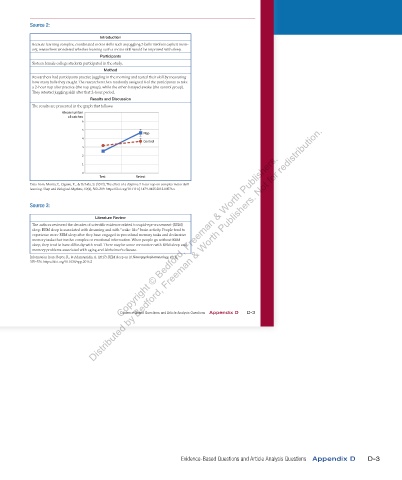
                  Researchers had participants practice juggling in the morning and tested their skill by measuring
                  how many balls they caught. The researchers then randomly assigned 8 of the participants to take
                  a 2-hour nap after practice (the nap group), while the other 8 stayed awake (the control group).
                  They retested juggling skill after that 2-hour period.
                                     Results and Discussion
                  The results are presented in the graph that follows.
                            Mean number
                              of catches
                                  6
                                      Distributed by Bedford, Freeman & Worth Publishers. Not for redistribution.
                                  5
                                                       Nap
                                  4
                                                       Control
                                  3
                                               Copyright © Bedford, Freeman & Worth Publishers.
                                  2
                                  1
                                  0
                                        Test        Retest
                 Data from: Morita, Y., Ogawa, K., & Uchida, S. (2012). The effect of a daytime 2-hour nap on complex motor skill
                 learning. Sleep and Biological Rhythms, 10(4), 302–309. https://doi.org/10.1111/j.1479-8425.2012.00576.x

                 Source 3:

                                       Literature Review
                  The authors reviewed the decades of scientific evidence related to rapid-eye-movement (REM)
                  sleep. REM sleep is associated with dreaming and with “wake-like” brain activity. People tend to
                  experience more REM sleep after they have engaged in procedural memory tasks and declarative
                  memory tasks that involve complex or emotional information. When people go without REM
                  sleep, they tend to have difficulty with recall. There may be some connection with REM sleep and
                  memory problems associated with aging and Alzheimer’s disease.
                 Information from: Boyce, R., & Adamantidis, A. (2017). REM sleep on it! Neuropsychopharmacology, 42(1),
                 375–376. https://doi.org/10.1038/npp.2016.2


                                               Evidence-Based Questions and Article Analysis Questions  Appendix D   D-3


         12_myersAPpsychology4e_28116_App-D_D-1_D-18.indd   3                             12/02/24   9:19 AM


                                                                   Evidence-Based Questions and Article Analysis Questions Appendix D   D-3


          12_HammerTE4e_47547_App-D_D-1_D-18_2pp.indd   3                                                                       12/02/24   9:21 AM

