


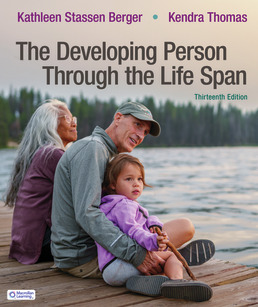
The Developing Person Through the Life Span
Thirteenth Edition
Publication Date: October 31, 2025
Paperback ISBN: 9781319615741
Pages: 792
Teach students to think like a developmentalists
Bring human development to life with The Developing Person Through the Life Span by Kathleen Stassen Berger and new co-author Kendra Thomas of Hope College. Through engaging storytelling, developmental science, and a scaffolded approach to learning, the new edition...

Online course materials that will help you in this class. Includes access to e-book and iClicker Student. Learn more about Achieve
ISBN: 9781319616885
The Achieve for Developing Person Through the Life Span (2-Term Online; International Edition)
Take notes, add highlights, and download our mobile-friendly e-books.
ISBN: 9781319616021
The Developing Person Through the Life Span
ISBN: 9781319615741
The Developing Person Through the Life Span
Combine the printed textbook with the online course in Achieve for a blended learning experience. Includes access to e-book and iClicker Student.
ISBN: 9781319618223
The Developing Person Through the Life Span 13e & Achieve for Developing Person Through the Life Span 13e (2-Term Access; International Edition)
Discover What's Inside! Click here to review a sample chapter, Chapter 1: The Science of Human Development, from The Developing Person Through the Life Span, Thirteenth Edition.
PART 1 The Beginnings
Chapter 1 The Science of Human Development
1.1 Thinking Like a Developmentalist
1.2 Doing Science
Chapter 2 Theories
2.1 Theories of Development
2.2 What Theories Contribute
Chapter 3 The New Genetics
3.1 The Genetic Code
3.2 New Cells, New People
3.3 From Genotype to Phenotype
3.4 Chromosomal and Genetic Conditions
Chapter 4 Prenatal Development and Birth
4.1 Prenatal Development
4.2 Birth
4.3 Risks and Protections
4.4 The New Family
PART 2 The First Two Years
Chapter 5 The First Two Years: Biosocial Development
5.1 Body Changes
5.2 Perceiving and Moving
5.3 Surviving in Good Health
Chapter 6 The First Two Years: Cognitive Development
6.1 Quick Learners
6.2 Active Learners
6.3 Social Learners
Chapter 7 The First Two Years: Psychosocial Development
7.1 Emotional Development in Context
7.2 Social Bonds
7.3 Who Cares for Baby?
PART 3 Early Childhood
Chapter 8 Early Childhood: Biosocial Development
8.1 Body Changes
8.2 Brain Growth
8.3 Avoidable Injury
8.4 Child Maltreatment
Chapter 9 Early Childhood: Cognitive Development
9.1 Thinking During Early Childhood
9.2 Constructed Cognition
9.3 Language Learning
9.4 Early-Childhood Schooling
Chapter 10 Early Childhood: Psychosocial Development
10.1 Emotional Development
10.2 Play
10.3 Challenges for Caregivers
10.4 Becoming Boys and Girls: Sex and Gender
PART 4 Middle Childhood
Chapter 11 Middle Childhood: Biosocial Development
11.1 A Healthy Time
11.2 Brain Development
11.3 Children with Distinct Educational Needs
Chapter 12 Middle Childhood: Cognitive Development
12.1 Thinking
12.2 Language
12.3 Teaching and Learning
Chapter 13 Middle Childhood: Psychosocial Development
13.1 The Nature of the Child
13.2 Families During Middle Childhood
13.3 Other Children
PART 5 Adolescence
Chapter 14 Adolescence: Biosocial Development
14.1 Puberty and Hormones
14.2 Growth and Nutrition
14.3 Sexual Maturation
Chapter 15 Adolescence: Cognitive Development
15.1 Cognition and the Brain
15.2 The Brain and Mental Health
15.3 Secondary Education
Chapter 16 Adolescence: Psychosocial Development
16.1 Identity
16.2 Close Relationships
16.3 Anxiety, Depression, and Aggression
PART 6 Emerging Adulthood
Chapter 17 Emerging Adulthood: Biosocial Development
17.1 Biological Universals
17.2 Health and Sickness
17.3 Risk-Taking
Chapter 18 Emerging Adulthood: Cognitive Development
18.1 Stages and Ages
18.2 Ethics and Religion
18.3 Higher Education
Chapter 19 Emerging Adulthood: Psychosocial Development
19.1 Identity Ongoing
19.2 Social Connections
19.3 Romantic Partnership
PART 7 Adulthood
Chapter 20 Adulthood: Biosocial Development
20.1 Growing Older
20.2 Body Systems
20.3 Habits: Good and Bad
Chapter 21 Adulthood: Cognitive Development
21.1 Adult Intelligence
21.2 Cognitive Hazards
21.3 Choices in Thinking
Chapter 22 Adulthood: Psychosocial Development
22.1 Personality Development in Adulthood
22.2 Intimacy: Connecting with Others
22.3 Generativity: The Work of Adulthood
PART 8 Late Adulthood
Chapter 23 Late Adulthood: Biosocial Development
23.1 Demography and Prejudice
23.2 Systems and Choices
23.3 Theories of Aging
Chapter 24 Late Adulthood: Cognitive Development
24.1 Cognitive Processing in Adulthood
24.2 Neurocognitive Disorders
24.3 Cognitive Gains
Chapter 25 Late Adulthood: Psychosocial Development
25.1 Theories of Late Adulthood
25.2 Activity in Late Adulthood
25.3 Home and Care
Epilogue: Death, Dying, and Affirmation of Life
EP.1 Living with Death
EP.2 A Good Death
EP.3 Grief and Hope
Appendix: More About Research Methods
Glossary
References

About Achieve
Achieve is our online learning system backed by extensive development and research. Proven to increase student engagement and boost performance. Achieve offers:
- Access to the ebook to download, read and virtually annotate for a completely flexible experience
- Course and book-specific resources including adaptive quizzing (Learning Curve) to personalise the experience for students
- A grade book, assignable assessments with targeted feedback, insights and reporting, instructor resources - all with seamless integration options.
Instructor Resources
Instructor Resources
Need instructor resources for your course?
Unlock Your ResourcesAccess Test Bank
You need to sign in as a verified instructor to access the Test Bank.

Test Bank for The Developing Person Through the Life Span
Kathleen Stassen Berger; Kendra Thomas | Thirteenth Edition | ©2026 | ISBN:9781319586461
