


- Content Hub
- Discipline
Discipline
back- Anatomy & Physiology Astronomy Biochemistry Biology Business Chemistry College Success Communication Economics Electrical Engineering English Environmental Science Geography Geology History Mathematics Music & Theater Nutrition and Health Philosophy & Religion Physics Psychology Sociology Statistics
- Digital
- Solutions
- News & Media
- Our Story
- Contact Us
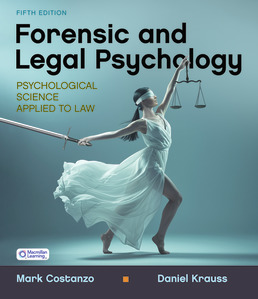
Forensic and Legal Psychology
Fifth Edition ©2026 Mark Costanzo; Daniel Krauss Formats: Achieve, E-book, Print
As low as C$71.99
As low as C$71.99
- Product Overview
- Content Material
- Assessment
- Teaching Resources
- Reports and Insights
- Support and Services

Authors
-

Mark Costanzo
Mark Costanzo received his PhD in applied social psychology from the University of California at Santa Cruz. He is a professor of psychological science at Claremont McKenna College and a member of the plenary faculty at Claremont Graduate University. He has published research on a variety of law-related topics, including police interrogations, false confessions, jury decision-making, sexual harassment, attorney argumentation, alternative dispute resolution, and the death penalty. Professor Costanzo is author of the books Dismantling the Death Penalty: Research-Based Answers to the Essential Questions (Oxford University Press, 2025) and Psychology Applied to Law. He has co-edited four books, including Expert Psychological Testimony for the Courts and Violence and the Law. His video-based research tool — The IPT-15 (developed with Dane Archer) — has been used in hundreds of universities, businesses, and other organizations to teach about the interpretation of nonverbal behavior.Professor Costanzo has served as a consultant for more than 400 criminal cases and has provided expert testimony in state, federal, military, and juvenile courts. He is the recipient of Outstanding Teaching and Mentoring Awards from the American Psychology–Law Society, the Western Psychological Association, the Society for the Psychological Study of Social Issues, and the Society for the Teaching of Psychology. In 2025, he served as President of the Western Psychological Association.

-

Daniel Krauss
Daniel Krauss completed a joint-degree program in psychology and law at the University of Arizona, receiving his JD and then his PhD in clinical psychology and psychology, policy, and law. He is the Crown Professor of Psychology and a George R. Roberts Fellow at Claremont McKenna College and is a member of the plenary faculty at Claremont Graduate University. Professor Krauss has published a large number of research articles and book chapters relating to clinical psychological evaluations for the courts, legal and psychological expertise, and jury decision-making. He is co-editor of The Law and Public Policy: Psychology and the Social Sciences book series published by the American Psychological Association Press and co-author (with Bruce Sales) of The Psychology of Law: Human Behavior, Legal Institutions, and Law in that series. He is also co-author of Forensic Mental Health Practice and the Law: A Primer for Clinicians, Researchers, and Consultants (Oxford University Press, in press).Professor Krauss is licensed to practice law in Arizona, is a member of the United States Supreme Court bar, and has served as the United States Supreme Court Fellow to the U.S. Sentencing Commission. He is a licensed clinical psychologist in the state of California; is a diplomate in forensic psychology, board certified by the American Board of Professional Psychology; and has served as president of the American Board of Forensic Psychology. Professor Krauss was a recipient of the Early Career Research Award by the Western Psychological Association. He was also awarded Outstanding Teaching and Mentoring Awards by the Western Psychological Association and the American Psychology–Law Society. He is a fellow of the Western Psychological Association, the American Psychological Association, the Society for Empirical Legal Studies, and the Association for Psychological Science.

Table of Contents
Chapter 1: Psychology and Law: A Cautious Alliance
Chapter 2: Lie Detection
Chapter 3: Interrogations and Confessions
Chapter 4: The Psychology of Forensic Identification: DNA, Fingerprints, and Other Types of Physical Trace Evidence
Chapter 5: Criminal Profiling and Psychological Autopsies
Chapter 6: Eyewitness Identification and Testimony
Chapter 7: Child Sexual Abuse: Interviewing Children and Assessing the Recovered Memories of Adults
Chapter 8: Competency to Stand Trial
Chapter 9: Plea Bargaining, Jury Selection, and Trial Procedure
Chapter 10: The Insanity Defense
Chapter 11: Intimate Partner Violence, Battered Woman Syndrome, Rape Trauma Syndrome, and Posttraumatic Stress Disorder in the Courtroom
Chapter 12: Juries and Judges as Decision Makers
Chapter 13: Child Custody Disputes
Chapter 14: Psychology and Law in the Workplace: Discrimination, Harassment, and Fairness
Chapter 15: Predicting Violent Behavior: The Psychology of Risk Assessment
Chapter 16: Corrections: Sentencing, Imprisonment, and Alternatives
Chapter 17: The Death Penalty
Product Updates
- Chapter 1: Expanded coverage of amicus curiae briefs submitted by the APA to the U.S. Supreme Court, now including briefs from several significant recent cases: U.S. Food and Drug Administration v. Alliance for Hippocratic Medicine (2024), Michigan v. Tyson (2023), Students for Fair Admissions v. Harvard College (2022), and Fulton v. Philadelphia (2021).
- Chapter 2: New discussion on the application of artificial intelligence to lie detection, highlighting its potential benefits and current limitations.
- Chapter 3: Significant new material on requiring independent evidence to conduct interrogations and on the effectiveness of science-based interrogation techniques, including a new section on banning false evidence ploys and minimization of culpability as problematic interrogation tactics.
- Chapter 4: New material on biometric identifiers (including GPS data and social media posts), friction ridge analysis in fingerprint evidence, and psychological biases in fingerprint identification.
- Chapter 5: Expanded coverage of demographic characteristics of serial killers, with a new discussion of the Stephen Paddock case (2017 Las Vegas mass shooting).
- Chapter 6: New photo example of Perry Lott, exonerated in 2023 after a 1988 wrongful rape conviction based on an unreliable witness identification in a suggestive police lineup.
- Chapter 7: New material on testimonial load and techniques for effective interviewing of children.
- Chapter 8: Updated discussions on a feigning response style (formerly “malingering”).
- Chapter 9: New research on why pre-trial detentions induce many defendants to accept a guilty plea and on the impact of negative pretrial publicity on guilty verdicts.
- Chapter 10: Updated findings on characteristics associated with defendants found not guilty by reason of insanity (NGRI).
- Chapter 11: PTSD coverage updated to reflect DSM-5-TR criteria; expanded discussion includes IPV in same-sex relationships and a new section on the critique of Lenore Walker’s cycle of abuse.
- Chapter 12: New material on unanimity in state criminal trials, updated to discuss U.S. Supreme Court Decision Ramos v. Louisiana (2020), and new research on the impact of nullification instructions on the likelihood of conviction.
- Chapter 13: Significant new material discussing varieties of custody/parenting plan arrangements, with a new section on the Best Interests of the Child Standard.
- Chapter 14: Reorganized and expanded coverage of psychology and the law in the workplace, with discussion of sexual harassment law updated to include recent advances, such as the Ending Forced Arbitration of Sexual Assault and Sexual Harassment Act and the Speak Out Act.
- Chapter 15: New research on the importance of dynamic markers in mitigating some risk assessment instruments’ likelihood of unfairly discriminating against minority/Indigenous groups.
- Chapter 16: Updated statistics on incarceration rates, with new research on the impact of defendants’ race on sentencing decisions, and on the influence of involvement in the criminal justice system on juveniles.
- Chapter 17: Updated data on U.S. executions, prisoners on death row, public support for the death penalty, racial disparities, and errors and mistakes in capital cases.
The fifth edition also includes new boxed features on timely and important topics, including: whether a child should have a parent in the interrogation room instead of an attorney; differences between male and female serial killers; how George Floyd’s death exposed the false concept of “excited delirium”; the national “competency crisis” in the criminal justice system; intimate partner violence in transgender and gender-diverse populations; child custody evaluation as a career path in forensic and legal psychology; whether people with severe mental illness are more dangerous than others; and flaws in a widely used criminal justice algorithm for assessing child pornography recidivism.
Authors
-
Mark Costanzo
Mark Costanzo received his PhD in applied social psychology from the University of California at Santa Cruz. He is a professor of psychological science at Claremont McKenna College and a member of the plenary faculty at Claremont Graduate University. He has published research on a variety of law-related topics, including police interrogations, false confessions, jury decision-making, sexual harassment, attorney argumentation, alternative dispute resolution, and the death penalty. Professor Costanzo is author of the books Dismantling the Death Penalty: Research-Based Answers to the Essential Questions (Oxford University Press, 2025) and Psychology Applied to Law. He has co-edited four books, including Expert Psychological Testimony for the Courts and Violence and the Law. His video-based research tool — The IPT-15 (developed with Dane Archer) — has been used in hundreds of universities, businesses, and other organizations to teach about the interpretation of nonverbal behavior.Professor Costanzo has served as a consultant for more than 400 criminal cases and has provided expert testimony in state, federal, military, and juvenile courts. He is the recipient of Outstanding Teaching and Mentoring Awards from the American Psychology–Law Society, the Western Psychological Association, the Society for the Psychological Study of Social Issues, and the Society for the Teaching of Psychology. In 2025, he served as President of the Western Psychological Association.
-
Daniel Krauss
Daniel Krauss completed a joint-degree program in psychology and law at the University of Arizona, receiving his JD and then his PhD in clinical psychology and psychology, policy, and law. He is the Crown Professor of Psychology and a George R. Roberts Fellow at Claremont McKenna College and is a member of the plenary faculty at Claremont Graduate University. Professor Krauss has published a large number of research articles and book chapters relating to clinical psychological evaluations for the courts, legal and psychological expertise, and jury decision-making. He is co-editor of The Law and Public Policy: Psychology and the Social Sciences book series published by the American Psychological Association Press and co-author (with Bruce Sales) of The Psychology of Law: Human Behavior, Legal Institutions, and Law in that series. He is also co-author of Forensic Mental Health Practice and the Law: A Primer for Clinicians, Researchers, and Consultants (Oxford University Press, in press).Professor Krauss is licensed to practice law in Arizona, is a member of the United States Supreme Court bar, and has served as the United States Supreme Court Fellow to the U.S. Sentencing Commission. He is a licensed clinical psychologist in the state of California; is a diplomate in forensic psychology, board certified by the American Board of Professional Psychology; and has served as president of the American Board of Forensic Psychology. Professor Krauss was a recipient of the Early Career Research Award by the Western Psychological Association. He was also awarded Outstanding Teaching and Mentoring Awards by the Western Psychological Association and the American Psychology–Law Society. He is a fellow of the Western Psychological Association, the American Psychological Association, the Society for Empirical Legal Studies, and the Association for Psychological Science.
Table of Contents
Chapter 1: Psychology and Law: A Cautious Alliance
Chapter 2: Lie Detection
Chapter 3: Interrogations and Confessions
Chapter 4: The Psychology of Forensic Identification: DNA, Fingerprints, and Other Types of Physical Trace Evidence
Chapter 5: Criminal Profiling and Psychological Autopsies
Chapter 6: Eyewitness Identification and Testimony
Chapter 7: Child Sexual Abuse: Interviewing Children and Assessing the Recovered Memories of Adults
Chapter 8: Competency to Stand Trial
Chapter 9: Plea Bargaining, Jury Selection, and Trial Procedure
Chapter 10: The Insanity Defense
Chapter 11: Intimate Partner Violence, Battered Woman Syndrome, Rape Trauma Syndrome, and Posttraumatic Stress Disorder in the Courtroom
Chapter 12: Juries and Judges as Decision Makers
Chapter 13: Child Custody Disputes
Chapter 14: Psychology and Law in the Workplace: Discrimination, Harassment, and Fairness
Chapter 15: Predicting Violent Behavior: The Psychology of Risk Assessment
Chapter 16: Corrections: Sentencing, Imprisonment, and Alternatives
Chapter 17: The Death Penalty
Product Updates
- Chapter 1: Expanded coverage of amicus curiae briefs submitted by the APA to the U.S. Supreme Court, now including briefs from several significant recent cases: U.S. Food and Drug Administration v. Alliance for Hippocratic Medicine (2024), Michigan v. Tyson (2023), Students for Fair Admissions v. Harvard College (2022), and Fulton v. Philadelphia (2021).
- Chapter 2: New discussion on the application of artificial intelligence to lie detection, highlighting its potential benefits and current limitations.
- Chapter 3: Significant new material on requiring independent evidence to conduct interrogations and on the effectiveness of science-based interrogation techniques, including a new section on banning false evidence ploys and minimization of culpability as problematic interrogation tactics.
- Chapter 4: New material on biometric identifiers (including GPS data and social media posts), friction ridge analysis in fingerprint evidence, and psychological biases in fingerprint identification.
- Chapter 5: Expanded coverage of demographic characteristics of serial killers, with a new discussion of the Stephen Paddock case (2017 Las Vegas mass shooting).
- Chapter 6: New photo example of Perry Lott, exonerated in 2023 after a 1988 wrongful rape conviction based on an unreliable witness identification in a suggestive police lineup.
- Chapter 7: New material on testimonial load and techniques for effective interviewing of children.
- Chapter 8: Updated discussions on a feigning response style (formerly “malingering”).
- Chapter 9: New research on why pre-trial detentions induce many defendants to accept a guilty plea and on the impact of negative pretrial publicity on guilty verdicts.
- Chapter 10: Updated findings on characteristics associated with defendants found not guilty by reason of insanity (NGRI).
- Chapter 11: PTSD coverage updated to reflect DSM-5-TR criteria; expanded discussion includes IPV in same-sex relationships and a new section on the critique of Lenore Walker’s cycle of abuse.
- Chapter 12: New material on unanimity in state criminal trials, updated to discuss U.S. Supreme Court Decision Ramos v. Louisiana (2020), and new research on the impact of nullification instructions on the likelihood of conviction.
- Chapter 13: Significant new material discussing varieties of custody/parenting plan arrangements, with a new section on the Best Interests of the Child Standard.
- Chapter 14: Reorganized and expanded coverage of psychology and the law in the workplace, with discussion of sexual harassment law updated to include recent advances, such as the Ending Forced Arbitration of Sexual Assault and Sexual Harassment Act and the Speak Out Act.
- Chapter 15: New research on the importance of dynamic markers in mitigating some risk assessment instruments’ likelihood of unfairly discriminating against minority/Indigenous groups.
- Chapter 16: Updated statistics on incarceration rates, with new research on the impact of defendants’ race on sentencing decisions, and on the influence of involvement in the criminal justice system on juveniles.
- Chapter 17: Updated data on U.S. executions, prisoners on death row, public support for the death penalty, racial disparities, and errors and mistakes in capital cases.
The fifth edition also includes new boxed features on timely and important topics, including: whether a child should have a parent in the interrogation room instead of an attorney; differences between male and female serial killers; how George Floyd’s death exposed the false concept of “excited delirium”; the national “competency crisis” in the criminal justice system; intimate partner violence in transgender and gender-diverse populations; child custody evaluation as a career path in forensic and legal psychology; whether people with severe mental illness are more dangerous than others; and flaws in a widely used criminal justice algorithm for assessing child pornography recidivism.
From investigations to court cases to policymaking—Exploring how psychological science influences the law
Available in print and e-textbook formats, Mark Costanzo and Daniel Krauss show students how psychological science can be used to enhance evidence collection, improve legal decision making, reduce crime, and promote justice. The authors integrate fascinating accounts of real trials, important cases, and other examples of the legal system in action to illustrate how research and theory can deepen our understanding of key participants in the legal system.
This wide-ranging and consistently accessible text persuasively demonstrates the relevance of key research findings in social, cognitive, clinical, and developmental psychology to virtually every aspect of the legal system that psychologists have studied.
Success Stories
Here are a few examples of how Achieve has helped instructors like you improve student preparedness, enhance their sense of belonging, and achieve course goals they set for themselves.
Prof. Kiandra Johnson, Spelman College
See how the resources in Achieve help you engage students before, during, and after class.
Prof. Jennifer Duncan
Use diagnostics in Achieve for a snapshot into cognitive and non-cognitive factors that may impact your students’ preparedness.
Prof. Ryan Elsenpeter
Here’s why educators who use Achieve would recommend it to their peers.
Instructor Resources
Instructor Resources
Access Test Bank
You need to sign in as a verified instructor to access the Test Bank.

Test Bank for Forensic and Legal Psychology (Online)
Mark Costanzo; Daniel Krauss | Fifth Edition | ©2026 | ISBN:9781319618544
Download Resources
You need to sign in to unlock your resources.

Image Slides
Instructor Resource Manual
Lecture Slides
You've selected:
Click the E-mail Download Link button and we'll send you an e-mail at with links to download your instructor resources. You will also be able to download your resources anytime from within your account once ready. Please note there may be a delay in delivering your e-mail depending on the size of the files.
Warning! These materials are owned by Macmillan Learning or its licensors and are protected by copyright laws in the United States and other jurisdictions. Such materials may include a digital watermark that is linked to your name and email address in your Macmillan Learning account to identify the source of any materials used in an unauthorised way and prevent online piracy. These materials are being provided solely for instructional use by instructors who have adopted Macmillan Learning’s accompanying textbooks or online products for use by students in their courses. These materials may not be copied, distributed, sold, shared, posted online, or used, in print or electronic format, except in the limited circumstances set forth in the Macmillan Learning Terms of Use and any other reproduction or distribution is illegal. These materials may not be made publicly available under any circumstances. All other rights reserved. For more information about the use of your personal data including for the purposes of anti-piracy enforcement, please refer to Macmillan Learning's.Privacy Notice
Thank you!
Your download request has been received and your download link will be sent to .
Please note you could wait up to 30 to 60 minutes to receive your download e-mail depending on the number and size of the files. You will also be able to download your resources anytime from within your account once ready. We appreciate your patience while we process your request.
Check your inbox, trash, and spam folders for an e-mail from InstructorResources@macmillan.com.
If you do not receive your e-mail, please visit macmillanlearning.com/support.
FAQs
-
-
Are you a campus bookstore looking for ordering information?
MPS Order Search Tool (MOST) is a web-based purchase order tracking program that allows customers to view and track their purchases. No registration or special codes needed! Just enter your BILL-TO ACCT # and your ZIP CODE to track orders.
Canadian Stores: Please use only the first five digits/letters in your zip code on MOST.
Visit MOST, our online ordering system for booksellers: https://tracking.mpsvirginia.com/Login.aspx
Learn more about our Bookstore programs here: https://www.macmillanlearning.com/college/us/contact-us/booksellers
-
-
-
Our courses currently integrate with Canvas, Blackboard (Learn and Ultra), Brightspace, D2L, and Moodle. Click on the support documentation below to find out more details about the integration with each LMS.
Integrate Macmillan courses with Blackboard
Integrate Macmillan courses with Canvas
-
-
-
If you’re a verified instructor, you can request a free sample of our courseware, e-book, or print textbook to consider for use in your courses. Only registered and verified instructors can receive free print and digital samples, and they should not be sold to bookstores or book resellers. If you don't yet have an existing account with Macmillan Learning, it can take up to two business days to verify your status as an instructor. You can request a free sample from the right side of this product page by clicking on the "Request Instructor Sample" button or by contacting your rep. Learn more.
-
-
-
Sometimes also referred to as a spiral-bound or binder-ready textbook, loose-leaf textbooks are available to purchase. This three-hole punched, unbound version of the book costs less than a hardcover or paperback book.
-
-
-
Achieve (full course) includes our complete e-book, as well as online quizzing tools, multimedia assets, and iClicker active classroom manager.
Most Achieve Essentials courses do not include our e-books and adaptive quizzing.
Visit our comparison table for details: https://www.macmillanlearning.com/college/us/digital/achieve/compare
-
-
-
Achieve (full course) includes our complete e-book, as well as online quizzing tools, multimedia assets, and iClicker active classroom manager.
Achieve Read & Practice only includes our e-book and adaptive quizzing, and does not include instructor resources and assignable assessments. Read & Practice does integrate with LMS.
Visit our comparison table for details: https://www.macmillanlearning.com/college/us/digital/achieve/compare
-
-
-
We can help! Contact your representative to discuss your specific needs for your course. If our off-the-shelf course materials don’t quite hit the mark, we also offer custom solutions made to fit your needs.
-
ISBN:9781319635541
Access all your course tools in one place!
ISBN:9781319606015
Take notes, add highlights, and download our mobile-friendly e-books.
ISBN:9781319606008
Save money with our hole-punched, loose-leaf textbook.
FAQs
-
-
Are you a campus bookstore looking for ordering information?
MPS Order Search Tool (MOST) is a web-based purchase order tracking program that allows customers to view and track their purchases. No registration or special codes needed! Just enter your BILL-TO ACCT # and your ZIP CODE to track orders.
Canadian Stores: Please use only the first five digits/letters in your zip code on MOST.
Visit MOST, our online ordering system for booksellers: https://tracking.mpsvirginia.com/Login.aspx
Learn more about our Bookstore programs here: https://www.macmillanlearning.com/college/us/contact-us/booksellers
-
-
-
Our courses currently integrate with Canvas, Blackboard (Learn and Ultra), Brightspace, D2L, and Moodle. Click on the support documentation below to find out more details about the integration with each LMS.
Integrate Macmillan courses with Blackboard
Integrate Macmillan courses with Canvas
-
-
-
If you’re a verified instructor, you can request a free sample of our courseware, e-book, or print textbook to consider for use in your courses. Only registered and verified instructors can receive free print and digital samples, and they should not be sold to bookstores or book resellers. If you don't yet have an existing account with Macmillan Learning, it can take up to two business days to verify your status as an instructor. You can request a free sample from the right side of this product page by clicking on the "Request Instructor Sample" button or by contacting your rep. Learn more.
-
-
-
Sometimes also referred to as a spiral-bound or binder-ready textbook, loose-leaf textbooks are available to purchase. This three-hole punched, unbound version of the book costs less than a hardcover or paperback book.
-
-
-
Achieve (full course) includes our complete e-book, as well as online quizzing tools, multimedia assets, and iClicker active classroom manager.
Most Achieve Essentials courses do not include our e-books and adaptive quizzing.
Visit our comparison table for details: https://www.macmillanlearning.com/college/us/digital/achieve/compare
-
-
-
Achieve (full course) includes our complete e-book, as well as online quizzing tools, multimedia assets, and iClicker active classroom manager.
Achieve Read & Practice only includes our e-book and adaptive quizzing, and does not include instructor resources and assignable assessments. Read & Practice does integrate with LMS.
Visit our comparison table for details: https://www.macmillanlearning.com/college/us/digital/achieve/compare
-
-
-
We can help! Contact your representative to discuss your specific needs for your course. If our off-the-shelf course materials don’t quite hit the mark, we also offer custom solutions made to fit your needs.
-
Forensic and Legal Psychology
Available in print and e-textbook formats, Mark Costanzo and Daniel Krauss show students how psychological science can be used to enhance evidence collection, improve legal decision making, reduce crime, and promote justice. The authors integrate fascinating accounts of real trials, important cases, and other examples of the legal system in action to illustrate how research and theory can deepen our understanding of key participants in the legal system.
This wide-ranging and consistently accessible text persuasively demonstrates the relevance of key research findings in social, cognitive, clinical, and developmental psychology to virtually every aspect of the legal system that psychologists have studied.
Select a demo to view:
 Sample Achieve