


Page 169 - 2024-bfw-MyersAP4e-TE
P. 169
Unit 1


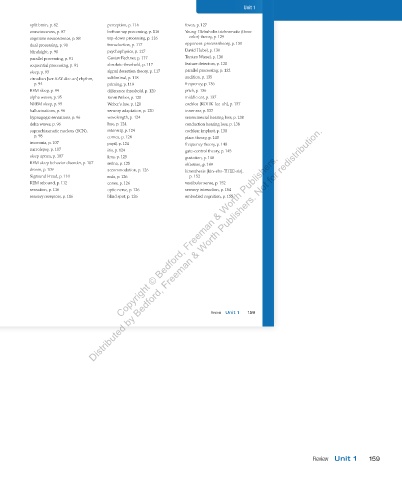
                 split brain, p. 82        perception, p. 116       fovea, p. 127
                 consciousness, p. 87      bottom-up processing, p. 116  Young–Helmholtz trichromatic (three-
                 cognitive neuroscience, p. 88  top-down processing, p. 116  color) theory, p. 129
                 dual processing, p. 90    transduction, p. 117     opponent-process theory, p. 130
                 blindsight, p. 90         psychophysics, p. 117    David Hubel, p. 130
                 parallel processing, p. 91  Gustav Fechner, p. 117  Torsten Wiesel, p. 130
                 sequential processing, p. 91  absolute threshold, p. 117  feature detectors, p. 130
                 sleep, p. 93              signal detection theory, p. 117  parallel processing, p. 132
                 circadian [ser-KAY-dee-an] rhythm,    subliminal, p. 118  audition, p. 135
                   p. 94                   priming, p. 119          frequency, p. 136
                 REM sleep, p. 94          difference threshold, p. 120  pitch, p. 136
                 alpha waves, p. 95        Ernst Weber, p. 120      middle ear, p. 137
                 NREM sleep, p. 95         Weber’s law, p. 120      cochlea [KOHK-lee-uh], p. 137
                 hallucinations, p. 96     sensory adaptation, p. 120  inner ear, p. 137
                 hypnagogic sensations, p. 96  wavelength, p. 124   sensorineural hearing loss, p. 138
                 delta waves, p. 96        hue, p. 124              conduction hearing loss, p. 138
                 suprachiasmatic nucleus (SCN),    intensity, p. 124  cochlear implant, p. 138
                   p. 98                   cornea, p. 124           place theory, p. 140
                 insomnia, p. 107          pupil, p. 124            frequency theory, p. 140
                 narcolepsy, p. 107        iris, p. 124             gate-control theory, p. 145
                                               Copyright © Bedford, Freeman & Worth Publishers.
                 sleep apnea, p. 107       lens, p. 125             gustation, p. 148
                 REM sleep behavior disorder, p. 107  retina, p. 125  olfaction, p. 149
                 dream, p. 109             accommodation, p. 126    kinesthesis [kin-ehs-THEE-sis],
                 Sigmund Freud, p. 110     rods, p. 126               p. 152
                 REM rebound, p. 112       cones, p. 126            vestibular sense, p. 152
                 sensation, p. 116         optic nerve, p. 126      sensory interaction, p. 154
                                                                    embodied cognition, p. 155
                                           blind spot, p. 126
                 sensory receptors, p. 116 Distributed by Bedford, Freeman & Worth Publishers. Not for redistribution.


                                                                             Review  Unit 1   159


         03_myersAPpsychology4e_28116_ch01_002_163.indd   159                             15/12/23   9:27 AM


                                                                                                              Review Unit 1   159


          03_HammerTE4e_47547_ch01_2a_163_4pp.indd   159                                                                        07/02/24   5:32 PM

