


Page 165 - 2024-bfw-MyersAP4e-TE
P. 165
Module 1.6d

                 life, sensation and perception are two points on a continuum. It’s not surprising, then, that
                 the brain circuits processing our physical sensations sometimes interact with the brain cir-
                 cuits responsible for cognition. The result is embodied cognition. We think from within a   TEACH 1.6-16
                 body. Two examples:                                                                 Active Learning
                 •  Judgments may mimic body sensations. Sitting at a wobbly desk and chair may make
                    relationships seem less stable (Forest et al., 2015: Kille et al., 2013).        (10 minutes) Have students engage
                 •  Hard chair, hard on crime. People who sat in a hard chair, compared with a soft chair,   in a directed paraphrasing activity
                    gave harsher punishments to criminals, and to college students who cheated on a final   by imagining that their first-grade
                    paper (Schaefer et al., 2018).
                                                                                                     cousin saw their textbook and asked
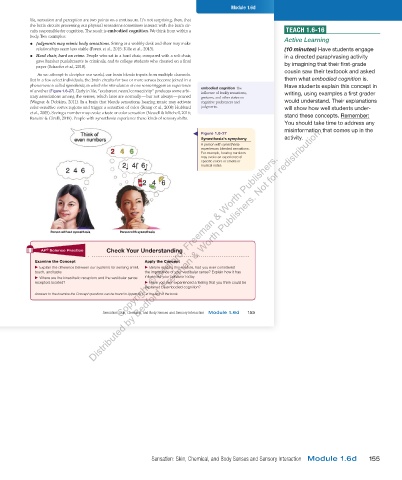
                    As we attempt to decipher our world, our brain blends inputs from multiple channels.
                 But in a few select individuals, the brain circuits for two or more senses become joined in a   them what embodied cognition is.
                 phenomenon called synesthesia, in which the stimulation of one sense triggers an experience   embodied cognition  the   Have students explain this concept in
                 of another (Figure 1.6-27). Early in life, “exuberant neural connectivity” produces some arbi-  influence of bodily sensations,   writing, using examples a first grader
                 trary associations among the senses, which later are normally — but not always — pruned   gestures, and other states on
                 (Wagner & Dobkins, 2011). In a brain that blends sensations, hearing music may activate   cognitive preferences and   would understand. Their explanations
                 color-sensitive cortex regions and trigger a sensation of color (Brang et al., 2008; Hubbard   judgments.  will show how well students under-
                 et al., 2005). Seeing a number may evoke a taste or color sensation (Newell & Mitchell, 2016;   stand these concepts. Remember:
                 Ranzini & Girelli, 2019). People with synesthesia experience these kinds of sensory shifts.
                                                                                                     You should take time to address any
                                                                                                     misinformation that comes up in the
                                                                         Figure 1.6-27
                                                                         Synesthesia’s symphony      activity.
                                                                         A person with synesthesia
                                                                         experiences blended sensations.
                                               Copyright © Bedford, Freeman & Worth Publishers.
                                                                         For example, hearing numbers
                                                                         may evoke an experience of
                                                                         specific colors or smells or
                                                                         musical notes.


                        Person without synesthesia  Person with synesthesia

                                           Check Your Understanding
                       ®
                     AP  Science Practice Distributed by Bedford, Freeman & Worth Publishers. Not for redistribution.
                   Examine the Concept                 Apply the Concept
                   ▶ ▶Explain the difference between our systems for sensing smell,   ▶ ▶Before reading this module, had you ever considered
                   touch, and taste.                   the importance of your vestibular sense? Explain how it has
                   ▶ ▶Where are the kinesthetic receptors and the vestibular sense   influenced your behavior today.
                   receptors located?                  ▶ ▶Have you ever experienced a feeling that you think could be
                                                       explained by embodied cognition?
                   Answers to the Examine the Concept questions can be found in Appendix C at the end of the book.

                                         Sensation: Skin, Chemical, and Body Senses and Sensory Interaction  Module 1.6d   155


         03_myersAPpsychology4e_28116_ch01_002_163.indd   155                             15/12/23   9:27 AM


                                                         Sensation: Skin, Chemical, and Body Senses and Sensory Interaction Module 1.6d   155


          03_HammerTE4e_47547_ch01_2a_163_4pp.indd   155                                                                        07/02/24   5:31 PM

