


Page 160 - 2024-bfw-MyersAP4e-TE
P. 160
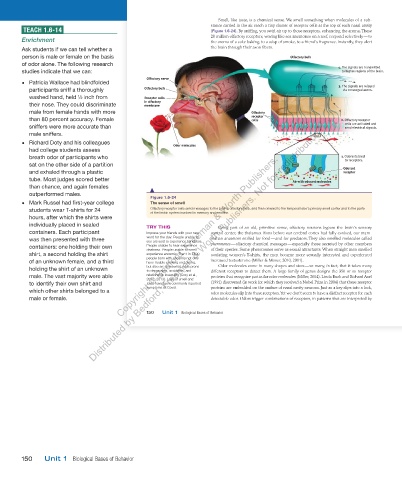
Smell, like taste, is a chemical sense. We smell something when molecules of a sub-
                                                                             stance carried in the air reach a tiny cluster of receptor cells at the top of each nasal cavity
               TEACH 1.6-14                                                  (Figure 1.6-24). By sniffing, you swirl air up to those receptors, enhancing the aroma. These
                                                                             20 million olfactory receptors, waving like sea anemones on a reef, respond selectively — to
               Enrichment                                                    the aroma of a cake baking, to a wisp of smoke, to a friend’s fragrance. Instantly, they alert
               Ask students if we can tell whether a                         the brain through their axon fibers.
               person is male or female on the basis                                                   Olfactory bulb
               of odor alone. The following research                                                                  4. The signals are transmitted
               studies indicate that we can:                                                                           to higher regions of the brain.
                                                        Olfactory nerve
               •  Patricia Wallace had blindfolded
                 participants sniff a thoroughly       Olfactory bulb                                                 3. The signals are relayed
                                                                                                                        via converged axons.
                 washed hand, held ½ inch from         Receptor cells
                 their nose. They could discriminate   in olfactory                             Bone
                                                       membrane
                 male from female hands with more                                         Olfactory
                 than 80 percent accuracy. Female                                         receptor                     2. Olfactory receptor
                                                                                          cells
                 sniffers were more accurate than                                                                       cells are activated and
                                      Distributed by Bedford, Freeman & Worth Publishers. Not for redistribution.
                                                                                                                        send electrical signals.
                 male sniffers.
               •  Richard Doty and his colleagues               Odor molecules
                 had college students assess
                 breath odor of participants who                                                                       1. Odorants bind
                                                                                                                        to receptors.
                 sat on the other side of a partition
                 and exhaled through a plastic                                                                          Odorant
                                                                                                                        receptor
                 tube. Most judges scored better                                                       Air with odorant molecules
                 than chance, and again females
                 outperformed males.
                                                         Figure 1.6-24
               •  Mark Russel had first-year college     The sense of smell
                 students wear T-shirts for 24           Olfactory receptor cells send messages to the brain’s olfactory bulb, and then onward to the temporal lobe’s primary smell cortex and to the parts
                                                         of the limbic system involved in memory and emotion.
                 hours, after which the shirts were
                 individually placed in sealed          TRY THIS               Being  part  of  an  old, primitive  sense, olfactory  neurons  bypass  the  brain’s  sensory
                 containers. Each participant  Copyright © Bedford, Freeman & Worth Publishers.
                                                                             control center, the thalamus. Eons before our cerebral cortex had fully evolved, our mam-
                                                        Impress your friends with your new
                 was then presented with three          word for the day: People unable to   malian ancestors sniffed for food — and for predators. They also smelled molecules called
                                                        see are said to experience blindness.
                 containers: one holding their own      People unable to hear experience     pheromones — olfactory chemical messages — especially those secreted by other members
                                                                             of their species. Some pheromones serve as sexual attractants. When straight men smelled
                                                        deafness. People unable to smell
                 shirt, a second holding the shirt      experience anosmia. The 1 in 7500   ovulating women’s T-shirts, the men became more sexually interested and experienced
                 of an unknown female, and a third      people born with anosmia not only   increased testosterone (Miller & Maner, 2010, 2011).
                                                        have trouble cooking and eating,
                                                                               Odor molecules come in many shapes and sizes — so many, in fact, that it takes many
                 holding the shirt of an unknown        but also are somewhat more prone   different receptors to detect them. A large family of genes designs the 350 or so receptor
                                                        to depression, accidents, and
                 male. The vast majority were able      relationship insecurity (Croy et al.,   proteins that recognize particular odor molecules (Miller, 2004). Linda Buck and Richard Axel
                                                        2012, 2013). Loss of smell and
                 to identify their own shirt and        taste have been commonly reported   (1991) discovered (in work for which they received a Nobel Prize in 2004) that these receptor
                 which other shirts belonged to a       symptoms of Covid.   proteins are embedded on the surface of nasal cavity neurons. Just as a key slips into a lock,
                                                                             odor molecules slip into these receptors. Yet we don’t seem to have a distinct receptor for each
                 male or female.                                             detectable odor. Odors trigger combinations of receptors, in patterns that are interpreted by
                                                        150   Unit 1  Biological Bases of Behavior
                                                  03_myersAPpsychology4e_28116_ch01_002_163.indd   150                              15/12/23   9:27 AM


               150   Unit 1  Biological Bases of Behavior


          03_HammerTE4e_47547_ch01_2a_163_4pp.indd   150                                                                        07/02/24   5:30 PM

