


Page 161 - 2024-bfw-MyersAP4e-TE
P. 161
Module 1.6d

                 the olfactory cortex. Just as the English alphabet’s 26 letters can combine to form many words,
                 so odor molecules bind to different receptor arrays, producing as many as 1  trillion odors that
                 we could potentially discriminate (Bushdid et al., 2014). Neuroscientists have identified com-  CONNECT 1.6-14
                 plex combinations of olfactory receptors that trigger different neural networks, allowing us to
                 distinguish between delightful and disagreeable odors (Zou et al., 2016).           •  This would be a nice time to review
                    Animals that have many times more olfactory receptors than we do also use their sense   evolutionary psychology from
                 of smell to survive, to communicate, and to navigate. Elephants can smell the difference
                 between small and large amounts of food — letting them know whether they have enough   Module 1.1. Ask students to explain
                 to feed themselves or their herd (Plotnik et al., 2019). And long before a shark can see its   why some animals have many
                 prey, or a moth its mate, olfactory cues direct them on their way to their target, just as they   times more olfactory receptors
                 do for migrating salmon returning to their home stream. After being exposed in a hatchery
                 to one of two odorant chemicals, returning salmon will later seek whichever stream was   than humans do.
                 spiked with the familiar smell (Barinaga, 1999).
                    Aided by smell, a mother fur seal returning to a beach crowded with pups will find her
                 own. Human mothers and nursing infants also quickly learn to recognize each other’s scents
                 (McCarthy, 1986). When people in relationships catch a whiff of their romantic partner’s
                 scent, their stress levels drop (Granqvist et al., 2019; Hofer et al., 2018). As any dog or cat
                 with a good nose could tell us, we each have our own identifiable chemical signature. (One
                 noteworthy exception: A dog will follow the tracks of one identical twin
                 as though they had been made by the other person [Thomas, 1974].)
                                      Distributed by Bedford, Freeman & Worth Publishers. Not for redistribution.
                    The brain knows what the nose knows (Cook et al., 2017; Zou et al.,
                 2016). When mice sniff a predator’s scent, their brain instinctively sends
                 signals to stress-related neurons (Kondoh et al., 2016). But smell expert
                 Rachel Herz (2001) notes that a smell’s appeal — or lack of it — also
                 depends on learned associations. In North America, people associate the
                                               Copyright © Bedford, Freeman & Worth Publishers.
                 smell of wintergreen with candy and gum, and they tend to like it. In
                 Britain, wintergreen often is associated with medicine, and people find it
                 less appealing. Odors also evoked unpleasant emotions when researchers
                 frustrated Brown University students with a rigged computer game in a
                 scented room (Herz et al., 2004). Later, if exposed to the same odor while   LAYNE BAILEY/AP Photo
                 working on a verbal task, the students’ frustration was rekindled and they
                 gave up sooner than others exposed to a different odor or no odor.
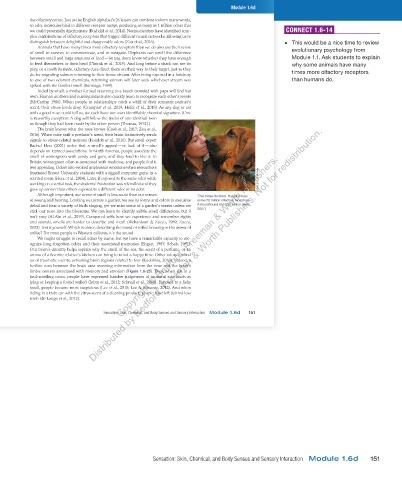
                    Although important, our sense of smell is less acute than our senses   The nose knows  Humans have
                 of seeing and hearing. Looking out across a garden, we see its forms and colors in exquisite   some 20 million olfactory receptors.
                 detail and hear a variety of birds singing, yet we miss some of a garden’s scents unless we   A bloodhound has 220 million (Herz,
                                                                        2007).
                 stick our nose into the blossoms. We can learn to identify subtle smell differences, but it
                 isn’t easy (Al Aïn et al., 2019). Compared with how we experience and remember sights
                 and sounds, smells are harder to describe and recall (Richardson & Zucco, 1989; Zucco,
                 2003). Test it yourself: Which is easier, describing the sound of coffee brewing or the aroma of
                 coffee? For most people in Western cultures, it’s the sound.
                    We might struggle to recall odors by name, but we have a remarkable capacity to rec-
                 ognize long-forgotten odors and their associated memories (Engen, 1987; Schab, 1991).
                 Our brain’s circuitry helps explain why the smell of the sea, the scent of a perfume, or an
                 aroma of a favorite relative’s kitchen can bring to mind a happy time. Other odors remind
                 us of traumatic events, activating brain regions related to fear (Kadohisa, 2013). Indeed, a
                 hotline runs between the brain area receiving information from the nose and the brain’s
                 limbic centers associated with memory and emotion (Figure 1.6-25). Thus, when put in a
                 foul-smelling room, people have expressed harsher judgments of immoral acts (such as
                 lying or keeping a found wallet) (Inbar et al., 2012; Schnall et al., 2008). Exposed to a fishy
                 smell, people became more suspicious (Lee et al., 2015; Lee & Schwarz, 2012). And when
                 riding in a train car with the citrus scent of a cleaning product, people have left behind less
                 trash (de Lange et al., 2012).

                                          Sensation: Skin, Chemical, and Body Senses and Sensory Interaction  Module 1.6d   151


         03_myersAPpsychology4e_28116_ch01_002_163.indd   151                             29/12/23   12:11 PM


                                                          Sensation: Skin, Chemical, and Body Senses and Sensory Interaction Module 1.6d   151


          03_HammerTE4e_47547_ch01_2a_163_4pp.indd   151                                                                        07/02/24   5:30 PM

