


Page 163 - 2024-bfw-MyersAP4e-TE
P. 163
Module 1.6d

                 us an accurate experience of the world can, under certain conditions, fool us.
                 Understanding how we get fooled provides clues to how our perceptual
                 system works.                                                                       ENGAGE 1.6-15
                    Your vestibular sense is super speedy. If you slip, your vestibular sen-
                 sors automatically and instantly order your skeletal response, well before          (5 minutes) Our ability to maintain
                 you have consciously decided how to right yourself. You might try this:             balance depends to some extent on
                 Hold one of your thumbs in front of your face, then move it rapidly right to        visual cues. Students can experience
                 left and back. Notice how your thumb blurs (your vision isn’t fast enough
                 to track it). Now hold your thumb still and swivel your head from left to           this for themselves by standing on
                 right — just as fast. Voila! Your thumb stays clear — because your vestibular       one foot for 30 seconds, first with
                 system, which is monitoring your head position, speedily moves the eyes.            their eyes open, then with their eyes
                 Head moves right, eyes move left. Vision is fast, but the vestibular sense   Tony Quinn/Icon Sportswire/Getty Images
                 is faster.                                                                          closed. The latter is more difficult,
                                      * * *                                                          because the vestibular and visual
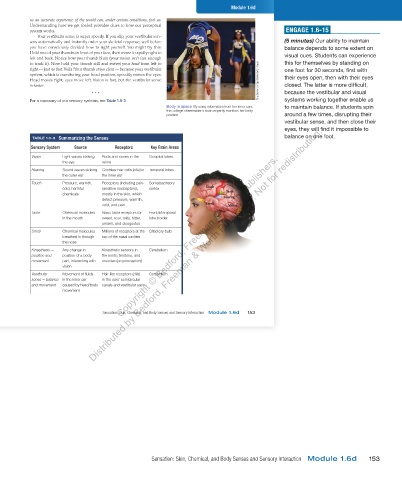
                 For a summary of our sensory systems, see Table 1.6-3.                              systems working together enable us
                                                              Body in space  By using information from her inner ears,   to maintain balance. If students spin
                                                              this college cheerleader’s brain expertly monitors her body
                                                              position.                              around a few times, disrupting their
                                                                                                     vestibular sense, and then close their
                                                                                                     eyes, they will find it impossible to
                  TABLE 1.6-3  Summarizing the Senses                                                balance on one foot.
                  Sensory System  Source     Receptors   Key Brain Areas
                                               Copyright © Bedford, Freeman & Worth Publishers.
                  Vision    Light waves striking   Rods and cones in the   Occipital lobes
                            the eye      retina
                  Hearing   Sound waves striking   Cochlear hair cells (cilia) in  Temporal lobes
                            the outer ear  the inner ear
                  Touch     Pressure, warmth,   Receptors (including pain-  Somatosensory
                            cold, harmful   sensitive nociceptors),   cortex  Touch  Taste
                            chemicals    mostly in the skin, which
                                         detect pressure, warmth,                Hearing
                                         cold, and pain                    Smell  Vision
                  Taste     Chemical molecules   Basic taste receptors for   Frontal/temporal
                            in the mouth  sweet, sour, salty, bitter,   lobe border
                                         umami, and oleogustus
                  Smell     Chemical molecules   Millions of receptors at the  Olfactory bulb
                            breathed in through   top of the nasal cavities
                            the nose  Distributed by Bedford, Freeman & Worth Publishers. Not for redistribution.
                  Kinesthesis —    Any change in   Kinesthetic sensors in   Cerebellum
                  position and   position of a body   the joints, tendons, and
                  movement  part, interacting with   muscles (proprioceptors)
                            vision
                  Vestibular   Movement of fluids   Hair-like receptors (cilia)   Cerebellum
                  sense — balance  in the inner ear   in the ears’ semicircular
                  and movement  caused by head/body  canals and vestibular sacs
                            movement


                                         Sensation: Skin, Chemical, and Body Senses and Sensory Interaction  Module 1.6d   153


         03_myersAPpsychology4e_28116_ch01_002_163.indd   153                             15/12/23   9:27 AM


                                                         Sensation: Skin, Chemical, and Body Senses and Sensory Interaction Module 1.6d   153


          03_HammerTE4e_47547_ch01_2a_163_4pp.indd   153                                                                        07/02/24   5:31 PM

