


Page 164 - 2024-bfw-MyersAP4e-TE
P. 164
Sensory Interaction
               ENGAGE 1.6-16                                                              1.6-16    How does   sensory interaction  influence our perceptions, and what is
                                                                                              y interaction
                                                                                              y interaction
                                                                                          1.6-16


                                                                                                                ceptions, and what is

                                                                                                      influence our per


                                                                                    How does
                                                                                          sensor
                                                                                          sensor


                                                                                    How does

                                                                                    How does

                                                                              embodied cognition?
               (10 minutes) Introduce sensory                                 embodied cognition?
               interaction to your students with this                          We have seen that vision and kinesthesis interact. Actually, none of our senses acts alone.
               activity. Have students bring in pieces                       All of them — seeing, hearing, tasting, smelling, touching — eavesdrop on one another, and
               of apple and potato, along with non-                          our brain blends their inputs to interpret the world ( Rosenblum, 2013 ). This is   sensory

                                                                             interaction    at work. One sense can influence another.


               carbonated soda and a sports drink.                               Consider how smell sticks its nose into the business of taste. Hold your nose, close your
               Using a blind taste test, have students                       eyes, and have someone feed you various foods. A slice of apple may be indistinguishable
                                                                             from a chunk of raw potato. A cracker may taste like cardboard. Without their smells, a cup
               plug their noses so that no air can get                       of cold coffee may be hard to distinguish from a glass of Gatorade. A big part of taste is right
               into the nose and taste the different                         under your nose.
                                                                                 Contrary to Aristotle’s presumption that taste sensors were found only on the tongue,
               samples. They should not be able to                           you also inhale the aroma through your nose — a scientific fact not understood until 1812
               tell the difference in taste between the                      ( Bartoshuk et al., 2019 ). Like smoke rising in a chimney, food molecules released by chewing
               foods or drinks if smell is impaired.                         rise into your nasal cavity. This is why food tastes bland when you have a bad cold. Smell
               Be cautious of food allergies with this                       can also change our perception of taste: A drink’s strawberry odor enhances our perception
                                                                             of its sweetness. Even touch can influence taste. Depending on its texture, a potato chip
               activity.                                                     “tastes” fresh or stale ( Smith, 2011 ). Smell + texture + taste = flavor. Yet perhaps you have
                                                                             noticed: Flavor  feels  located in the mouth ( Stevenson, 2014 ).
                                                                                 Vision and hearing may similarly interact. Baseball umpires’ vision informs their hear-
               TEACH 1.6-16                                                  ing of when the ball hits a player’s glove, influencing their judgments of whether baserun-
               Teaching Tip                                                  ners are safe or out ( Krynen & McBeath, 2019 ). Likewise, a weak flicker of light becomes
                                               Copyright © Bedford, Freeman & Worth Publishers.
                                                                             more visible when accompanied by a short burst of sound ( Kayser, 2007 ). The reverse is also
               Point out to students that vision and                         true: Soft sounds are more easily heard when paired with a visual cue. If I [DM], as a person
               taste can interact. Have students                             with hearing loss, watch a video with on-screen captions, I have no trouble hearing the
               imagine how appetizing blue macaroni            sensory interaction       the   words I am seeing. But if I then decide I don’t need the captions and turn them off, I quickly


                                                                             realize I do need them. The eyes guide the ears (  Figure 1.6-26 ).
               and cheese might taste. Or perhaps        principle that one sense can     So, our senses interact. But what happens if they disagree? What if our eyes  see  a speaker
                                                         influence another, as when the
               have them consider the tastiness of       smell of food influences its taste.     form one sound but our ears  hear  another sound? Surprise: Our brain may perceive a third
                                                                             sound that blends both inputs. Seeing mouth movements for  ga  while hearing  ba,  we may
               green mashed potatoes. Students                               perceive  da. This phenomenon is known as the  McGurk effect,  after Scottish psychologist

               may also expect that a red-colored                            Harry McGurk, who, with his assistant John MacDonald, discovered the effect ( McGurk
               drink may have a strawberry flavor                                                                   &  MacDonald, 1976 ).
                                                                                                                    For  most of us, lip
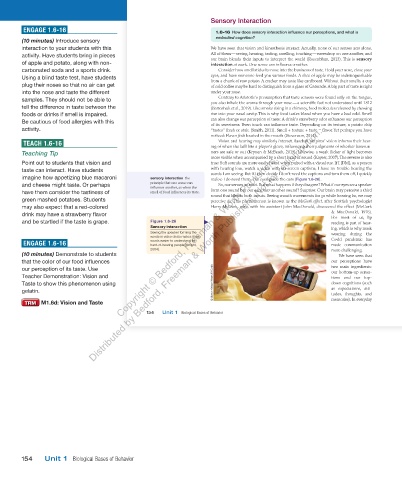
               and be startled if the taste is grape.              Figure   1.6-26                                  reading is part of hear-
                                                          Sensory interaction                                       ing, which is why mask
                                                         Seeing the speaker forming the                             wearing during the
                                                         words in video chats makes those                           Covid pandemic has
                                                         words easier to understand for
               ENGAGE 1.6-16          Distributed by Bedford, Freeman & Worth Publishers. Not for redistribution.   made communication
                                                         hard-of-hearing people ( Knight,
                                                         2004 ).                                                    more challenging.
               (10 minutes) Demonstrate to students                                                                     We have seen that
               that the color of our food influences                                                                our perceptions have
               our perception of its taste. Use                                                                     two main ingredients:
                                                                                                                    our  bottom-up  sensa-
               Teacher Demonstration: Vision and                                                                    tions and our top-
               Taste to show this phenomenon using                           © Albrecht Weisser/Westend61/Corbis    down cognitions (such
               gelatin.                                                                                             as expectations, atti-
                                                                                                                    tudes,  thoughts,  and
                     M1.6d: Vision and Taste                                                                        memories). In everyday
                                                        154   Unit 1  Biological Bases of Behavior
                                                  03_myersAPpsychology4e_28116_ch01_002_163.indd   154                              15/12/23   9:27 AM


               154   Unit 1  Biological Bases of Behavior


          03_HammerTE4e_47547_ch01_2a_163_4pp.indd   154                                                                        07/02/24   5:31 PM

