


Page 156 - 2024-bfw-MyersAP4e-TE
P. 156
(Zubieta et al., 2003). Others, who carry a mutated gene that disrupts pain circuit neuro-
                                                                             transmission, may not experience pain (Cox et al., 2006). Such discoveries point the way
               TEACH 1.6-13                                                  toward future pain medications that can mimic these genetic effects.
                                                                               Pain is not merely a physical phenomenon of injured nerves sending impulses to a
               Teaching Tip                                                  definable brain or spinal cord area — like pulling on a rope to ring a bell. The brain can also
               Explain to your students that phantom                         create pain, as it does in phantom limb sensations. When it lacks the normal sensory input
                                                                             from a missing limb, the brain may misinterpret and amplify spontaneous but irrelevant
               limb sensations occur when a person                           central nervous system activity. As the dreamer sees with eyes closed, so 7 in 10 people
               feels the presence of a limb after it has                     who have undergone limb amputation feel pain or movement in their nonexistent limbs
               been lost or removed. Invite a surgeon                        (Melzack, 1992, 2005). Some may even try to lift a cup with a phantom hand, or step off a
                                                                             bed onto a phantom leg. Even those born without a limb sometimes perceive sensations
               who specializes in amputations to visit                       from the absent arm or leg; the brain comes prepared to anticipate “that it will be getting
               the class and discuss how doctors                             information from a body that has limbs” (Melzack, 1998).
                                                                               Phantoms may haunt other senses, too. People with hearing loss often experience
                                                       Reinhold Matay/AP Photo  by vibrating air molecules but is accompanied by auditory brain activity (Sedley et al.,
               treat patients with phantom limb pain                         the sound of silence. Tinnitus, the phantom sound of ringing in the ears, is not produced
               and sensations.
                                                                             2015). People who lose vision to glaucoma, cataracts, diabetes, or macular degeneration
                                                                             Others who have nerve damage in the tasting and smelling systems have experienced
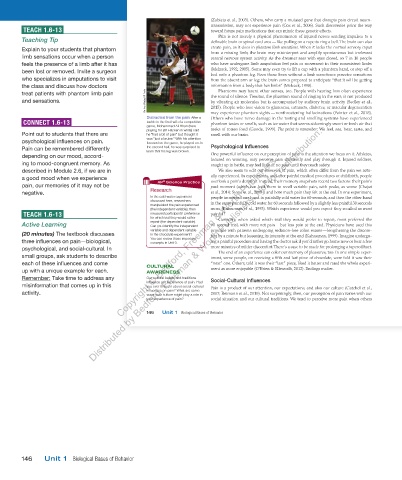
                                                        Distracted from the pain  After a   may experience phantom sights — nonthreatening hallucinations (Painter et al., 2018).
               CONNECT 1.6-13                           tackle in the first half of a competitive   phantom tastes or smells, such as ice water that seems sickeningly sweet or fresh air that
                                                        game, Mohammed Ali Khan (here
                                      Distributed by Bedford, Freeman & Worth Publishers. Not for redistribution.
                                                        playing for BK Häcken in white) said   reeks of rotten food (Goode, 1999). The point to remember: We feel, see, hear, taste, and
               Point out to students that there are     he “had a bit of pain” but thought it   smell with our brain.
               psychological influences on pain.        was “just a bruise.” With his attention
                                                        focused on the game, he played on. In
               Pain can be remembered differently       the second half, he was surprised to   Psychological Influences
                                                        learn that his leg was broken.
               depending on our mood, accord-                                One powerful influence on our perception of pain is the attention we focus on it. Athletes,
                                                                             focused on winning, may perceive pain differently and play through it. Injured soldiers,
               ing to mood-congruent memory. As                              caught up in battle, may feel little or no pain until they reach safety.
               described in Module 2.6, if we are in                           We also seem to edit our memories of pain, which often differ from the pain we actu-
               a good mood when we experience                ®               ally experienced. In experiments, and after painful medical procedures or childbirth, people
                                                                             overlook a pain’s duration. Instead, their memory snapshots record two factors: their pain’s
               pain, our memories of it may not be         AP  Science Practice  peak moment (which can lead them to recall variable pain, with peaks, as worse [Chajut
               negative.                                 Research            et al., 2014; Stone et al., 2005]) and how much pain they felt at the end. In one experiment,
                                                         In the cold-water experiment   people immersed one hand in painfully cold water for 60 seconds, and then the other hand
                                                         discussed here, researchers
                                                         manipulated the pain experienced   in the same painfully cold water for 60 seconds followed by a slightly less painful 30 seconds
                                                         (the independent variable), then   more (Kahneman et al., 1993). Which experience would you expect they recalled as most
               TEACH 1.6-13                              measured participants’ preference   painful?
                                                         for which trial they would rather   Curiously, when asked which trial they would prefer to repeat, most preferred the
               Active Learning                           repeat (the dependent variable).   90-second trial, with more net pain — but less pain at the end. Physicians have used this
                                                         Can you identify the independent
                                                         variable and dependent variable   principle with patients undergoing sedation-free colon exams — lengthening the discom-
               (20 minutes) The textbook discusses  Copyright © Bedford, Freeman & Worth Publishers.
                                                         in the chocolate experiment?
                                                                             fort by a minute but lessening its intensity at the end (Kahneman, 1999). Imagine undergo-
               three influences on pain—biological,      You can review these important   ing a painful procedure and having the doctor ask if you’d rather go home now or bear a few
                                                         concepts in Unit 0.
               psychological, and social-cultural. In                        more minutes of milder discomfort. There’s a case to be made for prolonging a tapered hurt.
                                                                               The end of an experience can color our memory of pleasures, too. In one simple exper-
               small groups, ask students to describe                        iment, some people, on receiving a fifth and last piece of chocolate, were told it was their
               each of these influences and come        CULTURAL             “next” one. Others, told it was their “last” piece, liked it better and rated the whole experi-
               up with a unique example for each.       AWARENESS            ment as more enjoyable (O’Brien & Ellsworth, 2012). Endings matter.
               Remember: Take time to address any       Our cultural beliefs and traditions   Social-Cultural Influences
               misinformation that comes up in this     influence our experience of pain. Had   Pain is a product of our attention, our expectations, and also our culture (Gatchel et al.,
                                                        you ever thought about social-cultural
               activity.                                influences on pain? What are some   2007; Reimann et al., 2010). Not surprisingly, then, our perception of pain varies with our
                                                        ways your culture might play a role in
                                                        your experience of pain?  social situation and our cultural traditions. We tend to perceive more pain when others
                                                        146   Unit 1  Biological Bases of Behavior
                                                  03_myersAPpsychology4e_28116_ch01_002_163.indd   146                              15/12/23   9:26 AM


               146   Unit 1  Biological Bases of Behavior


          03_HammerTE4e_47547_ch01_2a_163_4pp.indd   146                                                                        07/02/24   5:30 PM

