


Page 153 - 2024-bfw-MyersAP4e-TE
P. 153
Module 1.6d

                       Module 1.6d          Sensation: Skin, Chemical,                               INTRODUCE THE MODULE

                                          and Body Senses and                                        Make It Meaningful

                                          Sensory Interaction                                         (5 minutes) Ask students to recall
                                                                                                      a time when they felt physical
                                                                                                      pain. Have them respond to the
                        LEARNING TARGETS                                                              following question:

                        1.6-12     Explain the four basic touch sensations, and explain how we sense touch.

                       1.6-13      Compare and contrast the biological, psychological, and social-cultural   •  Why would it be bad not to
                         influences that affect our experience of pain, and explain how placebos and    feel pain? (Pain allows us to
                         distraction help control pain.                                                 determine injury, sickness, and

                       1.6-14     Explain our senses of taste and smell.                                danger.)

                       1.6-15     Explain how we sense our body’s position and movement.
                                                                                                      Use their responses as a basis
                       1.6-16       Explain how    sensory interaction    influences our perceptions, and explain the   for a class discussion about the
                         concept of    embodied cognition.
                                      Distributed by Bedford, Freeman & Worth Publishers. Not for redistribution.
                                                                                                      importance of all our senses.
                     harks and dogs rely on their outstanding sense of smell, aided by their large smell-
                     related brain areas. By comparison, our human brain allocates more of its real estate
                                               Copyright © Bedford, Freeman & Worth Publishers.
                  Sto seeing and hearing. But extraordinary happenings also occur as part of our skin   INTRODUCE THE MODULE
                 (touch and pain), chemical (taste and smell), and body (position and movement) senses.
                 Without these other senses, we humans would be seriously hampered, and our capacity for   Activate Prior Knowledge
                 enjoying the world would be greatly diminished.
                                                                                                      (10 minutes) Begin class with
                      Touch                                                                           this activity, which asks students
                                                                                                      to decide if statements are
                         1.6-12         What ar e the four basic touch sensations, and how do we sense touch?
                         1.6-12   What are the four basic touch sensations, and how do we sense touch?
                                                                                                      true or false. The statements
                 Touch,  our tactile sense, is vital. From infancy to adulthood, affectionate touches promote   tap into common beliefs and
                 our well-being ( Jakubiak & Feeney, 2017 ). Right from the start, touch aids our development.   misconceptions about psychology.
                 Infant rats deprived of their mother’s grooming produce less growth hormone and have a
                 lower metabolic rate — a good way to keep alive until the mother returns, but a reaction that   This activity will benefit students’
                 stunts growth if prolonged. Infant monkeys that are allowed to see, hear, and smell — but   understanding of Module 1.6d as
                 not touch — their mother become desperately unhappy ( Suomi et  al.,  1976 ). Premature   they read.
                 human babies gain weight faster and go home sooner if they are stimulated by hand
                 massage ( Field et al., 2006 ). When coping with disaster or grieving a death, we may find   M1.6d: Fact or
                 comfort in a hug. As adults, we still yearn to touch — to kiss, to stroke, to snuggle.
                        Humorist Dave Barry (1985)  was perhaps right to jest that your skin “keeps people   Falsehood?
                 from seeing the inside of your body, which is repulsive, and it prevents your organs from       © Jose Luis Pelaez/Blend Images/Corbis
                 falling onto the ground.” But skin does much more. Touching various spots on the skin with
                 a soft hair, a warm or cool wire, and the point of a pin reveals that some spots are especially
                 sensitive to  pressure,  others to  warmth,  others to  cold,  and still others to  pain.  Our “sense

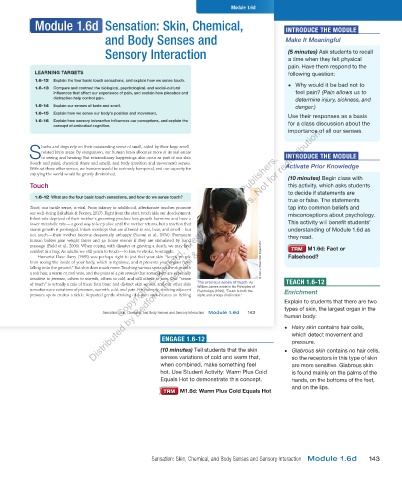
                 of touch” is actually a mix of these four basic and distinct skin senses, and our other skin   The precious sense of touch  As   TEACH 1.6-12
                                                                        William James wrote in his  Principles of
                 sensations are variations of pressure, warmth, cold, and pain. For example, stroking adjacent   Psychology  (1890) , “Touch is both the   Enrichment
                 pressure spots creates a tickle. Repeated gentle stroking of a pain spot creates an itching   alpha and omega of affection.”
                                                                                                     Explain to students that there are two
                                                                                                     types of skin, the largest organ in the
                                         Sensation: Skin, Chemical, and Body Senses and Sensory Interaction  Module 1.6d   143
                                                                                                     human body:
                                                                                                     •  Hairy skin contains hair cells,
                                                                                                       which detect movement and
                                                             ENGAGE 1.6-12                             pressure.
         03_myersAPpsychology4e_28116_ch01_002_163.indd   143                             15/12/23   4:34 PM
                                                            (10 minutes) Tell students that the skin   •  Glabrous skin contains no hair cells,
                                                            senses variations of cold and warm that,   so the receptors in this type of skin
                                                            when combined, make something feel         are more sensitive. Glabrous skin
                                                            hot. Use Student Activity: Warm Plus Cold   is found mainly on the palms of the
                                                            Equals Hot to demonstrate this concept.    hands, on the bottoms of the feet,
                                                                                                       and on the lips.
                                                                  M1.6d: Warm Plus Cold Equals Hot


                                                         Sensation: Skin, Chemical, and Body Senses and Sensory Interaction Module 1.6d   143


          03_HammerTE4e_47547_ch01_2a_163_4pp.indd   143                                                                        07/02/24   5:29 PM

