


Page 154 - 2024-bfw-MyersAP4e-TE
P. 154
sensation. Touching adjacent cold and pressure spots triggers a sense of wetness (which
                                                                             you can experience by touching dry, cold metal). Activating receptors for cold and warmth
                                                                             produces a hot sensation.
                                                                                 Touch sensations involve more than tactile stimulation, however. A self-administered
                                                                             tickle produces less somatosensory cortex activation than does the same tickle from some-
                                                                             thing or someone else ( Blakemore et al., 1998 ). Likewise, a leg caress evokes a different
                                                                             somatosensory cortex response when a straight man believes it comes from an attractive
                                                                             woman rather than a man ( Gazzola et al., 2012 ). Such responses reveal how quickly cogni-
                                                                             tion influences our brain’s sensory response.


               CONNECT 1.6-13                                                      Pain      What biological, psychological, and social-cultural influences af fect our
                                                                                          1.6-13
                                                                                          1.6-13   What biological, psychological, and social-cultural influences affect our


                                                                              experience of pain? How do placebos and distraction help control pain?
               Explain to students that pain is mainly       Photo by Jeff Riedel/Contour by Getty Images  experience of pain? How do placebos and distraction help control pain?
               governed by nerves known as “free                               Be thankful for occasional pain. Pain is your body’s way of telling you something has gone
                                                                             wrong. By drawing your attention to a burn, a break, or a sprain, pain orders you to change your
               nerve endings,” which are not directly                        behavior — “Stay off that ankle!” Pain also serves a psychological purpose, enhancing our self-
               connected to any specific nervous                             awareness, arousing others’ empathy, and promoting social connections ( Bastian et al., 2014 ).
                                                        “Pain is a gift.”   So said a doctor
               system. Pain is regulated within its     studying Ashlyn Blocker, who has a     The rare people born without the ability to feel pain are at risk of severe injury or even
                                      Distributed by Bedford, Freeman & Worth Publishers. Not for redistribution.
                                                        rare genetic mutation that prevents   early death ( Habib et al., 2019 ). Without the discomfort that makes the rest of us shift posi-
               own system, working where needed         her from feeling pain. At birth, she   tion, their joints can fail from excess strain. Without the warnings of pain, infections can run
               to alert the body to a painful stimulus.   didn’t cry. As a child, she ran around   wild and injuries can accumulate ( Neese, 1991 ).
                                                        for 2 days on a broken ankle. She
               Nervous systems are discussed in         has put her hands on a hot machine         More numerous are the people who live with chronic pain, which is rather like an
                                                        and burned the flesh off. And she has   alarm that won’t shut off. Persistent backaches, arthritis, headaches, and cancer-related pain
               more detail in Module 1.2.               reached into boiling water to retrieve a   prompt two questions: What is pain? How might we control it?
                                                        dropped spoon. “Everyone in my class
                                                        asks me about it, and I say, ‘I can feel
                                                        pressure, but I can’t feel pain.’  Pain!      Understanding Pain
                                                                      )
                                                        I cannot feel it!” ( Heckert, 2012 .
               TEACH 1.6-13                                                    Our experience of pain reflects both  bottom-up  sensations and  top-down  cognition. Pain is
                                                                             a biopsychosocial phenomenon ( Hadjistavropoulos et al., 2011 ). As such, pain experiences
               Teaching Tip                                                  vary widely, both from group to group and from person to person. Viewing pain from many


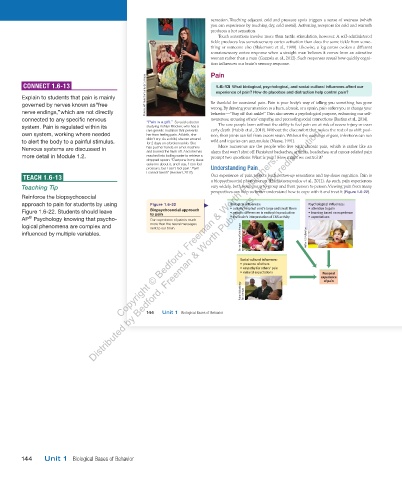
                                                                             perspectives can help us better understand how to cope with it and treat it ( Figure 1.6-22 ).


               Reinforce the biopsychosocial
               approach to pain for students by using              Figure   1.6-22    Biological influences:  Psychological influences:
               Figure 1.6-22. Students should leave       Biopsychosocial approach   •  activity in spinal cord’s large and small fibers  •  attention to pain
                                                                                                            •  learning based on experience
                                                                                   •  genetic differences in endorphin production
                                                         to pain
                 ®
               AP  Psychology knowing that psycho-       Our experience of pain is much   •  the brain’s interpretation of CNS activity  •  expectations
               logical phenomena are complex and         more than the neural messages
                                                                                      Barros & Barros/Getty Images  Halfpoint/Shutterstock
                                                         sent to our brain.
               influenced by multiple variables. Copyright © Bedford, Freeman & Worth Publishers.
                                                                                      Social-cultural influences:
                                                                                      •  presence of others
                                                                                      •  empathy for others’ pain
                                                                                      •  cultural expectations   Pe r son al
                                                                                                                 Personal
                                                                                                                 e
                                                                                                                 experience
                                                                                                                 of pain
                                                                                      Robert Nickelsberg/  Getty Images
                                                        144   Unit 1  Biological Bases of Behavior
                                                  03_myersAPpsychology4e_28116_ch01_002_163.indd   144                              15/12/23   9:26 AM


               144   Unit 1  Biological Bases of Behavior


          03_HammerTE4e_47547_ch01_2a_163_4pp.indd   144                                                                        07/02/24   5:29 PM

