


Page 157 - 2024-bfw-MyersAP4e-TE
P. 157
Module 1.6d

                 also seem to be experiencing pain (Symbaluk et al., 1997). This may help explain the
                 apparent social aspects of pain, as when groups of Australian keyboard operators during
                 the mid-1980s suffered outbreaks of severe pain while typing or performing other repeti-
                 tive work — without any discernible physical abnormalities (Gawande, 1998). Sometimes,
                 the  pain  in  a  sprain  is  mainly  in  the  brain — literally.  When  people  feel  empathy  for
                 another’s pain, their own brain activity partly mirrors the activity of the actual brain in
                 pain (Singer et al., 2004).
                 Controlling Pain
                 If pain is where body meets mind — if it is both a physical and a psychological phenomenon —
                 then it should be treatable both physically and psychologically. Depending on the symp-
                 toms, pain control therapies may include drugs, surgery, acupuncture, electrical stimulation,
                 massage, exercise, hypnosis (see Module 5.5), relaxation training, meditation, and thought
                 distraction.


                                      Distributed by Bedford, Freeman & Worth Publishers. Not for redistribution.


                                               Copyright © Bedford, Freeman & Worth Publishers.

                                                                  Gary Conner/Medical Images


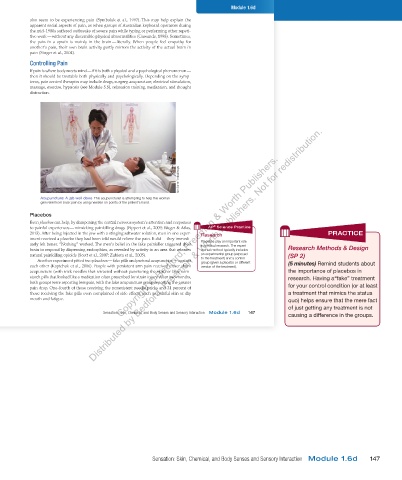
                     Acupuncture: A jab well done  This acupuncturist is attempting to help this woman
                     gain relief from back pain by using needles on points of the patient’s hand.
                 Placebos
                 Even placebos can help, by dampening the central nervous system’s attention and responses
                                                                              ®
                 to painful experiences — mimicking painkilling drugs (Eippert et al., 2009; Wager & Atlas,   AP  Science Practice
                 2013). After being injected in the jaw with a stinging saltwater solution, men in one exper-  Research  PRACTICE
                 iment received a placebo they had been told would relieve the pain. It did — they immedi-  Placebos play an important role
                 ately felt better. “Nothing” worked. The men’s belief in the fake painkiller triggered their   in medical research. The experi-
                 brain to respond by dispensing endorphins, as revealed by activity in an area that releases   mental method typically includes   Research Methods & Design
                 natural painkilling opioids (Scott et al., 2007; Zubieta et al., 2005).  an experimental group (exposed   (SP 2)
                    Another experiment pitted two placebos — fake pills and pretend acupuncture — against   to the treatment) and a control
                                                                         group (given a placebo or different
                 each other (Kaptchuk et al., 2006). People with persistent arm pain received either sham   version of the treatment).  (5 minutes) Remind students about
                 acupuncture (with trick needles that retracted without puncturing the skin) or blue corn-  the importance of placebos in
                 starch pills that looked like a medication often prescribed for strain injury. After two months,   research. Having a “fake” treatment
                 both groups were reporting less pain, with the fake acupuncture group reporting the greater
                 pain drop. One-fourth of those receiving the nonexistent needle pricks and 31 percent of   for your control condition (or at least
                 those receiving the fake pills even complained of side effects, such as painful skin or dry   a treatment that mimics the status
                 mouth and fatigue.                                                                   quo) helps ensure that the mere fact
                                                                                                      of just getting any treatment is not
                                         Sensation: Skin, Chemical, and Body Senses and Sensory Interaction  Module 1.6d   147
                                                                                                      causing a difference in the groups.


         03_myersAPpsychology4e_28116_ch01_002_163.indd   147                             15/12/23   9:26 AM


                                                         Sensation: Skin, Chemical, and Body Senses and Sensory Interaction Module 1.6d   147


          03_HammerTE4e_47547_ch01_2a_163_4pp.indd   147                                                                        07/02/24   5:30 PM

