


Page 155 - 2024-bfw-MyersAP4e-TE
P. 155
Module 1.6d

                 Biological Influences
                 Pain is a physical event produced by your senses. But pain differs from some of your other
                 sensations. No one type of stimulus triggers pain the way that light triggers vision. And no
                 specialized receptors process pain signals the way that your retina receptors react to light      PRACTICE
                 rays. Instead, sensory receptors called nociceptors — mostly in your skin, but also in your
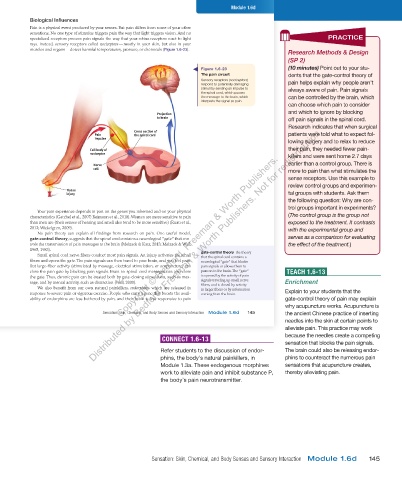
                 muscles and organs — detect harmful temperatures, pressure, or chemicals (Figure 1.6-23).
                                                                                                      Research Methods & Design
                                                                                                      (SP 2)
                                                                         Figure 1.6-23                (10 minutes) Point out to your stu-
                                                                         The pain circuit             dents that the gate-control theory of
                                                                         Sensory receptors (nociceptors)   pain helps explain why people aren’t
                                                                         respond to potentially damaging
                                                                         stimuli by sending an impulse to   always aware of pain. Pain signals
                                                                         the spinal cord, which passes
                                                                         the message to the brain, which   can be controlled by the brain, which
                                                                         interprets the signal as pain.
                                                                                                      can choose which pain to consider
                                                                                                      and which to ignore by blocking
                                                           Projection
                                                           to brain                                   off pain signals in the spinal cord.
                                                                                                      Research indicates that when surgical
                                      Distributed by Bedford, Freeman & Worth Publishers. Not for redistribution.
                                                    Cross section of
                                       Pain         the spinal cord                                   patients were told what to expect fol-
                                       impulse
                                                                                                      lowing surgery and to relax to reduce
                                     Cell body of                                                     their pain, they needed fewer pain-
                                               Copyright © Bedford, Freeman & Worth Publishers.
                                     nociceptor
                                                                                                      killers and were sent home 2.7 days
                                                                                                      earlier than a control group. There is
                                      Nerve
                                      cell
                                                                                                      more to pain than what stimulates the
                                                                                                      sense receptors. Use this example to
                                                                                                      review control groups and experimen-
                             Tissue
                             injury                                                                   tal groups with students. Ask them
                                                                                                      the following question: Why are con-
                                                                                                      trol groups important in experiments?
                    Your pain experience depends in part on the genes you inherited and on your physical
                 characteristics (Gatchel et al., 2007; Reimann et al., 2010). Women are more sensitive to pain   (The control group is the group not
                 than men are (their senses of hearing and smell also tend to be more sensitive) (Ruau et al.,   exposed to the treatment. It contrasts
                 2012; Wickelgren, 2009).                                                             with the experimental group and
                    No pain theory can explain all findings from research on pain. One useful model,
                 gate-control theory, suggests that the spinal cord contains a neurological “gate” that con-  serves as a comparison for evaluating
                 trols the transmission of pain messages to the brain (Melzack & Katz, 2013; Melzack & Wall,   the effect of the treatment.)
                 1965, 1983).                                            gate-control theory  the theory
                    Small spinal cord nerve fibers conduct most pain signals. An injury activates the small   that the spinal cord contains a
                 fibers and opens the gate. The pain signals can then travel to your brain, and you feel pain.   neurological “gate” that blocks
                 But large-fiber activity (stimulated by massage, electrical stimulation, or acupuncture) can   pain signals or allows them to
                 close the pain gate by blocking pain signals. Brain-to-spinal-cord messages can also close   pass on to the brain. The “gate”   TEACH 1.6-13
                 the gate. Thus, chronic pain can be treated both by gate-closing stimulation, such as mas-  is opened by the activity of pain
                 sage, and by mental activity, such as distraction (Wall, 2000).  signals traveling up small nerve   Enrichment
                                                                         fibers, and is closed by activity
                    We  also  benefit  from  our  own  natural  painkillers, endorphins, which are released in   in larger fibers or by information
                 response to severe pain or vigorous exercise. People who carry a gene that boosts the avail-  coming from the brain.  Explain to your students that the
                 ability of endorphins are less bothered by pain, and their brain is less responsive to pain   gate-control theory of pain may explain
                                                                                                     why acupuncture works. Acupuncture is
                                         Sensation: Skin, Chemical, and Body Senses and Sensory Interaction  Module 1.6d   145  the ancient Chinese practice of inserting
                                                                                                     needles into the skin at certain points to
                                                                                                     alleviate pain. This practice may work
                                                             CONNECT 1.6-13
         03_myersAPpsychology4e_28116_ch01_002_163.indd   145                             15/12/23   9:26 AM  because the needles create a competing
                                                                                                     sensation that blocks the pain signals.
                                                            Refer students to the discussion of endor-  The brain could also be releasing endor-
                                                            phins, the body’s natural painkillers, in   phins to counteract the numerous pain
                                                              Module 1.3a. These endogenous morphines   sensations that acupuncture creates,
                                                            work to alleviate pain and inhibit substance P,   thereby alleviating pain.
                                                            the body’s pain neurotransmitter.


                                                         Sensation: Skin, Chemical, and Body Senses and Sensory Interaction Module 1.6d   145


          03_HammerTE4e_47547_ch01_2a_163_4pp.indd   145                                                                        07/02/24   5:30 PM

