


Page 151 - 2024-bfw-MyersAP4e-TE
P. 151
Module 1.6c

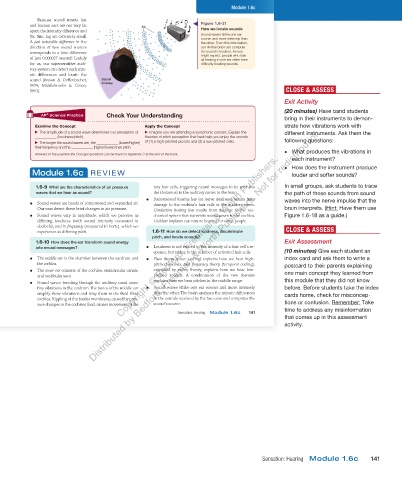
                    Because sound travels fast
                 and human ears are not very far      Air                Figure 1.6-21
                 apart, the intensity difference and                     How we locate sounds
                 the time lag are extremely small.                       Sound waves strike one ear
                                                                         sooner and more intensely than
                 A  just noticeable difference in the                    the other. From this information,
                 direction of two sound sources                          our nimble brain can compute
                 corresponds to a time difference                        the sound’s location. As you
                 of just 0.000027 second! Luckily                        might expect, people who lose
                                                                         all hearing in one ear often have
                 for us, our supersensitive audi-                        difficulty locating sounds.
                 tory system can detect such min-
                 ute  differences and locate the
                 sound (Brown & Deffenbacher,   Sound
                 1979; Middlebrooks & Green,   shadow
                 1991).                                                                              CLOSE & ASSESS
                                                                                                     Exit Activity
                                                                                                     (20 minutes) Have band students
                       ®
                     AP  Science Practice  Check Your Understanding                                  bring in their instruments to demon-
                   Examine the Concept                 Apply the Concept                             strate how vibrations work with
                                      Distributed by Bedford, Freeman & Worth Publishers. Not for redistribution.
                   ▶ ▶The amplitude of a sound wave determines our perception of   ▶ ▶Imagine you are attending a symphonic concert. Explain the   different instruments. Ask them the
                   ____________ (loudness/pitch).      theories of pitch perception that best help you enjoy the sounds
                   ▶ ▶The longer the sound waves are, the ____________ (lower/higher)   of (1) a high-pitched piccolo and (2) a low-pitched cello.  following questions:
                   their frequency and the ____________ (higher/lower) their pitch.
                                               Copyright © Bedford, Freeman & Worth Publishers.
                   Answers to the Examine the Concept questions can be found in Appendix C at the end of the book.  •  What produces the vibrations in
                                                                                                       each instrument?
                                                                                                     •  How does the instrument produce
                  Module 1.6c   REVIEW                                                                 louder and softer sounds?

                   1.6-9 What are the characteristics of air pressure   tiny hair cells, triggering neural messages to be sent (via   In small groups, ask students to trace
                   waves that we hear as sound?           the thalamus) to the auditory cortex in the brain.  the path of these sounds from sound
                                                       •  Sensorineural hearing loss (or nerve deafness) results from   waves into the nerve impulse that the
                 •  Sound waves are bands of compressed and expanded air.   damage to the cochlea’s hair cells or the auditory nerve.
                    Our ears detect these brief changes in air pressure.  Conduction hearing loss results from damage to the me-  brain interprets. (Hint: Have them use
                 •  Sound waves vary in amplitude, which we perceive as   chanical system that transmits sound waves to the cochlea.   Figure 1.6-18 as a guide.)
                    differing loudness (with sound intensity measured in   Cochlear implants can restore hearing for some people.
                    decibels), and in frequency (measured in hertz), which we
                    experience as differing pitch.       1.6-11 How do we detect loudness, discriminate   CLOSE & ASSESS
                                                         pitch, and locate sounds?
                   1.6-10 How does the ear transform sound energy                                    Exit Assessment
                   into neural messages?               •  Loudness is not related to the intensity of a hair cell’s re-
                                                          sponse, but rather to the number of activated hair cells.  (10 minutes) Give each student an
                 •  The middle ear is the chamber between the eardrum and   •  Place theory (place coding) explains how we hear high-  index card and ask them to write a
                    the cochlea.                          pitched sounds, and frequency theory (temporal  coding),   postcard to their parents explaining
                 •  The inner ear consists of the cochlea, semicircular canals,   extended by volley theory, explains how we hear low-  one main concept they learned from
                    and vestibular sacs.                  pitched sounds.  A combination of the two theories
                 •  Sound waves traveling through the auditory canal cause     explains how we hear pitches in the middle range.  this module that they did not know
                    tiny vibrations in the eardrum. The bones of the middle ear   •  Sound waves strike one ear sooner and more intensely   before. Before students take the index
                    amplify these vibrations and relay them to the fluid-filled   than the other. The brain analyzes the minute differences   cards home, check for misconcep-
                    cochlea. Rippling of the basilar membrane, caused by pres-  in the sounds received by the two ears and computes the
                    sure changes in the cochlear fluid, causes movement of the   sound’s source.     tions or confusion. Remember: Take
                                                                                                     time to address any misinformation
                                                                  Sensation: Hearing  Module 1.6c   141
                                                                                                     that comes up in this assessment
                                                                                                     activity.

         03_myersAPpsychology4e_28116_ch01_002_163.indd   141                             15/12/23   9:26 AM


                                                                                             Sensation: Hearing Module 1.6c   141


          03_HammerTE4e_47547_ch01_2a_163_4pp.indd   141                                                                        07/02/24   5:29 PM

