


Page 146 - 2024-bfw-MyersAP4e-TE
P. 146
The Stimulus Input: Sound Waves
               CONNECT 1.6-9                               AP  Exam Tip                   1.6-9   What are the characteristics of air pressure waves that we hear as sound?


                                                                                       e the characteristics of air pr
                                                                                   What ar
                                                           ®
                                                                                          1.6-9

                                                                                                         essur
                                                                                                            e waves that we hear as sound?
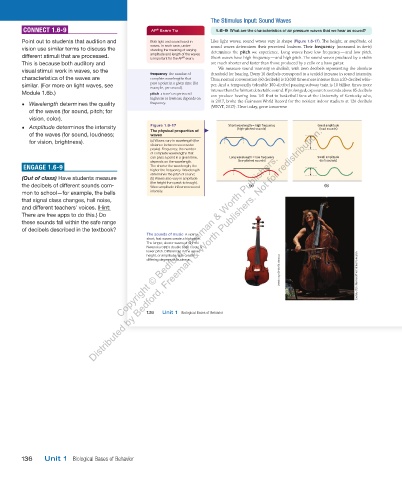
               Point out to students that audition and     Both light and sound travel in     Like light waves, sound waves vary in shape ( Figure 1.6-17 ). The height, or  amplitude,  of


               vision use similar terms to discuss the   waves. In each case, under-  sound waves  determines  their perceived  loudness.  Their     frequency   (measured  in  hertz )
                                                         standing the meaning of varying

                                                                             determines the   pitch  we experience. Long waves have low frequency — and low pitch.
               different stimuli that are processed.     amplitude and length of the waves   Short waves have high frequency — and high pitch. The sound waves produced by a violin
                                                                   ®
                                                         is important for the AP  exam.
               This is because both auditory and                             are much shorter and faster than those produced by a cello or a bass guitar.
                                                                                 We measure sound intensity in  decibels,  with zero decibels representing the absolute
               visual stimuli work in waves, so the            frequency       the number of   threshold for hearing. Every 10 decibels correspond to a tenfold increase in sound intensity.
               characteristics of the waves are          complete wavelengths that   Thus, normal conversation (60 decibels) is 10,000 times more intense than a 20-decibel whis-
               similar. (For more on light waves, see    pass a point in a given time (for   per. And a temporarily tolerable 100-decibel passing subway train is 10 billion times more

                                                         example, per second).
               Module 1.6b.)                                pitch       a tone’s experienced   intense than the faintest detectable sound. If prolonged, exposure to sounds above 85 decibels
                                                         highness or lowness; depends on   can produce hearing loss. Tell that to basketball fans at the University of Kentucky who,
               •  Wavelength determines the quality      frequency.          in 2017, broke the Guinness World Record for the noisiest indoor stadium at 126 decibels

                                                                             ( WKYT, 2017 ). Hear today, gone tomorrow.

                 of the waves (for sound, pitch; for
                 vision, color).
               •  Amplitude determines the intensity               Figure   1.6-17    Short wavelength = high frequency  Great amplitude
                                                                                                                (loud sounds)
                                                                                     (high-pitched sounds)
                 of the waves (for sound, loudness;        The physical properties of
                                                         waves
                 for vision, brightness).                (a) Waves vary in  wavelength  (the
                                                         distance between successive
                                                         peaks).  Frequency,  the number
                                               Copyright © Bedford, Freeman & Worth Publishers.
                                                         of complete wavelengths that
                                                         can pass a point in a given time,   Long wavelength = low frequency  Small amplitude
                                                         depends on the wavelength.   (low-pitched sounds)      (soft sounds)
               ENGAGE 1.6-9                              The shorter the wavelength, the
                                                         higher the frequency. Wavelength
                                                         determines the  pitch  of sound.
               (Out of class) Have students measure      (b) Waves also vary in  amplitude
               the decibels of different sounds com-     (the height from peak to trough).   (a)                  (b)
                                                         Wave amplitude influences sound
                                                         intensity.
               mon to school—for example, the bells     lower pitch. Differences in the waves’ Worth Publishers. Not for redistribution.
               that signal class changes, hall noise,
               and different teachers’ voices. (Hint:
               There are free apps to do this.) Do
               these sounds fall within the safe range
               of decibels described in the textbook?
                                                        The sounds of music  A violin’s

                                                        short, fast waves create a high pitch.
                                                        The longer, slower waves of Chi-chi
                                                        Nwanoku   Obe ’ s double bass create a

                                      Distributed by Bedford, Freeman &
                                                        height, or amplitude, also create
                                                                                                     Vereshchagin Dmitry/Shutterstock      Courtesy of Eric Richmond/The Chineke! Foundation
                                                        differing degrees of loudness.
                                                        136   Unit 1  Biological Bases of Behavior
                                                  03_myersAPpsychology4e_28116_ch01_002_163.indd   136                              15/12/23   9:26 AM


               136   Unit 1  Biological Bases of Behavior


          03_HammerTE4e_47547_ch01_2a_163_4pp.indd   136                                                                        07/02/24   5:29 PM

