


Page 142 - 2024-bfw-MyersAP4e-TE
P. 142
Parallel Processing


                                                                                                       ocessing to construct visual per
                                                                                                                          ceptions?
                                                                                          1.6-8   How does the brain use parallel processing to construct visual perceptions?
                                                                                          1.6-8
                                                                                   How does the brain use parallel pr


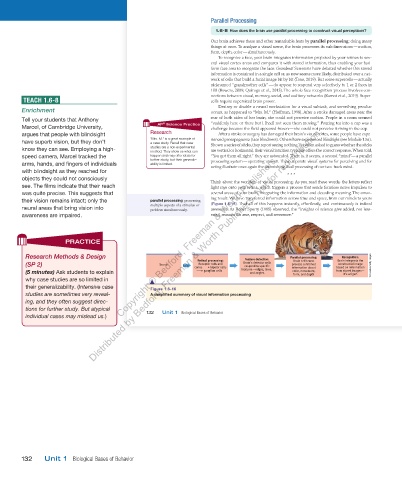
                                                                               Our brain achieves these and other remarkable feats by   parallel processing :  doing many

                                                                             things at once. To analyze a visual scene, the brain processes its subdimensions — motion,
                                                                             form, depth, color — simultaneously.
                                                                                     To recognize a face, your brain integrates information projected by your retinas to sev-
                                                                             eral visual cortex areas and compares it with stored information, thus enabling your fusi-
                                                                             form face area to recognize the face:  Grandma!  Scientists have debated whether this stored
                                                                             information is contained in a single cell or, as now seems more likely, distributed over a net-
                                                                             work of cells that build a facial image bit by bit ( Tsao, 2019 ). But some supercells —  actually
                                                                             nicknamed “grandmother cells” — do appear to respond very selectively to 1 or 2 faces in
                                                                             100 ( Bowers, 2009 ;  Quiroga et al., 2013 ). The whole face recognition process involves con-
                                                                             nections between visual, memory, social, and auditory networks ( Ramot et al., 2019 ). Super-
               TEACH 1.6-8                                                   cells require supersized brain power.
                                                                                 Destroy or disable a neural workstation for a visual subtask, and something peculiar
               Enrichment                                                    occurs, as happened to “Mrs. M.” ( Hoffman, 1998 ). After a stroke damaged areas near the
               Tell your students that Anthony                               rear of both sides of her brain, she could not perceive motion. People in a room seemed
                                                                             “suddenly here or there but I [had] not seen them moving.” Pouring tea into a cup was a
                                                             ®
               Marcel, of Cambridge University,            AP  Science Practice  challenge because the fluid appeared frozen — she could not perceive it rising in the cup.
                                      Distributed by Bedford, Freeman & Worth Publishers. Not for redistribution.
               argues that people with blindsight                  Research        After a stroke or surgery has damaged their brain’s visual cortex, some people have expe-
                                                           “Mrs. M.” is a great example of   rienced prosopagnosia (face blindness). Others have experienced  blindsight  (see   Module 1.5a )  .
               have superb vision, but they don’t        a case study. Recall  that case   Shown a series of sticks, they report seeing nothing. Yet when asked to guess whether the sticks

               know they can see. Employing a high-      studies are a non-experimental
                                                         method. They show us what can   are vertical or horizontal, their visual intuition typically offers the correct response. When told,
               speed camera, Marcel tracked the          happen and may offer ideas for   “You got them all right,” they are astounded. There is, it seems, a second “mind” — a parallel
                                                         further study, but their generaliz-
               arms, hands, and fingers of individuals   ability is limited.     processing system — operating unseen. These separate visual systems for perceiving and for
                                                                             acting illustrate once again the astonishing dual processing of our two-track mind.
               with blindsight as they reached for                                                      * * *
               objects they could not consciously                              Think about the wonders of visual processing. As you read these words, the letters reflect
               see. The films indicate that their reach                      light rays onto your retina, which triggers a process that sends formless nerve impulses to
               was quite precise. This suggests that                         several areas of your brain, integrating the information and decoding meaning. The amaz-
               their vision remains intact; only the           parallel processing       processing   ing result: We have transferred information across time and space, from our minds to yours


                                                                             (   Figure 1.6-16 ). That all of this happens instantly, effortlessly, and continuously is indeed
               neural areas that bring vision into       multiple aspects of a stimulus or   awesome.  As Roger Sperry (1985) observed, the “insights of science give added, not less-

                                                         problem simultaneously.
               awareness are impaired.                                       ened, reasons for awe, respect, and reverence.”
                             PRACTICE          Copyright © Bedford, Freeman & Worth Publishers.
                Research Methods & Design                                                             Parallel processing:  Recognition:
                                                                        Retinal processing:  Feature detection:  Brain cell teams  Brain interprets the
                (SP 2)                                      Scene      cones          bipolar cells  Brain’s detector cells  process combined  based on information  Tom Walker/Getty Images
                                                                                                                      constructed image
                                                                        Receptor rods and
                                                                                        respond to specific
                                                                                                       information about
                (5 minutes) Ask students to explain                             ganglion cells  features—edges, lines,   color, movement,  from stored images—
                                                                                         and angles
                                                                                                       form, and depth
                                                                                                                        it’s a tiger!
                why case studies are so limited in
                their generalizability. (Intensive case             Figure   1.6-16
                studies are sometimes very reveal-         A simplified summary of visual information processing
                ing, and they often suggest direc-
                tions for further study. But atypical
                individual cases may mislead us.)       132   Unit 1  Biological Bases of Behavior
                                                  03_myersAPpsychology4e_28116_ch01_002_163.indd   132                              15/12/23   9:26 AM


               132   Unit 1  Biological Bases of Behavior


          03_HammerTE4e_47547_ch01_2a_163_4pp.indd   132                                                                        07/02/24   5:28 PM

