


Page 147 - 2024-bfw-MyersAP4e-TE
P. 147
Module 1.6c
The Ear
1.6-10
1.6-10 How does the ear transform sound energy into neural messages? ENGAGE 1.6-10
How does the ear transform sound energy into neural messages?
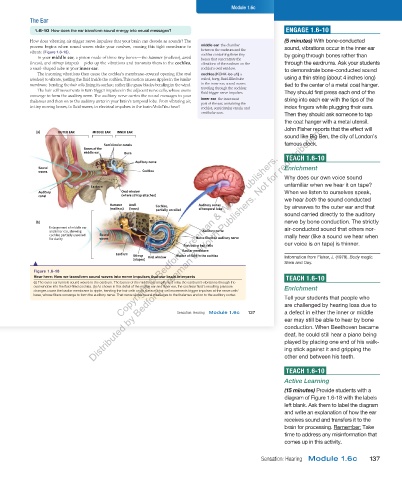
How does vibrating air trigger nerve impulses that your brain can decode as sounds? The (5 minutes) With bone-conducted
process begins when sound waves strike your eardrum, causing this tight membrane to middle ear the chamber sound, vibrations occur in the inner ear
vibrate ( Figure 1.6-18 ). between the eardrum and the
cochlea containing three tiny
In your middle ear a piston made of three tiny bones — the hammer (malleus), anvil bones that concentrate the by going through bones rather than
,
(incus), and stirrup (stapes) — picks up the vibrations and transmits them to the cochlea , vibrations of the eardrum on the through the eardrums. Ask your students
a snail-shaped tube in your inner ear . cochlea’s oval window. to demonstrate bone-conducted sound
The incoming vibrations then cause the cochlea’s membrane-covered opening (the oval cochlea [KOHK-lee-uh] a
window ) to vibrate, jostling the fluid inside the cochlea. This motion causes ripples in the basilar coiled, bony, fluid-filled tube using a thin string (about 4 inches long)
membrane, bending the hair cells lining its surface, rather like grass blades bending in the wind. in the inner ear; sound waves tied to the center of a metal coat hanger.
The hair cell movements in turn trigger impulses in the adjacent nerve cells, whose axons traveling through the cochlear They should first press each end of the
fluid trigger nerve impulses.
converge to form the auditory nerve. The auditory nerve carries the neural messages to your inner ear the innermost
thalamus and then on to the auditory cortex in your brain’s temporal lobe . From vibrating air, part of the ear, containing the string into each ear with the tips of the
to tiny moving bones, to fluid waves, to electrical impulses to the brain: Voila! You hear! cochlea, semicircular canals, and index fingers while plugging their ears.
vestibular sacs. Then they should ask someone to tap
the coat hanger with a metal utensil.
Distributed by Bedford, Freeman & Worth Publishers. Not for redistribution.
John Fisher reports that the effect will
(a) OUTER EAR MIDDLE EAR INNER EAR
sound like Big Ben, the city of London’s
Semicircular canals famous clock.
Bones of the
middle ear Bone
TEACH 1.6-10
Auditory nerve
Sound Enrichment
waves Cochlea
Why does our own voice sound
unfamiliar when we hear it on tape?
Eardrum
Auditory Oval window When we listen to ourselves speak,
canal (where stirrup attaches)
we hear both the sound conducted
Hammer Anvil Cochlea, Auditory cortex by airwaves to the outer ear and that
(malleus) (incus) partially uncoiled of temporal lobe
sound carried directly to the auditory
(b) nerve by bone conduction. The strictly
Enlargement of middle ear air-conducted sound that others nor-
and inner ear, showing Auditory nerve
cochlea partially uncoiled Sound Copyright © Bedford, Freeman & Worth Publishers. mally hear (like a sound we hear when
for clarity waves Nerve fibers to auditory nerve
Protruding hair cells our voice is on tape) is thinner.
Basilar membrane
Eardrum Stirrup Motion of fluid in the cochlea
(stapes) Oval window Information from Fisher, J. (1979). Body magic.
Stein and Day.
Figure 1.6-18
Hear here: How we transform sound waves into nerve impulses that our brain interprets TEACH 1.6-10
(a) The outer ear funnels sound waves to the eardrum. The bones of the middle ear amplify and relay the eardrum’s vibrations through the
oval window into the fluid-filled cochlea. (b) As shown in this detail of the middle ear and inner ear, the cochlear fluid’s resulting pressure Enrichment
changes cause the basilar membrane to ripple, bending the hair cells on its surface. Hair cell movements trigger impulses at the nerve cells’
base, whose fibers converge to form the auditory nerve. That nerve sends neural messages to the thalamus and on to the auditory cortex.
Tell your students that people who
are challenged by hearing loss due to
Sensation: Hearing Module 1.6c 137 a defect in either the inner or middle
ear may still be able to hear by bone
conduction. When Beethoven became
deaf, he could still hear a piano being
03_myersAPpsychology4e_28116_ch01_002_163.indd 137 15/12/23 9:26 AM
played by placing one end of his walk-
ing stick against it and gripping the
other end between his teeth.
TEACH 1.6-10
Active Learning
(15 minutes) Provide students with a
diagram of Figure 1.6-18 with the labels
left blank. Ask them to label the diagram
and write an explanation of how the ear
receives sound and transfers it to the
brain for processing. Remember: Take
time to address any misinformation that
comes up in this activity.
Sensation: Hearing Module 1.6c 137
03_HammerTE4e_47547_ch01_2a_163_4pp.indd 137 07/02/24 5:29 PM

