


Page 148 - 2024-bfw-MyersAP4e-TE
P. 148
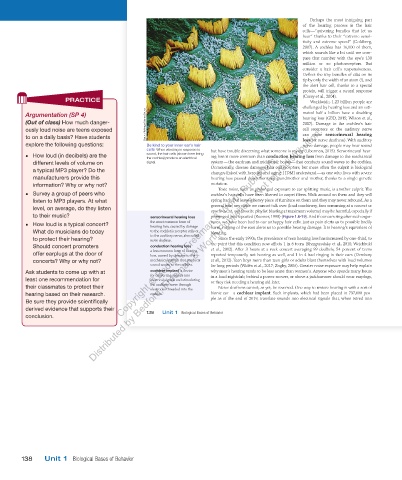
Perhaps  the  most intriguing  part
                                                                                                           of the hearing process is the hair
                                                                                                           cells — “quivering  bundles  that  let us
                                                                                                           hear” thanks to their “extreme sensi-
                                                                                                           tivity and extreme speed”   (Goldberg,
                                                                                                           2007).  A cochlea has 16,000 of them,
                                                                                                           which sounds like a lot until we com-
                                                                                                           pare that number with the eye’s 130
                                                                                                           million or so photoreceptors. But
                                                                                                           consider a hair cell’s responsiveness.
                                                                                                           Deflect the tiny bundles of cilia on its
                                                                                                           tip by only the width of an atom (!), and
                                                                                                           the alert hair cell,  thanks to a special
                                                                                                           protein, will trigger a neural response
                                                                                                           (Corey et al., 2004).
                             PRACTICE                                                                        Worldwide, 1.23 billion people are
                                                                                                           challenged by hearing loss and an esti-
                Argumentation (SP 4)                                                                       mated half a billion have a disabling
                                                                                                           hearing loss (GBD, 2015; Wilson et al.,
                (Out of class) How much danger-        Susumu Nishinaga/Science Source                     2017). Damage to the cochlea’s hair
                                      Distributed by Bedford, Freeman & Worth Publishers. Not for redistribution.
                ously loud noise are teens exposed                                                         cell receptors or the auditory nerve
                to on a daily basis? Have students                                                         can cause  sensorineural  hearing
                                                                                                           loss (or nerve deafness). With auditory
                explore the following questions:        Be kind to your inner ear’s hair                   nerve damage, people may hear sound
                                                        cells  When vibrating in response to   but have trouble discerning what someone is saying (Liberman, 2015). Sensorineural hear-
                •  How loud (in decibels) are the       sound, the hair cells (shown here lining   ing loss is more common than conduction hearing loss from damage to the mechanical
                                                        the cochlea) produce an electrical
                  different levels of volume on         signal.              system — the eardrum and middle ear bones — that conducts sound waves to the cochlea.
                  a typical MP3 player? Do the                               Occasionally, disease damages hair cell receptors, but more often the culprit is biological
                                                                             changes linked with heredity and aging. I [DM] understand — as one who lives with severe
                  manufacturers provide this                                 hearing loss passed down from my grandmother and mother, thanks to a single genetic
                  information? Why or why not?                               mutation.
                                                                               Toxic noise, such as prolonged exposure to ear-splitting music, is another culprit. The
                •  Survey a group of peers who                               cochlea’s hair cells have been likened to carpet fibers. Walk around on them and they will
                  listen to MP3 players. At what                             spring back. But leave a heavy piece of furniture on them and they may never rebound. As a
                  level, on average, do they listen                          general rule, any noise we cannot talk over (loud machinery, fans screaming at a concert or
                                                                             sports event, our favorite playlist blasting at maximum volume) may be harmful, especially if
                  to their music?                        sensorineural hearing loss     prolonged and repeated (Roesser, 1998) (Figure 1.6-19). And if our ears ring after such expo-
                •  How loud is a typical concert?        the most common form of   sures, we have been bad to our unhappy hair cells. Just as pain alerts us to possible bodily
                                                         hearing loss, caused by damage
                                                                             harm, ringing of the ears alerts us to possible hearing damage. It is hearing’s equivalent of
                  What do musicians do today   Copyright © Bedford, Freeman & Worth Publishers.
                                                         to the cochlea’s receptor cells or
                                                                             bleeding.
                  to protect their hearing?              to the auditory nerve; also called   Since the early 1990s, the prevalence of teen hearing loss has increased by one-third, to
                                                         nerve deafness.
                  Should concert promoters               conduction hearing loss     the point that this condition now affects 1 in 6 teens (Shargorodsky et al., 2010;  Weichbold
                                                                             et al., 2012). After 3 hours at a rock concert averaging 99 decibels, 54 percent of teens
                  offer earplugs at the door of          a less common form of hearing   reported temporarily not hearing as well, and 1 in 4 had ringing in their ears (Derebery
                                                         loss, caused by damage to the
                  concerts? Why or why not?              mechanical system that conducts   et al., 2012). Teen boys more than teen girls or adults blast themselves with loud volumes
                                                         sound waves to the cochlea.  for long periods (Widén et al., 2017; Zogby, 2006). Greater noise exposure may help explain
                Ask students to come up with at          cochlear implant  a device   why men’s hearing tends to be less acute than women’s. Anyone who spends many hours
                                                         for converting sounds into
                least one recommendation for             electrical signals and stimulating   in a loud nightclub, behind a power mower, or above a jackhammer should wear earplugs,
                                                                             or they risk needing a hearing aid later.
                their classmates to protect their        the auditory nerve through   Nerve deafness cannot, as yet, be reversed. One way to restore hearing is with a sort of
                                                         electrodes threaded into the
                hearing based on their research.         cochlea.            bionic ear — a cochlear implant. Such implants, which had been placed in 737,000 peo-
                Be sure they provide scientifically                          ple as of the end of 2019, translate sounds into electrical signals that, when wired into
                derived evidence that supports their
                conclusion.                             138   Unit 1  Biological Bases of Behavior
                                                  03_myersAPpsychology4e_28116_ch01_002_163.indd   138                              15/12/23   9:26 AM


               138   Unit 1  Biological Bases of Behavior


          03_HammerTE4e_47547_ch01_2a_163_4pp.indd   138                                                                        07/02/24   5:29 PM

