


Page 149 - 2024-bfw-MyersAP4e-TE
P. 149
Module 1.6c

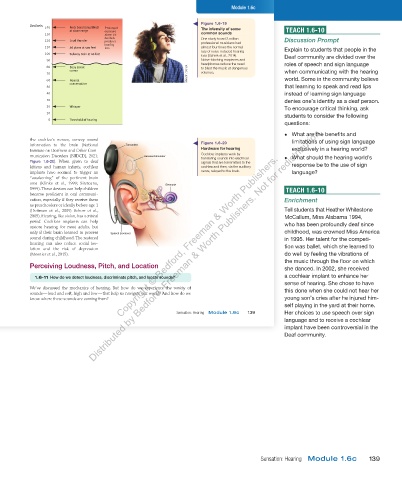
                                                                                   Figure   1.6-19
                 Decibels
                      140     Rock band (amplified)  Prolonged
                              at close range  exposure                     The intensity of some     TEACH 1.6-10
                      130                 above 85                       common sounds
                                          decibels                       One study found 3 million
                      120     Loud thunder  produces                     professional musicians had   Discussion Prompt
                                          hearing
                      110     Jet plane at 500 feet  loss.               almost four times the normal
                                                                         rate of noise-induced hearing   Explain to students that people in the
                      100     Subway train at 20 feet                    loss (Schink et al., 2014).   Deaf community are divided over the
                       90                                                Noise-blocking earpieces and
                                                                         headphones reduce the need   roles of speech and sign language
                       80     Busy street                                to blast the music at dangerous
                              corner                                                                 when communicating with the hearing
                       70                                            sebra/Shutterstock  volumes.
                       60     Normal                                                                 world. Some in the community believe
                              conversation
                       50                                                                            that learning to speak and read lips
                       40                                                                            instead of learning sign language
                       30                                                                            denies one’s identity as a deaf person.
                       20     Whisper                                                                To encourage critical thinking, ask
                       10
                                                                                                     students to consider the following
                        0     Threshold of hearing
                                                                                                     questions:
                                      Distributed by Bedford, Freeman & Worth Publishers. Not for redistribution.
                                                                                                     •  What are the benefits and
                 the cochlea’s nerves, convey sound                                                    limitations of using sign language
                 information  to  the  brain  (National   Transmitter              Figure   1.6-20
                 Institute on Deafness and Other Com-                      Hardware for hearing        exclusively in a hearing world?
                                               Copyright © Bedford, Freeman & Worth Publishers.
                 munication  Disorders  [ NIDCD], 2021   ;  Receiver/stimulator  Cochlear implants work by   •  What should the hearing world’s
                                                                         translating sounds into electrical


                 Figure 1.6-20 ).  When given to deaf                    signals that are transmitted to the
                 kittens and human infants, cochlear                     cochlea and then, via the auditory   response be to the use of sign
                 implants  have  seemed to trigger an                    nerve, relayed to the brain.    language?
                 “awakening” of the pertinent brain
                 area (Klinke et al., 1999;  Sireteanu,        Electrode
                 1999 ). These devices can help children                                             TEACH 1.6-10
                 become proficient in oral communi-
                 cation, especially if they receive them                                             Enrichment
                 as preschoolers or ideally before age 1
                 ( Dettman et al., 2007 ;  Schorr et al.,                                            Tell students that Heather Whitestone
                 2005 ). Hearing, like vision, has a  critical                                       McCallum, Miss Alabama 1994,

                 period.  Cochlear implants can help                                                 who has been profoundly deaf since
                 restore hearing for most adults, but
                 only if their brain learned to process   Speech processor                           childhood, was crowned Miss America
                 sound during childhood. The restored                                                in 1995. Her talent for the competi-
                 hearing can also reduce social iso-
                 lation and the risk of depression                                                   tion was ballet, which she learned to
                 ( Mosnier et al., 2015 ).                                                           do well by feeling the vibrations of
                                                                                                     the music through the floor on which
                               Perceiving Loudness, Pitch, and Location                              she danced. In 2002, she received
                               1.6-11         How do we detect loudness, discriminate pitch, and locate sounds?                   a cochlear implant to enhance her
                               1.6-11   How do we detect loudness, discriminate pitch, and locate sounds?
                                                                                                     sense of hearing. She chose to have
                   We’ve discussed the mechanics of hearing. But how do we experience the  variety   of   this done when she could not hear her
                 sounds — loud and soft, high and low — that help us navigate our world? And how do we
                 know where these sounds are coming from?                                            young son’s cries after he injured him-
                                                                                                     self playing in the yard at their home.
                                                                 Sensation: Hearing  Module 1.6c   139  Her choices to use speech over sign
                                                                                                     language and to receive a cochlear
                                                                                                     implant have been controversial in the
                                                                                                     Deaf community.
         03_myersAPpsychology4e_28116_ch01_002_163.indd   139                             15/12/23   9:26 AM


                                                                                             Sensation: Hearing Module 1.6c   139


          03_HammerTE4e_47547_ch01_2a_163_4pp.indd   139                                                                        07/02/24   5:29 PM

