


Page 137 - 2024-bfw-MyersAP4e-TE
P. 137
Module 1.6b

                                              2. Chemical reaction in turn
                                               activates bipolar cells.   Figure 1.6-9
                        1. Light entering eye triggers                   The retina’s reaction to
                         chemical reaction in rods   3  2                light                       ENGAGE 1.6-5
                         and cones at back of retina.   1
                                                                                                     (10 minutes) Tell students that the
                             Light
                                                                                                     term retina is derived from a Latin
                                                               Cone
                                                               Rod                                   word meaning “net” and refers to the
                                           Ganglion
                                           Ganglion                                                  intricate network of blood vessels that
                                           cell
                                           cell
                                              Bipolar
                                              Bipolar
                                              cell
                                              cell           Neural                                  nourish the retina’s nerve cells. Use
                                                             impulse
                             Light                                                                   Student Activity: Locating the Retinal
                             Light
                                          3
                                                                                                     Blood Vessels to demonstrate proper-
                                              2                                                      ties of the retina.
                                                   1                                                       M1.6b: Locating the Retinal
                      Cross section of retina  Optic nerve  To the brain’s visual                    Blood Vessels
                                                   cortex via the thalamus
                                3. Bipolar cells then activate the ganglion cells, whose
                                 combined axons form the optic nerve. This nerve transmits
                                      Distributed by Bedford, Freeman & Worth Publishers. Not for redistribution.
                                 information (via the thalamus) to the brain’s visual cortex.
                                                                                                     TEACH 1.6-5
                      Figure 1.6-10                                                                  Teaching Tip
                      The blind spot
                      There are no receptor cells where the optic nerve leaves the eye. This creates a blind spot   Point out to your students that the
                                               Copyright © Bedford, Freeman & Worth Publishers.
                      in your vision. To demonstrate, close your left eye, look at the black dot, and move your face
                      away until one of the cars disappears. (Which one do you predict it will be?) Repeat with   cells that make up the retina seem
                      your right eye closed — and note that now the other car disappears. Can you explain why?
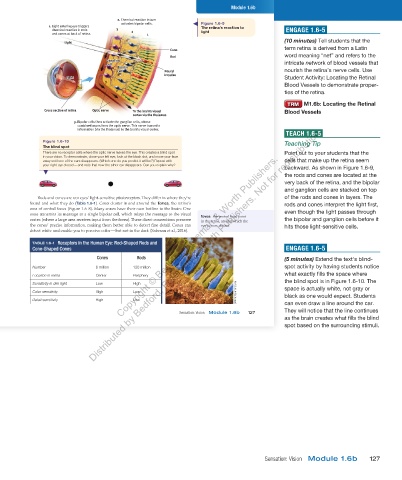
                                                                                                     backward. As shown in Figure 1.6-9,
                                                                                                     the rods and cones are located at the
                                                                                                     very back of the retina, and the bipolar
                                                                                                     and ganglion cells are stacked on top
                    Rods and cones are our eyes’ light-sensitive photoreceptors. They differ in where they’re   of the rods and cones in layers. The
                 found and what they do (Table 1.6-1). Cones cluster in and around the fovea, the retina’s   rods and cones interpret the light first,
                 area of central focus (Figure 1.6-8). Many cones have their own hotline to the brain: One   even though the light passes through
                 cone transmits its message to a single bipolar cell, which relays the message to the visual   fovea   the central focal point
                 cortex (where a large area receives input from the fovea). These direct connections preserve   in the retina, around which the   the bipolar and ganglion cells before it
                 the cones’ precise information, making them better able to detect fine detail. Cones can   eye’s cones cluster.  hits those light-sensitive cells.
                 detect white and enable you to perceive color — but not in the dark (Sabesan et al., 2016).
                  TABLE 1.6-1  Receptors in the Human Eye: Rod-Shaped Rods and
                  Cone-Shaped Cones                                                                  ENGAGE 1.6-5
                                       Cones        Rods                                             (5 minutes) Extend the text’s blind-
                  Number               6 million   120 million                                       spot activity by having students notice
                  Location in retina   Center      Periphery                                         what exactly fills the space where
                                                                                                     the blind spot is in Figure 1.6-10. The
                  Sensitivity in dim light  Low    High
                  Color sensitivity    High        Low                               Omikron/Science Source  space is actually white, not gray or
                                                                                                     black as one would expect. Students
                  Detail sensitivity   High        Low                                               can even draw a line around the car.
                                                                                                     They will notice that the line continues
                                                                  Sensation: Vision  Module 1.6b   127
                                                                                                     as the brain creates what fills the blind
                                                                                                     spot based on the surrounding stimuli.
         03_myersAPpsychology4e_28116_ch01_002_163.indd   127                             15/12/23   9:25 AM


                                                                                              Sensation: Vision Module 1.6b   127


          03_HammerTE4e_47547_ch01_2a_163_4pp.indd   127                                                                        07/02/24   5:27 PM

