


Page 135 - 2024-bfw-MyersAP4e-TE
P. 135
Module 1.6b

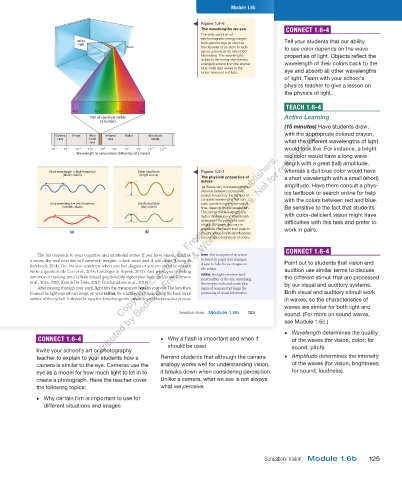
                                                                         Figure 1.6-6
                                                                         The wavelengths we see      CONNECT 1.6-4
                                                                         The wide spectrum of
                                                                         electromagnetic energy ranges
                                 White                                   from gamma rays as short as   Tell your students that our ability
                                 light
                                                 Prism                   the diameter of an atom to radio   to see color depends on the wave
                                                                         waves as long as 62 miles (100
                                                                         kilometers). The wavelengths   properties of light. Objects reflect the
                                                                         visible to the human eye (shown
                                                                         enlarged) extend from the shorter   wavelength of their colors back to the
                                                                         blue-violet light waves to the
                                                                         longer waves of red light.  eye and absorb all other wavelengths
                                                                                                     of light. Team with your school’s
                                                                                                     physics teacher to give a lesson on
                                                                                                     the physics of light.
                                                                                                     TEACH 1.6-4
                               400     500    600    700
                                     Part of spectrum visible                                        Active Learning
                                        to humans
                                                                                                     (15 minutes) Have students draw,
                                      Distributed by Bedford, Freeman & Worth Publishers. Not for redistribution.
                                                                                                     with the appropriate colored crayon,
                          Gamma  X-rays  Ultra-  Infrared  Radar  Broadcast
                          rays       violet  rays        bands
                                     rays                                                            what the different wavelengths of light
                        10 –5  10 –3  10 –1  10 1  10 3  10 5  10 7  10 9  10 11  10 13              would look like. For instance, a bright
                                               Copyright © Bedford, Freeman & Worth Publishers.
                                 Wavelength in nanometers (billionths of a meter)
                                                                                                     red color would have a long wave-
                                                                                                     length with a great (tall) amplitude,
                        Short wavelength = high frequency  Great amplitude  Figure 1.6-7             whereas a dull blue color would have
                            (bluish colors)          (bright colors)
                                                                         The physical properties of   a short wavelength with a small (short)
                                                                         waves
                                                                          (a) Waves vary in wavelength (the   amplitude. Have them consult a phys-
                                                                         distance between successive   ics textbook or search online for help
                                                                         peaks). Frequency, the number of
                                                                         complete wavelengths that can   with the colors between red and blue.
                        Long wavelength = low frequency  Small amplitude  pass a point in a given amount of
                            (reddish colors)          (dull colors)      time, depends on the wavelength.   Be sensitive to the fact that students
                                                                         The shorter the wavelength, the
                                                                         higher the frequency. Wavelength   with color-deficient vision might have
                                                                         determines the perceived color   difficulties with this task and prefer to
                                                                         of light. (b) Waves also vary in
                                                                         amplitude (the height from peak to   work in pairs.
                               (a)                     (b)               trough). Wave amplitude influences
                                                                         the perceived brightness of colors.
                                                                                                     CONNECT 1.6-4
                    The iris responds to your cognitive and emotional states. If you have vision, imagine   lens  the transparent structure
                 a sunny sky and your iris will constrict; imagine a dark room and it will dilate (Laeng &   behind the pupil that changes   Point out to students that vision and
                 Sulutvedt, 2014). The iris also constricts when you feel disgust or you are about to answer   shape to help focus images on
                                                                         the retina.
                 No to a question (de Gee et al., 2014; Goldinger & Papesh, 2012). And when you’re feeling   audition use similar terms to discuss
                 amorous or trusting, your telltale dilated pupils subtly signal your feelings (Attard-Johnson   retina  the light-sensitive back   the different stimuli that are processed
                                                                         inner surface of the eye, containing
                 et al., 2016, 2017; Kret & De Dreu, 2017; Prochanzkova et al., 2018).  the receptor rods and cones plus   by our visual and auditory systems.
                    After passing through your pupil, light hits the transparent lens in your eye. The lens then   layers of neurons that begin the
                 focuses the light rays into an image on your retina, the multilayered tissue lining the back inner   processing of visual information.  Both visual and auditory stimuli work
                 surface of the eyeball. To focus the rays, the lens changes its curvature and thickness in a process   in waves, so the characteristics of
                                                                                                     waves are similar for both light and
                                                                  Sensation: Vision  Module 1.6b   125  sound. (For more on sound waves,
                                                                                                     see Module 1.6c.)
                                                                                                     •  Wavelength determines the quality
                    CONNECT 1.6-4                                                                      of the waves (for vision, color; for
         03_myersAPpsychology4e_28116_ch01_002_163.indd   125  •  Why a flash is important and when it
                                                                                          15/12/23   9:25 AM
                                                               should be used                          sound, pitch).
                    Invite your school’s art or photography
                    teacher to explain to your students how a   Remind students that although the camera   •  Amplitude determines the intensity
                    camera is similar to the eye. Cameras use the   analogy works well for understanding vision,   of the waves (for vision, brightness;
                    eye as a model for how much light to let in to   it breaks down when considering perception.   for sound, loudness).
                    create a photograph. Have the teacher cover   Unlike a camera, what we see is not always
                    the following topics:                   what we perceive.
                    •  Why certain film is important to use for
                      different situations and images


                                                                                              Sensation: Vision Module 1.6b   125


          03_HammerTE4e_47547_ch01_2a_163_4pp.indd   125                                                                        07/02/24   5:27 PM

