


Page 139 - 2024-bfw-MyersAP4e-TE
P. 139
Module 1.6b

                 your finger moves. Why do you see light? Why at the left? This happens because your retinal
                 cells are so responsive that even pressure triggers them. But your brain interprets their firing
                 as light. Moreover, it interprets the light as coming from the left — the normal direction of   ENGAGE 1.6-6
                 light that activates the right side of the retina.
                                                                                                     (5 minutes) Use Teacher Demonstra-
                    Color Processing                                                                 tion: Subjective Colors to demonstrate
                             1.6-6 How do we perceive color in the world around us?                   the text’s discussion of color vision
                        How do we per
                                 ceive color in the world ar
                                                ound us?
                             1.6-6
                                                                                                     to your students. This demonstration
                   We talk as though objects possess color: “A tomato is red.” Recall the old question, “If a tree   illustrates subjective colors (colors that
                 falls in the forest and no one hears it, does it make a sound?” We can ask the same of color:
                 If no one sees the tomato, is it red?                                               appear in the absence of the appropri-
                      The answer is  No.  First, the tomato is everything  but  red, because it  rejects  (reflects) the         Young–Helmholtz   ate wavelengths of light).
                 long wavelengths of red. Second, the tomato’s color is our mental construction. As Sir Isaac   trichromatic (three-color)


                 Newton (1704) noted, “The [light] rays are not colored.” Like all aspects of vision, our percep-  theory    the theory that the retina   M1.6b: Subjective Colors
                                                                         contains three different types
                 tion of color resides not in the object itself but in the theater of our brain; even while dreaming,   of color receptors — one most
                 we usually perceive things in color. Likewise, air molecules striking the eardrum are silent and   sensitive to red, one to green,
                 scent molecules have no smell. Our brain creates experiences of sight, sound, and smell.   one to blue — which, when
                      One of vision’s most basic and intriguing mysteries is how we see the world in color.   stimulated in combination, can
                 How, from the light energy striking the retina, does our brain construct our experience of   produce the perception of any   PRACTICE
                                      Distributed by Bedford, Freeman & Worth Publishers. Not for redistribution.
                 such a multitude of colors?                             color.
                      Modern detective work on the mystery of color vision began in the nineteenth century,
                 when German scientist Hermann von Helmholtz built on the insights of an English physicist,   Research Methods & Design
                 Thomas Young. Both knew that any color can be created by combining the light waves of
                 three primary colors — red, green, and blue. So Young and von Helmholtz’s research led to a   (SP 2)
                 hypothesis: The eye must have three corresponding types of color receptors.          (10 minutes) Take this time to
                                                                              ®
                      Researchers later confirmed the    Young–Helmholtz  trichromatic  (three-color)   AP  Science Practice  review hypotheses with students.
                 theory    by measuring the responses of various cones to different color stimuli. The retina does             Research
                 indeed have three types of color receptors, each especially sensitive to the wavelengths of     Recall from  Unit 0  that a hypoth-  Remind them that the researchers’
                 red, green, and blue. When light stimulates combinations of these cones, we see other colors.   esis is a falsifiable prediction that   hypothesis should determine their
                 For example, the retina has no separate receptors especially sensitive to yellow. But when red   can be used to check the theory or   research methods. In small groups,
                 and green wavelengths stimulate both red-sensitive and green-sensitive cones, we see yellow.   produce practical applications of it.
                                                                         By testing Young and Helmholtz’s
                 Said differently, when your eyes see red and green without blue, your brain says  yellow.      hypothesis, researchers supported   have them come up with a few
                            Worldwide, about 1 in 12 males and 1 in 200 females have the genetically sex-  their theory of color vision.     hypotheses about color vision on
                 linked  condition of  color-deficient vision.  Most with color vision deficiency are not entirely   their own.
                   “colorblind”: They simply lack  functioning red- or green-sensitive cones, or sometimes both.
                 Their vision — perhaps unknown to them, because their lifelong vision  seems normal — is

                 monochromatic (one-color) or dichromatic (two-color) instead of trichromatic, making
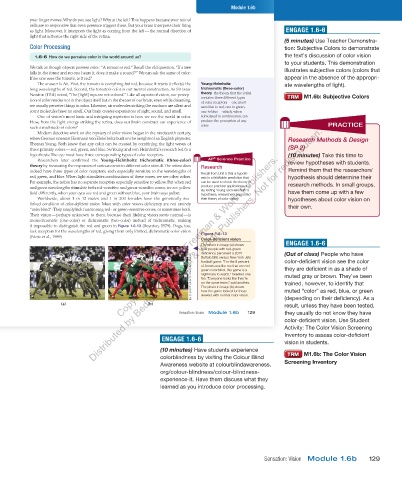
                 it impossible to distinguish the red and green in   Figure 1.6-13  ( Boynton, 1979 ). Dogs, too,


                 lack receptors for the wavelengths of red, giving them only limited, dichromatic color vision             Figure   1.6-13
                 ( Neitz et al., 1989 ).       Copyright © Bedford, Freeman & Worth Publishers.
                                                                          Color-deficient vision
                                                                         The photo in image (a) shows   ENGAGE 1.6-6
                                                                         how people with red-green
                                                                         deficiency perceived a 2015   (Out of class) People who have
                                                                      Ben Solomon/The New York Times/Redux Pictures  of Americans like me that are red-  they are deficient in as a shade of
                                                                         Buffalo Bills versus New York Jets
                                                                                                     color-deficient vision see the color
                                                                         football game. “For the 8 percent
                                                                         green colorblind, this game is a
                                                                         nightmare to watch,” tweeted one
                                                                                                     muted gray or brown. They’ve been
                                                                         fan. “Everyone looks like they’re
                                                                                                     trained, however, to identify that
                                                                         on the same team,” said another.
                                                                         The photo in image (b) shows
                                                                         viewers with normal color vision.
                                                                                                     (depending on their deficiency). As a
                            (a)                         (b)              how the game looked for those        muted “color” as red, blue, or green
                                                                                                     result, unless they have been tested,
                                                                  Sensation: Vision  Module 1.6b   129  they usually do not know they have
                                                                                                     color-deficient vision. Use Student
                                                                                                     Activity: The Color Vision Screening
                                                                                                     Inventory to assess color-deficient
                                                             ENGAGE 1.6-6
         03_myersAPpsychology4e_28116_ch01_002_163.indd   129                             15/12/23   9:25 AM
                                                                                                     vision in students.
                                                            (10 minutes) Have students experience
                                                            colorblindness by visiting the Colour Blind    M1.6b: The Color Vision
                                                            Awareness website at colourblindawareness.  Screening Inventory
                                                            org/colour-blindness/colour-blindness-
                                                            experience-it. Have them discuss what they
                                                            learned as you introduce color processing.
                                                                                              Sensation: Vision Module 1.6b   129


          03_HammerTE4e_47547_ch01_2a_163_4pp.indd   129                                                                        07/02/24   5:28 PM

