


Page 136 - 2024-bfw-MyersAP4e-TE
P. 136
called   accommodation   If the lens focuses the image on a point in front of the retina, you see
                                                                                          .
                                                                             near objects clearly but not distant objects. This  nearsightedness — myopia  — can be remedied
               ENGAGE 1.6-4                                                  with glasses, contact lenses, or surgery. (Farsightedness — seeing distant objects better than
                                                                             near objects — occurs when the lens focuses the image on a point behind the retina.)
               (5 minutes) Point out to students that                                    For centuries, scientists knew that an image of a candle passing through a small open-
               nearsightedness occurs when the lens                          ing will cast an inverted mirror image on a dark wall behind. If the image passing through

                                                                                                                          ,

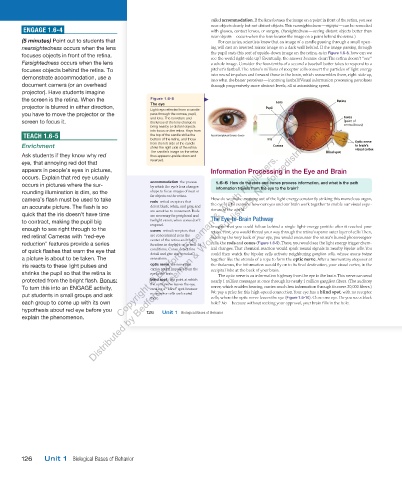
               focuses objects in front of the retina.                       the pupil casts this sort of upside-down image on the retina, as in   F igure  1.6-8  how can we
                                                                             see the world right-side up? Eventually, the answer became clear: The retina doesn’t “see”
               Farsightedness occurs when the lens                           a whole image. Consider the four-tenths of a second a baseball batter takes to respond to a
               focuses objects behind the retina. To                         pitcher’s fastball. The retina’s millions of receptor cells convert the particles of light energy
               demonstrate accommodation, use a                              into neural impulses and forward those to the brain, which reassembles them, right-side up,
                                                                             into what the batter perceives — incoming fastball! Visual information processing percolates
               document camera (or an overhead                               through progressively more abstract levels, all at astonishing speed.
               projector). Have students imagine
               the screen is the retina. When the                  Figure   1.6-8                 Lens                Retina
               projector is blurred in either direction,    The eye                           Pupil
                                                         Light rays reflected from a candle
               you have to move the projector or the     pass through the cornea, pupil,                                Fovea
               screen to focus it.                       and lens. The curvature and                                    (point of
                                                         thickness of the lens change to
                                                         bring nearby or distant objects                                central focus)
                                      Distributed by Bedford, Freeman & Worth Publishers. Not for redistribution.
                                                         into focus on the retina. Rays from
               TEACH 1.6-5                               the top of the candle strike the   Pascal Goetgheluck/Science Source
                                                         bottom of the retina, and those       Iris                         Optic nerve
               Enrichment                                from the left side of the candle        Cornea                     to brain’s
                                                         strike the right side of the retina.
                                                         The candle’s image on the retina                         Blind spot  visual cortex
               Ask students if they know why red         thus appears upside down and
               eye, that annoying red dot that           reversed.
               appears in people’s eyes in pictures,                               Information Processing in the Eye and Brain
               occurs. Explain that red eye usually
                                                                                   How do the r

                                                                                          1.6-5

                                                                                           ods and cones pr
                                                                                                     ocess information, and what is the path

               occurs in pictures where the sur-               accommodation       the process               1.6-5   How do the rods and cones process information, and what is the path
                                                         by which the eye’s lens changes
                                                                              information travels from the eye to the brain?
               rounding illumination is dim, so the      shape to focus images of near or   information travels from the eye to the brain?

                                                         far objects on the retina.
               camera’s flash must be used to take          rods       retinal receptors that     How do we make  meaning  out of the light energy constantly striking this marvelous organ,
               an accurate picture. The flash is so      detect black, white, and gray, and   the eye? Let’s examine how our eyes and our brain work together to enable our visual expe-
                                                                             rience of the world.
               quick that the iris doesn’t have time     are sensitive to movement. Rods
                                                         are necessary for peripheral and
               to contract, making the pupil big         twilight vision, when cones don’t      The Eye-to-Brain Pathway
                                                         respond.
               enough to see right through to the           cones       retinal receptors that     Imagine that you could follow behind a single light-energy particle after it reached your
                                                                             retina. First, you would thread your way through the retina’s sparse outer layer of cells. Then,
               red retina! Cameras with “red-eye  Copyright © Bedford, Freeman & Worth Publishers.
                                                         are concentrated near the
                                                                             reaching the very back of your eye, you would encounter the retina’s buried photoreceptor
                                                         center of the retina and that


               reduction” features provide a series      function in daylight or in well-lit   cells, the    rods   and   cones  (  F igure 1.6-9 ). There, you would see the light energy trigger chem-
               of quick flashes that warn the eye that   conditions. Cones detect fine   ical changes. That chemical reaction would spark neural signals in nearby  bipolar cells.  You
                                                                             could then watch the bipolar cells activate neighboring  ganglion cells,  whose axons twine
                                                         detail and give rise to color
               a picture is about to be taken. The       sensations.         together like the strands of a rope to form the    optic nerve   After a momentary stopover at

                                                                                                               .

               iris reacts to these light pulses and        optic nerve       the nerve that   the thalamus, the information would fly on to its final destination, your visual cortex, in the
                                                         carries neural impulses from the
               shrinks the pupil so that the retina is   eye to the brain.     occipital lobe at the back of your brain.
                                                                                 The optic nerve is an information highway from the eye to the brain. This nerve can send
               protected from the bright flash. Bonus:      blind spot     the point at which   nearly 1 million messages at once through its nearly 1 million ganglion fibers. (The auditory


               To turn this into an ENGAGE activity,     the optic nerve leaves the eye,   nerve, which enables hearing, carries much less information through its mere 30,000 fibers.)
                                                         creating a “blind” spot because
                                                                                                                       ,
               put students in small groups and ask      no receptor cells are located   We pay a price for this high-speed connection. Your eye has a    blind spot   with no receptor


                                                                             cells, where the optic nerve leaves the eye ( Figure 1.6-10 ). Close one eye. Do you see a black

                                                         there.
               each group to come up with its own                            hole?  No —  because without seeking your approval, your brain fills in the hole.
               hypothesis about red eye before you      126   Unit 1  Biological Bases of Behavior
               explain the phenomenon.
                                                  03_myersAPpsychology4e_28116_ch01_002_163.indd   126                              15/12/23   9:25 AM
               126   Unit 1  Biological Bases of Behavior
          03_HammerTE4e_47547_ch01_2a_163_4pp.indd   126                                                                        07/02/24   5:27 PM

