


Page 132 - 2024-bfw-MyersAP4e-TE
P. 132
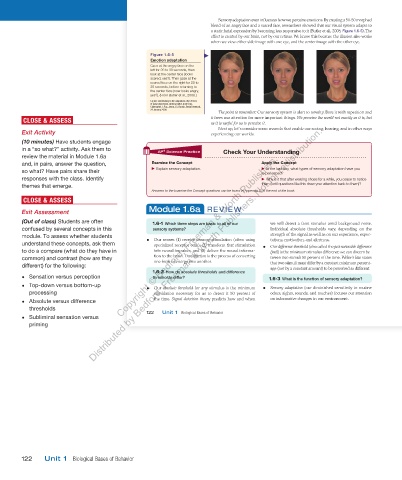
Sensory adaptation even influences how we perceive emotions. By creating a 50-50 morphed
                                                                             blend of an angry face and a scared face, researchers showed that our visual system adapts to
                                                                             a static facial expression by becoming less responsive to it (Butler et al., 2008; Figure 1.6-5). The
                                                                             effect is created by our brain, not by our retinas. We know this because the illusion also works
                                                                             when we view either side image with one eye, and the center image with the other eye.

                                                         Figure 1.6-5
                                                         Emotion adaptation
                                                         Gaze at the angry face on the
                                                         left for 20 to 30 seconds, then
                                                         look at the center face (looks
                                                         scared, yes?). Then gaze at the
                                                         scared face on the right for 20 to
                                                         30 seconds, before returning to
                                                         the center face (now looks angry,
                                                         yes?). (From Butler et al., 2008.)
                                                         Factors contributing to the adaptation after effects
                                                         of facial expression, Andrea Butler, lpek Oruc,
                                                         Christopher J. Fox, Jason J.S. Barton, Brain Research,
                                                         29 January 2008.
                                                                               The point to remember: Our sensory system is alert to novelty. Bore it with repetition and
               CLOSE & ASSESS                                                it frees our attention for more important things. We perceive the world not exactly as it is, but
                                                                             as it is useful for us to perceive it.
                                      Distributed by Bedford, Freeman & Worth Publishers. Not for redistribution.
                                                                               Next up, let’s consider some marvels that enable our seeing, hearing, and in other ways
               Exit Activity                                                 experiencing our worlds.
               (10 minutes) Have students engage
               in a “so what?” activity. Ask them to       AP  Science Practice  Check Your Understanding
                                                             ®
               review the material in Module 1.6a
               and, in pairs, answer the question,       Examine the Concept                 Apply the Concept
               so what? Have pairs share their           ▶ ▶Explain sensory adaptation.      ▶ ▶In the last day, what types of sensory adaptation have you
                                                                                             experienced?
               responses with the class. Identify                                            ▶ ▶Why is it that after wearing shoes for a while, you cease to notice
               themes that emerge.                                                           them (until questions like this draw your attention back to them)?
                                                         Answers to the Examine the Concept questions can be found in Appendix C at the end of the book.
               CLOSE & ASSESS
               Exit Assessment                          Module 1.6a   REVIEW
               (Out of class) Students are often          1.6-1 Which three steps are basic to all of our   we will detect a faint stimulus amid background noise.
               confused by several concepts in this       sensory systems?                      Individual absolute thresholds vary, depending on the
               module. To assess whether students  Copyright © Bedford, Freeman & Worth Publishers.  strength of the signal as well as on our experience, expec-
                                                                                                tations, motivation, and alertness.
               understand these concepts, ask them      •  Our senses (1) receive sensory stimulation (often using   •  Our difference threshold (also called the just noticeable difference
                                                          specialized receptor cells), (2) transform that stimulation
               to do a compare (what do they have in      into neural impulses, and (3) deliver the neural informa-  [jnd]) is the minimum stimulus difference we can discern be-
               common) and contrast (how are they         tion to the brain. Transduction is the process of converting   tween two stimuli 50 percent of the time. Weber’s law states
                                                          one form of energy into another.
               different) for the following:                                                    that two stimuli must differ by a constant minimum percent-
                                                                                                age (not by a constant amount) to be perceived as different.
                                                          1.6-2 How do absolute thresholds and difference
               •  Sensation versus perception             thresholds differ?                    1.6-3 What is the function of sensory adaptation?
               •  Top-down versus bottom-up             •  Our absolute threshold for any stimulus is the minimum   •  Sensory adaptation (our diminished sensitivity to routine
                 processing                               stimulation necessary for us to detect it 50 percent of   odors, sights, sounds, and touches) focuses our attention
               •  Absolute versus difference              the time. Signal detection theory predicts how and when   on informative changes in our environment.
                 thresholds
                                                        122   Unit 1  Biological Bases of Behavior
               •  Subliminal sensation versus
                 priming

                                                  03_myersAPpsychology4e_28116_ch01_002_163.indd   122                              15/12/23   9:25 AM


               122   Unit 1  Biological Bases of Behavior


          03_HammerTE4e_47547_ch01_2a_163_4pp.indd   122                                                                        07/02/24   5:27 PM

