


Page 131 - 2024-bfw-MyersAP4e-TE
P. 131
Module 1.6a

                    Why, then, if we stare at an object without flinching, does it not vanish from sight?
                 Because, unnoticed by us, our eyes are always moving. This continual flitting from one spot
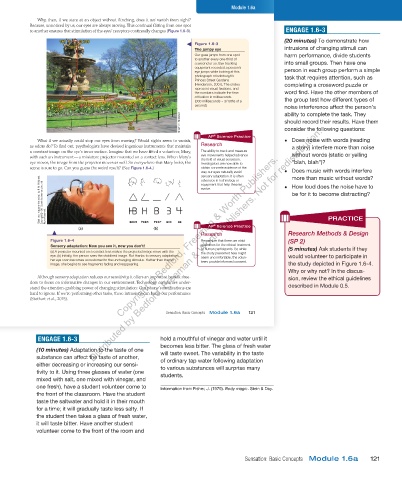
                 to another ensures that stimulation of the eyes’ receptors continually changes (Figure 1.6-3).  ENGAGE 1.6-3
                                                                                                     (20 minutes) To demonstrate how
                                                                       Figure 1.6-3
                                                                       The jumpy eye                 intrusions of changing stimuli can
                                                                       Our gaze jumps from one spot   harm performance, divide students
                                                                       to another every one-third of
                                                                       a second or so. Eye-tracking   into small groups. Then have one
                                                                       equipment recorded a person’s
                                                                       eye jumps while looking at this   person in each group perform a simple
                                                                       photograph of Edinburgh’s     task that requires attention, such as
                                                                       Princes Street Gardens
                                                                       (Henderson, 2007). The circles   completing a crossword puzzle or
                                                                       represent visual fixations, and
                                                                       the numbers indicate the time    word find. Have the other members of
                                                                       of fixation in milliseconds
                                                                       (300 milliseconds = 3/10ths of a   the group test how different types of
                                                                       second).                      noise interference affect the person’s
                                                                                                     ability to complete the task. They
                                                                  © John M. Henderson                should record their results. Have them
                                      Distributed by Bedford, Freeman & Worth Publishers. Not for redistribution.
                                                                                                     consider the following questions:
                                                                              ®
                                                                            AP  Science Practice
                    What if we actually could stop our eyes from moving? Would sights seem to vanish,   •  Does noise with words (reading
                 as odors do? To find out, psychologists have devised ingenious instruments that maintain   Research  a story) interfere more than noise
                 a constant image on the eye’s inner surface. Imagine that we have fitted a volunteer, Mary,   The ability to track and measure   without words (static or yelling
                                               Copyright © Bedford, Freeman & Worth Publishers.
                 with such an instrument — a miniature projector mounted on a contact lens. When Mary’s   eye movements helped advance
                                                                         the field of visual sensation.
                 eye moves, the image from the projector moves as well. So everywhere that Mary looks, the   Investigators are now able to   “blah, blah”)?
                 scene is sure to go. Can you guess the weird result? (See Figure 1.6-4.)  obtain concrete evidence of the
                                                                         way our eyes naturally avoid   •  Does music with words interfere
                                                                           sensory adaptation. It is often
                                                                                                       more than music without words?
                     “Stabilized images on the retina,” by R. M. Pritchard.  Copyright © 1961 Scientific American, Inc. All   evolve.  •  How loud does the noise have to
                                                                         advances in technology or
                                                                         equipment that help theories
                                                                                                       be for it to become distracting?
                       Rights Reserved.
                                                                              ®
                                 (a)                      (b)               AP  Science Practice                   PRACTICE
                                                                         Research                     Research Methods & Design
                        Figure 1.6-4                                     Remember that there are strict   (SP 2)
                        Sensory adaptation: Now you see it, now you don’t!  guidelines for the ethical treatment
                                                                         of human participants. So while   (5 minutes) Ask students if they
                        (a) A projector mounted on a contact lens makes the projected image move with the   the study presented here might
                        eye. (b) Initially, the person sees the stabilized image. But thanks to sensory adaptation,   seem uncomfortable, the volun-  would volunteer to participate in
                        her eye soon becomes accustomed to the unchanging stimulus. Rather than the full   teers provide informed consent.
                        image, she begins to see fragments fading and reappearing.                    the study depicted in Figure 1.6-4.
                                                                                                      Why or why not? In the discus-
                    Although sensory adaptation reduces our sensitivity, it offers an important benefit: free-  sion, review the ethical guidelines
                 dom to focus on informative changes in our environment. Technology companies under-
                 stand the attention-grabbing power of changing stimulation: Our phone’s notifications are   described in Module 0.5.
                 hard to ignore. If we’re performing other tasks, these intrusions can harm our performance
                 (Stothart et al., 2015).
                                                              Sensation: Basic Concepts  Module 1.6a   121


                    ENGAGE 1.6-3
         03_myersAPpsychology4e_28116_ch01_002_163.indd   121  hold a mouthful of vinegar and water until it
                                                                                          15/12/23   9:25 AM
                                                            becomes less bitter. The glass of fresh water
                    (10 minutes) Adaptation to the taste of one   will taste sweet. The variability in the taste
                    substance can affect the taste of another,   of ordinary tap water following adaptation
                    either decreasing or increasing our sensi-  to various substances will surprise many
                    tivity to it. Using three glasses of water (one   students.
                    mixed with salt, one mixed with vinegar, and
                    one fresh), have a student volunteer come to   Information from Fisher, J. (1979). Body magic. Stein & Day.
                    the front of the classroom. Have the student
                    taste the saltwater and hold it in their mouth
                    for a time; it will gradually taste less salty. If
                    the student then takes a glass of fresh water,
                    it will taste bitter. Have another student
                    volunteer come to the front of the room and


                                                                                        Sensation: Basic Concepts Module 1.6a   121


          03_HammerTE4e_47547_ch01_2a_163_4pp.indd   121                                                                        07/02/24   5:27 PM

