


Page 126 - 2024-bfw-MyersAP4e-TE
P. 126
motionless flies. But let one zoom by and the frog’s “bug detector” cells snap awake. (As
                                                                               Kermit the Frog said, “Time’s fun when you’re having flies.”)
                                                                             •  Male silkworm moths’ odor receptors can detect one-billionth of an ounce of chemical
                                                                               sex attractant per second, released by a female one mile away (Sagan, 1977). That is why
                                                                               there continue to be silkworms.
                                                        CULTURAL               In Module 1.6, we’ll look at what psychologists have learned about how we sense our
                                                        AWARENESS            world; in Module 2.1, we’ll explore how we perceive our world. Let’s begin by considering
                                                        Pay close attention to the difference   some basic principles of both sensation and perception.
                                                        between sensation and perception.
                                                        Many people mistakenly believe that
                                                        the brain perceives situations in an   Basic Concepts of Sensation and Perception
                                                        objective, calculating way. In fact,
                                                        the brain implements a number of   How do we create meaning from the blizzard of sensory stimuli that bombards our body
                                                        biases and filters that influence our   24 hours a day? In its silent, cushioned, inner world, our brain floats in utter darkness. By
                                                        experience in the world, and those
                                                        applied are often influenced by our   itself, it sees nothing. It hears nothing. It feels nothing. So, how does the world out there get
                                                        culture.             in? To phrase the question scientifically: How do we construct our representations of the
                                                                             external world? How do a campfire’s flicker, crackle, heat, and smoky scent activate neural
                                                                             connections? And how, from this living neurochemistry, do we create our conscious experi-
                                                                             ence of the fire’s motion and temperature, its aroma and beauty?
                                                         sensation  the process by
                                      Distributed by Bedford, Freeman & Worth Publishers. Not for redistribution.
                                                         which our sensory receptors   Processing Sensations and Perceptions
                                                         and nervous system receive and   Indiana  Adams’ curious mix of perfect vision and face blindness illustrates the distinction
                                                         represent stimulus energies from
                                                         our environment.    between sensation and perception. When she looks at a friend, her sensation is normal: Her
                                                                             sensory receptors detect the same information any sighted person’s would, and her nervous
                                                         sensory receptors  sensory
               TEACH                                     nerve endings that respond to   system transmits that information to her brain. Her perception — the processes by which her
                                                         stimuli.            brain organizes and interprets sensory input — is almost normal (see  Module 2.1). Thus, she may
               Teaching Tip                              perception  the process by                            recognize people from their hair,
                                                         which our brain organizes and                         gait, voice, or particular physique,
               Students may get bottom-up and top-       interprets sensory information,                       just not from their face. Her expe-
               down processing confused. Help them       enabling us to recognize objects                      rience is much like the struggle
                                                         and events as meaningful.
               remember the difference between the       bottom-up processing                                  any human would have trying to
                                                                                                               recognize a specific penguin.
               two concepts by picturing a pyramid,      information processing that                             Under normal circumstan-
                                                         begins with the sensory
               with data points (pieces of information)   receptors and works up to the                        ces, sensation and perception
                                                         brain’s integration of sensory                        blend into one continuous
               at the bottom and one consolidating       information.                                          process. In this module and
               theory at the top. Then the terms may     top-down processing                                   Module 2.1, we slow down that
               make more sense:                          information processing                                process to study its parts; in
                                                         guided by higher-level mental                         real life, your sensory and per-
                                                         processes, as when we construct
               •  Bottom-up processing—we      Copyright © Bedford, Freeman & Worth Publishers.                ceptual processes work toge-
                                                         perceptions drawing on our
                                                                                                               ther to help you decipher the
                 process this way when we have           experience and expectations.                          world around you.  As your
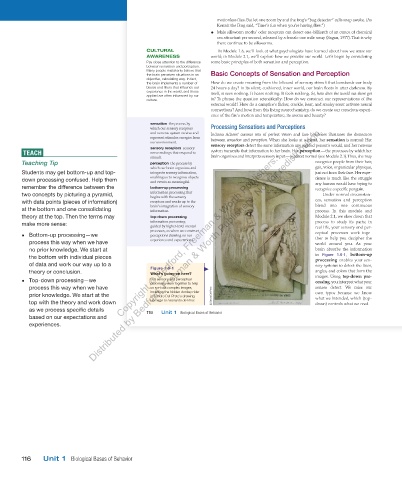
                 no prior knowledge. We start at                                                               brain absorbs the information
                 the bottom with individual pieces                                                             in  Figure 1.6-1,  bottom-up
                                                                                                               processing enables your sen-
                 of data and work our way up to a                                                              sory systems to detect the lines,
                 theory or conclusion.                   Figure 1.6-1                                          angles, and colors that form the
                                                         What’s going on here?
               •  Top-down processing—we                 Our sensory and perceptual                            images. Using  top-down  pro-
                                                                                                               cessing, you interpret what your
                                                         processes work together to help
                 process this way when we have           us sort out complex images,                           senses detect.  We miss our
                                                         including the hidden donkey rider                     own typos because we know
                 prior knowledge. We start at the        in Sandro Del-Prete’s drawing,   © Sandro Del-Prete   what we intended, which (top-
                 top with the theory and work down       Homage to Leonardo de Vinci.                          down) controls what we read.
                 as we process specific details         116   Unit 1  Biological Bases of Behavior
                 based on our expectations and
                 experiences.
                                                  03_myersAPpsychology4e_28116_ch01_002_163.indd   116                              15/12/23   9:24 AM


               116   Unit 1  Biological Bases of Behavior


          03_HammerTE4e_47547_ch01_2a_163_4pp.indd   116                                                                        07/02/24   5:26 PM

