


Page 125 - 2024-bfw-MyersAP4e-TE
P. 125
Module 1.6a

                   Module 1.6a            Sensation: Basic Concepts
                                                                                                     INTRODUCE THE MODULE
                                                                                                     Make It Meaningful
                   LEARNING TARGETS
                   1.6-1    Explain the three steps that are basic to all of our sensory systems.     (10 minutes) Ask students what
                   1.6-2   Explain the difference between absolute thresholds and difference          they know about subliminal
                         thresholds.
                                                                                                      persuasion. Where did they learn
                   1.6-3    Explain the function of sensory adaptation.
                                                                                                      about it? Are they skeptical of
                                                                                                      it? How do they think our senses
                                                                                                      might play a role? Use this
                       hen Indiana Adams awoke on New Year’s Day in 2020, she decided to buy her
                       husband exercise equipment. As she scrolled through the social media market-   discussion to introduce sensation
                  Wplace, a used psychology textbook cover caught her attention. Adams’ vision is     and perception.
                  perfect, but her perception is not. A former model and actor, Adams noted that the woman
                  on the textbook cover wore clothes that evoked memories of one of her photoshoots. But
                  Adams has prosopagnosia — face blindness — which means she can’t even recognize her
                  own face.
                                      Distributed by Bedford, Freeman & Worth Publishers. Not for redistribution.
                    She went into her bedroom and showed her husband the picture. “That’s you!” he said.
                  And we [DM and ND] were that textbook’s authors.                                   INTRODUCE THE MODULE
                    People with face blindness sometimes struggle socially.                          Activate Prior Knowledge
                  On one occasion, Adams was shopping and complimented
                  another woman on her cute clothes.  When the woman
                                               Copyright © Bedford, Freeman & Worth Publishers.
                  didn’t respond, Adams realized she was actually looking                             (10 minutes) Begin class with
                  at herself in the   mirror — and talking to her own reflec-                         this activity, which asks students
                  tion! Other people with face blindness report being aloof                           to decide if statements are
                  or experiencing distress when they confuse coworkers and
                  strangers with loved ones. Face-blind people sometimes                              true or false. The statements
                  pretend to recognize people, just in case they turn out to                          tap into common beliefs and
                  be someone they know. One woman found a way to use                                  misconceptions about psychology.
                  her face blindness to build friendships (Dingfelder, 2019).
                  “When I was walking to class, if someone seemed to look                             This activity will benefit students’
                  my way, I smiled. If they smiled, I stopped to chat,” she said.                     understanding of Module 1.6a as
                  “Before long, the whole campus was brimming with close,                             they read.
                  personal friends of mine.”
                    Unlike Adams, most of us have a functioning area on
                  the underside of our brain’s right hemisphere that helps                                  M1.6a: Fact or Falsehood?
                  us recognize a familiar human face, including our own,
                  as soon as we detect it — in only one-seventh of a second
                  (Jacques & Rossion, 2006). Our remarkable ability illus-
                  trates a broader principle: Nature’s sensory gifts enable each
                  animal to obtain essential information. Other examples:                            TEACHING TIP
                  •  Human ears are most sensitive to sound frequencies                              The Essential Knowledge for Topic
                    that include human voices, especially a baby’s cry.                     Red Chopsticks/Getty Images  1.6—Sensation—includes a discussion
                  •  Frogs, which feed on flying insects, have cells in their
                    eyes that fire only in response to small, dark, mov-                             of blindsight. You can find detailed
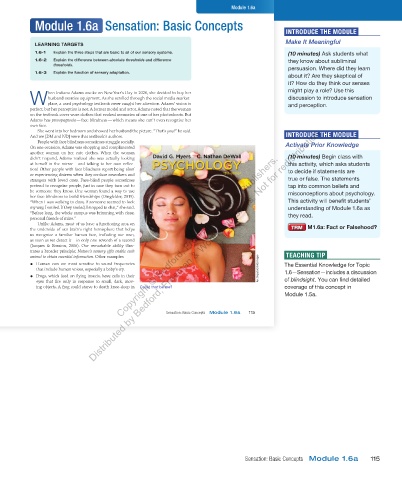
                    ing objects. A frog could starve to death knee-deep in   Could that be me?       coverage of this concept in
                                                                                                     Module 1.5a.

                                                              Sensation: Basic Concepts  Module 1.6a   115


         03_myersAPpsychology4e_28116_ch01_002_163.indd   115                             18/12/23   5:04 PM


                                                                                        Sensation: Basic Concepts Module 1.6a   115


          03_HammerTE4e_47547_ch01_2a_163_4pp.indd   115                                                                        07/02/24   5:26 PM

