


Page 120 - 2024-bfw-MyersAP4e-TE
P. 120
Our two-track mind continues to monitor our environment while we sleep. A sen-
                                                             ®
                                                           AP  Science Practice  sory stimulus — a particular odor or a phone’s ringing — may be instantly and ingeniously
                                                         Research            woven into the dream story. In a classic experiment, researchers lightly sprayed cold water
                             PRACTICE                    In the experiment in which   on dreamers’ faces (Dement & Wolpert, 1958). Compared with sleepers who did not get the
                                                         researchers sprayed water on   cold-water treatment, these people were more likely to dream about a waterfall, a leaky roof,
                                                         the faces of sleeping individuals,   or even about being sprayed by someone.
                Research Methods & Design                the independent variable (the   So, could we learn a foreign language by hearing it played while we sleep? If only. While
                (SP 2)                                   factor that is manipulated by the   sleeping, we can learn to associate a sound with a mild electric shock (and to react to the sound
                                                         investigator) was the cold-water
                                                                             accordingly). We can also learn to associate a particular sound with a pleasant or unpleasant
                (10 minutes) Pause and do a              treatment. Can you identify the   odor (Arzi et al., 2012). But we do not remember recorded information played while we are
                                                         dependent variable (the outcome
                research review in the context of        that is measured)?                       soundly asleep (Eich, 1990; Wyatt & Bootzin, 1994). In
                dreams with your students. Ask                                                    fact, anything that happens during the 5 minutes just
                                                                                                  before sleep is typically lost from memory (Roth et al.,
                them to identify the dependent                                                    1988). This explains why people with sleep apnea, who
                variable in Dement and Wolpert’s                                                  repeatedly awaken with a gasp and then immediately
                “water spray” study. (It’s the dream                                              fall back to sleep, do not recall these episodes. Ditto for
                                                                                                  someone who awakens momentarily, sends a text mes-
                content.) Ask them why this study                                                 sage, and the next day can’t remember doing so. It also
                is an experiment. (It’s because                                                   explains why dreams that momentarily awaken us are
                the researchers manipulated the                                                   mostly forgotten by morning. To remember a dream,
                                      Distributed by Bedford, Freeman & Worth Publishers. Not for redistribution.
                                                                                                  get up and stay awake for a few minutes.
                independent variable.)
                                                                                                  Why We Dream
                                                                                                  In his landmark book The Interpretation of Dreams,
                                                                                                  Sigmund Freud offered what he thought was “the
               TEACH 1.5-10                                                                       most valuable of all the discoveries it has been my
               Teaching Tip                            Meredith Southard/Cartoon Stock            good fortune to make.” He proposed that dreams
                                                                                                  provide a psychic safety valve that discharges other-
               Although students are fascinated by                                                wise unacceptable feelings. Freud viewed a dream’s
                                                                                                  manifest content (the apparent and remembered
               dream analysis, the psychoanalytic                                                 story line) as a censored, symbolic version of its
               theory of dreams is outside the scope                                              latent content, the unconscious drives and wishes
                                                                                                  (often erotic) that would be threatening if expressed
                      ®
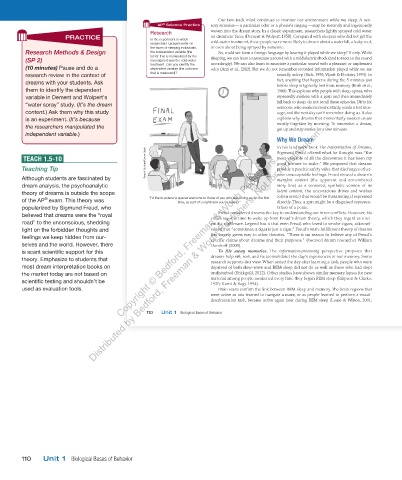
               of the AP exam. This theory was          “I’d like to extend a special welcome to those of you who are joining us for the first   directly. Thus, a gun might be a disguised represen-
                                                                  time, as part of a nightmare you’re having.”
               popularized by Sigmund Freud, who                                                  tation of a penis.
                                                                               Freud considered dreams the key to understanding our inner conflicts. However, his
               believed that dreams were the “royal                          critics say it is time to wake up from Freud’s dream theory, which they regard as a sci-
               road” to the unconscious, shedding                            entific nightmare. Legend has it that even Freud, who loved to smoke cigars, acknowl-
               light on the forbidden thoughts and                           edged that “sometimes, a cigar is just a cigar.” Freud’s wish-fulfillment theory of dreams
                                                                             has largely given way to other theories. “There is no reason to believe any of Freud’s
               feelings we keep hidden from our- Copyright © Bedford, Freeman & Worth Publishers.
                                                                             specific claims about dreams and their purposes,” observed dream researcher William
               selves and the world. However, there                          Domhoff (2003).
               is scant scientific support for this                            To  file  away  memories. The  information-processing perspective proposes  that
               theory. Emphasize to students that                            dreams help sift, sort, and fix (consolidate) the day’s experiences in our memory. Some
                                                                             research supports this view. When tested the day after learning a task, people who were
               most dream interpretation books on                            deprived of both slow-wave and REM sleep did not do as well as those who had slept
               the market today are not based on                             undisturbed (Stickgold, 2012). Other studies have shown similar memory lapses for new
               scientific testing and shouldn’t be                           material among people awakened every time they began REM sleep (Empson & Clarke,
                                                                             1970; Karni & Sagi, 1994).
               used as evaluation tools.                                       Brain scans confirm the link between REM sleep and memory. The brain regions that
                                                                             were active as rats learned to navigate a maze, or as people learned to perform a visual-
                                                                             discrimination task, became active again later during REM sleep (Louie & Wilson, 2001;
                                                        110   Unit 1  Biological Bases of Behavior


                                                  03_myersAPpsychology4e_28116_ch01_002_163.indd   110                              15/12/23   4:31 PM


               110   Unit 1  Biological Bases of Behavior


          03_HammerTE4e_47547_ch01_2a_163_4pp.indd   110                                                                        07/02/24   5:26 PM

