


Page 122 - 2024-bfw-MyersAP4e-TE
P. 122
To make sense of neural static. Other researchers propose that dreams erupt from
                                                                             neural activation spreading upward from the brainstem (Antrobus, 1991; Hobson, 2009).
                                                                             According to the activation-synthesis theory, dreams are the brain’s attempt to synthesize
                                                                             random neural activity. Much as a neurosurgeon can produce hallucinations by stimulat-
                                                                             ing different parts of a patient’s cortex, so can stimulation originating within the brain. As
                                                                             Freud might have expected, PET scans of sleeping people also reveal increased activity in
                                                                             the emotion-related limbic system (in the amygdala) during emotional dreams (Schwartz,
                                                                             2012). In contrast, the frontal lobe regions responsible for inhibition and logical thinking
                                                                             seem to idle, which may explain why we are less inhibited when dreaming than when
                                                                             awake (Maquet et al., 1996). Add the limbic system’s emotional tone to the brain’s visual
                                                                             bursts and — voila! — we dream. Damage either the limbic system or the visual centers
                                                                             active during dreaming, and dreaming itself may be impaired (Domhoff, 2003).
                                                                               To reflect cognitive development. Some dream researchers focus on dreams as part
                                                                             of brain maturation and cognitive development (Domhoff, 2010, 2011; Foulkes, 1999). For
                                                                             example, prior to age 9, children’s dreams seem more like a slide show and less like an active
                                                                             story in which the dreamer is an actor. Dreams overlap with waking cognition and feature
                                                                             coherent speech. They simulate reality by drawing on our concepts and knowledge. They
                                                                             engage brain networks that also are active during daydreaming — and so may be viewed as
                                                                             intensified mind-wandering, enhanced by visual imagery (Fox et al., 2013). Unlike the idea
                                                                             that dreams arise from bottom-up brain activation, the cognitive perspective emphasizes our
                                      Distributed by Bedford, Freeman & Worth Publishers. Not for redistribution.
                                                                             mind’s top-down control of our dream content (Nir & Tononi, 2010). Dreams, says Domhoff
                                                                             (2014), “dramatize our wishes, fears, concerns, and interests in striking scenarios that we
                                                                             experience as real events.”
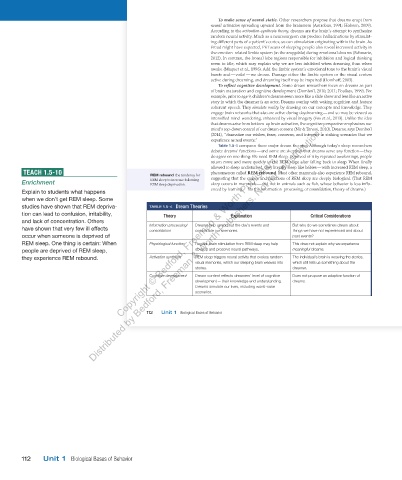
                                                                               Table 1.5-4 compares these major dream theories. Although today’s sleep researchers
                                                                             debate dreams’ functions — and some are skeptical that dreams serve any function — they
                                                                             do agree on one thing: We need REM sleep. Deprived of it by repeated awakenings, people
                                                                             return more and more quickly to the REM stage after falling back to sleep. When finally
                                                                             allowed to sleep undisturbed, they literally sleep like babies — with increased REM sleep, a
               TEACH 1.5-10                              REM rebound  the tendency for   phenomenon called REM rebound. Most other mammals also experience REM rebound,
               Enrichment                                REM sleep to increase following   suggesting that the causes and functions of REM sleep are deeply biological. (That REM
                                                                             sleep occurs in mammals — and not in animals such as fish, whose behavior is less influ-
                                                         REM sleep deprivation.
               Explain to students what happens                              enced by learning — fits the information-processing, or consolidation, theory of dreams.)
               when we don’t get REM sleep. Some
               studies have shown that REM depriva-     TABLE 1.5-4  Dream Theories
               tion can lead to confusion, irritability,     Theory                Explanation               Critical Considerations
               and lack of concentration. Others
                                                         Information processing/  Dreams help us sort out the day’s events and   But why do we sometimes dream about
               have shown that very few ill effects      consolidation  consolidate our memories.      things we have not experienced and about
               occur when someone is deprived of  Copyright © Bedford, Freeman & Worth Publishers.     past events?
               REM sleep. One thing is certain: When     Physiological function  Regular brain stimulation from REM sleep may help   This does not explain why we experience
               people are deprived of REM sleep,                       develop and preserve neural pathways.  meaningful dreams.
               they experience REM rebound.              Activation synthesis  REM sleep triggers neural activity that evokes random   The individual’s brain is weaving the stories,
                                                                       visual memories, which our sleeping brain weaves into   which still tells us something about the
                                                                       stories.                        dreamer.
                                                         Cognitive development  Dream content reflects dreamers’ level of cognitive   Does not propose an adaptive function of
                                                                       development — their knowledge and understanding.   dreams.
                                                                       Dreams simulate our lives, including worst-case
                                                                       scenarios.


                                                        112   Unit 1  Biological Bases of Behavior


                                                  03_myersAPpsychology4e_28116_ch01_002_163.indd   112                              15/12/23   9:24 AM


               112   Unit 1  Biological Bases of Behavior


          03_HammerTE4e_47547_ch01_2a_163_4pp.indd   112                                                                        07/02/24   5:26 PM

