


Page 118 - 2024-bfw-MyersAP4e-TE
P. 118
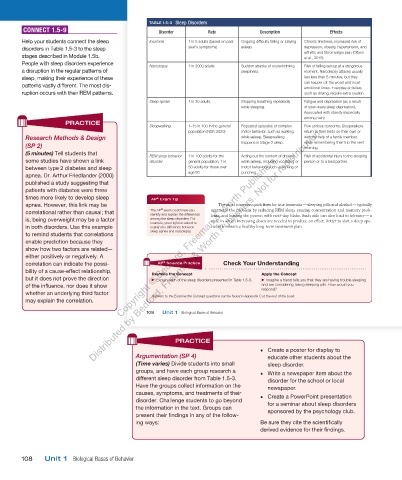
TABLE 1.5-3  Sleep Disorders
               CONNECT 1.5-9                                Disorder        Rate             Description           Effects

               Help your students connect the sleep      Insomnia    1 in 5 adults (based on past   Ongoing difficulty falling or staying   Chronic tiredness, increased risk of
               disorders in Table 1.5-3 to the sleep                 year’s symptoms)  asleep.             depression, obesity, hypertension, and
               stages described in Module 1.5b.                                                            arthritic and fibromyalgia pain (Olfson
                                                                                                           et al., 2018).
               People with sleep disorders experience    Narcolepsy  1 in 2000 adults  Sudden attacks of overwhelming   Risk of falling asleep at a dangerous
               a disruption in the regular patterns of                                sleepiness.          moment. Narcolepsy attacks usually
               sleep, making their experience of these                                                     last less than 5 minutes, but they
               patterns vastly different. The most dis-                                                    can happen at the worst and most
                                                                                                           emotional times. Everyday activities,
               ruption occurs with their REM patterns.                                                     such as driving, require extra caution.
                                                         Sleep apnea  1 in 20 adults  Stopping breathing repeatedly   Fatigue and depression (as a result
                                                                                      while sleeping.      of slow-wave sleep deprivation).
                                                                                                           Associated with obesity (especially
                                                                                                           among men).
                             PRACTICE
                                                         Sleepwalking  1–15 in 100 in the general   Repeated episodes of complex   Few serious concerns. Sleepwalkers
                                      Distributed by Bedford, Freeman & Worth Publishers. Not for redistribution.
                                                                     population (NSF, 2020)  motor behavior, such as walking,   return to their beds on their own or
                Research Methods & Design                                             while asleep. Sleepwalking   with the help of a family member,
                (SP 2)                                                                happens in Stage 3 sleep.  rarely remembering their trip the next
                                                                                                           morning.
                (5 minutes) Tell students that           REM sleep behavior   1 in 100 adults for the   Acting out the content of dreams   Risk of accidental injury to the sleeping
                some studies have shown a link           disorder    general population; 1 in   while asleep, including vocalizing or   person or to a bed partner.
                between type 2 diabetes and sleep                    50 adults for those over   motor behaviors such as kicking or
                apnea. Dr. Arthur Friedlander (2000)                 age 50           punching.
                published a study suggesting that
                patients with diabetes were three
                times more likely to develop sleep       AP  Exam Tip
                                                           ®
                apnea. However, this link may be                               The most common quick fixes for true insomnia — sleeping pills and alcohol — typically
                                                            ®
                correlational rather than causal; that   The AP  exam could have you   aggravate the problem by reducing REM sleep, causing concentration and memory prob-
                                                         identify and explain the differences
                                                                             lems, and leaving the person with next-day blahs. Such aids can also lead to tolerance — a
                is, being overweight may be a factor     among the sleep disorders. For   state in which increasing doses are needed to produce an effect. Better to visit a sleep spe-
                                                         example, you might be asked to
                in both disorders. Use this example      explain the difference between   cialist to obtain a healthy long-term treatment plan.
                                                         sleep apnea and narcolepsy.
                to remind students that correlations  Copyright © Bedford, Freeman & Worth Publishers.
                enable prediction because they
                show how two factors are related—
                either positively or negatively. A
                correlation can indicate the possi-        AP  Science Practice  Check Your Understanding
                                                             ®
                bility of a cause-effect relationship,   Examine the Concept                 Apply the Concept
                but it does not prove the direction      ▶ ▶Explain each of the sleep disorders presented in Table 1.5-3.  ▶ ▶Imagine a friend tells you that they are having trouble sleeping
                of the influence, nor does it show                                           and are considering taking sleeping pills. How would you
                                                                                             respond?
                whether an underlying third factor       Answers to the Examine the Concept questions can be found in Appendix C at the end of the book.
                may explain the correlation.
                                                        108   Unit 1  Biological Bases of Behavior


                                                  03_myersAPpsychology4e_28116_ch01_002_163.indd   108                              15/12/23   9:24 AM
                                                                 PRACTICE
                                                                                             •  Create a poster for display to
                                                    Argumentation (SP 4)                       educate other students about the
                                                    (Time varies) Divide students into small   sleep disorder.
                                                    groups, and have each group research a   •  Write a newspaper item about the
                                                    different sleep disorder from Table 1.5-3.   disorder for the school or local
                                                    Have the groups collect information on the   newspaper.
                                                    causes, symptoms, and treatments of their   •  Create a PowerPoint presentation
                                                    disorder. Challenge students to go beyond   for a seminar about sleep disorders
                                                    the information in the text. Groups can    sponsored by the psychology club.
                                                    present their findings in any of the follow-
                                                    ing ways:                                Be sure they cite the scientifically
                                                                                             derived evidence for their findings.


               108   Unit 1  Biological Bases of Behavior


          03_HammerTE4e_47547_ch01_2a_163_4pp.indd   108                                                                        07/02/24   5:25 PM

