


Page 114 - 2024-bfw-MyersAP4e-TE
P. 114
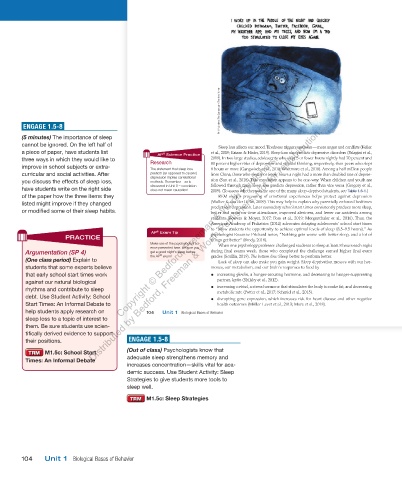
Phil McAndrew/The Cartoonbank/The New Yorker


               ENGAGE 1.5-8
                Times: An Informal Debate Distributed by Bedford, Freeman & Worth Publishers. Not for redistribution.
               (5 minutes) The importance of sleep
               cannot be ignored. On the left half of                          Sleep loss affects our mood. Tiredness triggers testiness — more anger and conflicts (Keller
               a piece of paper, have students list                          et al., 2019; Krizan & Hisler, 2019). Sleep loss also predicts depressive disorders (Palagini et al.,
                                                             ®
                                                           AP  Science Practice
               three ways in which they would like to    Research            2019). In two large studies, adolescents who slept 5 or fewer hours nightly had 70 percent and
               improve in school subjects or extra-      The statement that sleep loss   80 percent higher risks of depression and suicidal thinking, respectively, than peers who slept
                                                                             8 hours or more (Gangwisch et al., 2010; Whitmore et al., 2018). Among a half million people
               curricular and social activities. After   predicts (as opposed to causes)   from China, those who slept 5 or fewer hours a night had a more than doubled rate of depres-
                                                         depression implies correlational
               you discuss the effects of sleep loss,    methods. Remember – as is    sion (Sun et al., 2018). This correlation appears to be one-way: When children and youth are
                                                         discussed in Unit 0 – correlation   followed through time, sleep loss predicts depression, rather than vice versa (Gregory et al.,
               have students write on the right side     does not mean causation!  2009). (To assess whether you are one of the many sleep-deprived students, see Table 1.5-1.)
               of the paper how the three items they                           REM sleep’s processing of emotional experiences helps protect against depression
               listed might improve if they changed                          (Walker & van der Helm, 2009). This may help to explain why parentally enforced bedtimes
                                                                             predict less depression. Later secondary school start times consistently produce more sleep,
               or modified some of their sleep habits.                       better and more on-time attendance, improved alertness, and fewer car accidents among
                                                                             students (Bowers & Moyer, 2017; Foss et al., 2019; Morgenthaler et al., 2016). Thus, the
                                                                             American Academy of Pediatrics (2014) advocates delaying adolescents’ school start times
                                                                             to “allow students the opportunity to achieve optimal levels of sleep (8.5–9.5 hours).” As
                                                           ®
                                                         AP  Exam Tip
                                                                             psychologist Roxanne Prichard notes, “Nothing gets worse with better sleep, and a lot of
                             PRACTICE          Copyright © Bedford, Freeman & Worth Publishers.
                                                                             things get better” (Brody, 2018).
                                                         Make use of the psychological sci-
                                                         ence presented here. Be sure you   When one psychology professor challenged students to sleep at least 8 hours each night
                Argumentation (SP 4)                     get a good night’s sleep before   during final exams week, those who completed the challenge earned higher final exam
                                                            ®
                (One class period) Explain to            the AP  exam!       grades (Scullin, 2019). The bottom line: Sleep better to perform better.
                                                                               Lack of sleep can also make you gain weight. Sleep deprivation messes with our hor-
                students that some experts believe                           mones, our metabolism, and our brain’s responses to food by
                that early school start times work                           •  increasing ghrelin, a hunger-arousing hormone, and decreasing its hunger-suppressing
                against our natural biological                                 partner, leptin (Shilsky et al., 2012).
                rhythms and contribute to sleep                              •  increasing cortisol, a stress hormone that stimulates the body to make fat, and decreasing
                                                                               metabolic rate (Potter et al., 2017; Schmid et al., 2015).
                debt. Use Student Activity: School                           •  disrupting gene expression, which increases risk for heart disease and other negative
                Start Times: An Informal Debate to                             health outcomes (Möller-Levet et al., 2013; Mure et al., 2018).
                help students apply research on         104   Unit 1  Biological Bases of Behavior
                sleep loss to a topic of interest to
                them. Be sure students use scien-
                tifically derived evidence to support
                                                  03_myersAPpsychology4e_28116_ch01_002_163.indd   104
                their positions.                  ENGAGE 1.5-8                                                                      15/12/23   9:24 AM
                      M1.5c: School Start        (Out of class) Psychologists know that
                                                 adequate sleep strengthens memory and
                                                 increases concentration—skills vital for aca-
                                                 demic success. Use Student Activity: Sleep
                                                 Strategies to give students more tools to
                                                 sleep well.

                                                        M1.5c: Sleep Strategies


               104   Unit 1  Biological Bases of Behavior


          03_HammerTE4e_47547_ch01_2a_163_4pp.indd   104                                                                        07/02/24   5:25 PM

