


Page 115 - 2024-bfw-MyersAP4e-TE
P. 115
Module 1.5c

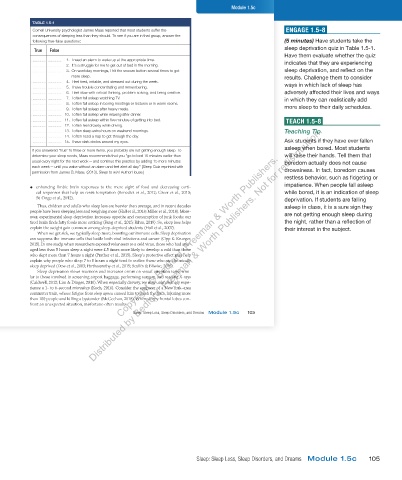
                  TABLE 1.5-1
                  Cornell University psychologist James Maas reported that most students suffer the   ENGAGE 1.5-8
                  consequences of sleeping less than they should. To see if you are in that group, answer the
                  following true-false questions:                                                    (5 minutes) Have students take the
                                                                                                     sleep deprivation quiz in Table 1.5-1.
                   True  False
                                                                                                     Have them evaluate whether the quiz
                               1.  I need an alarm to wake up at the appropriate time.               indicates that they are experiencing
                               2.  It’s a struggle for me to get out of bed in the morning.
                                3.  On weekday mornings, I hit the snooze button several times to get    sleep deprivation, and reflect on the
                               more sleep.                                                           results. Challenge them to consider
                               4.  I feel tired, irritable, and stressed out during the week.        ways in which lack of sleep has
                               5.  I have trouble concentrating and remembering.
                               6.  I feel slow with critical thinking, problem solving, and being creative.  adversely affected their lives and ways
                               7.  I often fall asleep watching TV.                                  in which they can realistically add
                               8.  I often fall asleep in boring meetings or lectures or in warm rooms.
                               9.  I often fall asleep after heavy meals.                            more sleep to their daily schedules.
                               10.  I often fall asleep while relaxing after dinner.
                               11.  I often fall asleep within five minutes of getting into bed.     TEACH 1.5-8
                               12.  I often feel drowsy while driving.
                                      Distributed by Bedford, Freeman & Worth Publishers. Not for redistribution.
                               13.  I often sleep extra hours on weekend mornings.                   Teaching Tip
                               14.  I often need a nap to get through the day.
                               15.  I have dark circles around my eyes.                              Ask students if they have ever fallen
                                                                                                     asleep when bored. Most students
                  If you answered “true” to three or more items, you probably are not getting enough sleep. To
                                               Copyright © Bedford, Freeman & Worth Publishers.
                  determine your sleep needs, Maas recommends that you “go to bed 15 minutes earlier than   will raise their hands. Tell them that
                  usual every night for the next week — and continue this practice by adding 15 more minutes   boredom actually does not cause
                  each week — until you wake without an alarm and feel alert all day.” [Sleep Quiz reprinted with
                  permission from James B. Maas. (2013). Sleep to win! AuthorHouse.]                 drowsiness. In fact, boredom causes
                                                                                                     restless behavior, such as fidgeting or
                                                                                                     impatience. When people fall asleep
                 •  enhancing limbic brain responses to the mere sight of food and decreasing corti-
                    cal responses that help us resist temptation (Benedict et al., 2012; Greer et al., 2013;   while bored, it is an indication of sleep
                    St-Onge et al., 2012).                                                           deprivation. If students are falling
                    Thus, children and adults who sleep less are heavier than average, and in recent decades   asleep in class, it is a sure sign they
                 people have been sleeping less and weighing more (Hall et al., 2018; Miller et al., 2018). More-  are not getting enough sleep during
                 over, experimental sleep deprivation increases appetite and consumption of junk foods; our
                 tired brain finds fatty foods more enticing (Fang et al., 2015; Rihm, 2019). So, sleep loss helps   the night, rather than a reflection of
                 explain the weight gain common among sleep-deprived students (Hull et al., 2007).   their interest in the subject.
                    When we get sick, we typically sleep more, boosting our immune cells. Sleep deprivation
                 can suppress the immune cells that battle both viral infections and cancer (Opp & Krueger,
                 2015). In one study, when researchers exposed volunteers to a cold virus, those who had aver-
                 aged less than 5 hours sleep a night were 4.5 times more likely to develop a cold than those
                 who slept more than 7 hours a night (Prather et al., 2015). Sleep’s protective effect may help
                 explain why people who sleep 7 to 8 hours a night tend to outlive those who are chronically
                 sleep deprived (Dew et al., 2003; Parthasarathy et al., 2015; Scullin & Bliwise, 2015).
                    Sleep deprivation slows reactions and increases errors on visual attention tasks simi-
                 lar to those involved in screening airport baggage, performing surgery, and reading X-rays
                 (Caldwell, 2012; Lim & Dinges, 2010). When especially drowsy, we may unknowingly expe-
                 rience a 1- to 6-second microsleep (Koch, 2016). Consider the engineer of a New York–area
                 commuter train, whose fatigue from sleep apnea caused him to crash the train, injuring more
                 than 100 people and killing a bystander (McGeehan, 2018). When sleepy frontal lobes con-
                 front an unexpected situation, misfortune often results.
                                                   Sleep: Sleep Loss, Sleep Disorders, and Dreams  Module 1.5c   105


         03_myersAPpsychology4e_28116_ch01_002_163.indd   105                             15/12/23   9:24 AM


                                                                        Sleep: Sleep Loss, Sleep Disorders, and Dreams Module 1.5c   105


          03_HammerTE4e_47547_ch01_2a_163_4pp.indd   105                                                                        07/02/24   5:25 PM

