


Page 110 - 2024-bfw-MyersAP4e-TE
P. 110
4.  Sleep feeds creative thinking. Dreams can inspire noteworthy artistic and scientific
                                                                               achievements, such as the dreams that inspired novelist Stephanie Meyer to write
                                                                               the first book in the Twilight series (CNN, 2009) and medical researcher Carl Alving
                                                                               (2011) to invent the vaccine patch. More commonplace is the boost that a complete
                                                                               night’s sleep gives to our thinking and learning. After working on a task, then sleep-
                                                                               ing on it, people solve difficult problems more insightfully than do those who stay
                                                                               awake (Barrett, 2011; Sio et al., 2013). They also are better at spotting connections
                                                                               among novel pieces of information (Ellenbogen et al., 2007; Whitehurst et al., 2016).
                                                                               To think smart and see connections, it often pays to ponder a problem just before bed
                                                                               and then sleep on it.
                                                                               5.  Sleep supports growth. During slow-wave sleep, the pituitary gland releases human
                                                                               growth hormone, which is necessary for muscle development.
                                                       TIMOTHY A. CLARY/AFP/Getty Images    6.  Sleep conserves energy. By making us inactive during the night, when food gathering
                                                                               and other activity would be inefficient, sleep preserves our energy for waking times.
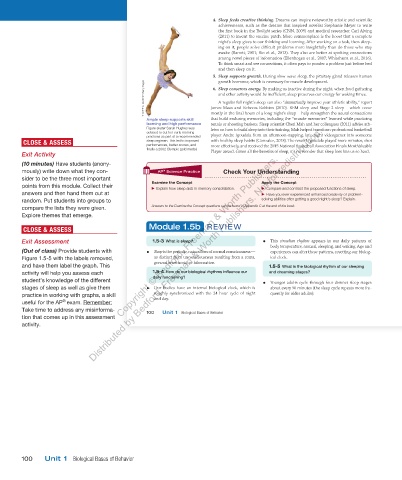
                                                                               A regular full night’s sleep can also “dramatically improve your athletic ability,” report
                                                                             James Maas and Rebecca Robbins (2010). REM sleep and Stage 2 sleep — which occur
                                                                             that build enduring memories, including the “muscle memories” learned while practicing
                                                        Ample sleep supports skill   mostly in the final hours of a long night’s sleep — help strengthen the neural connections
                                                        learning and high performance    tennis or shooting baskets. Sleep scientist Cheri Mah and her colleagues (2011) advise ath-
                                      Distributed by Bedford, Freeman & Worth Publishers. Not for redistribution.
                                                        Figure skater Sarah Hughes was   letes on how to build sleep into their training. Mah helped transform professional basketball
                                                        advised to cut her early-morning
                                                        practices as part of a recommended   player Andre Igoudala from an afternoon-napping, late-night videogamer into someone
               CLOSE & ASSESS                           sleep regimen. This led to improved   with healthy sleep habits (Gonzalez, 2018). The result? Igoudala played more minutes, shot
                                                        performances, better scores, and
                                                        finally a 2002 Olympic gold medal.  more effectively, and received the 2015 National Basketball Association Finals Most Valuable
               Exit Activity                                                 Player award. Given all the benefits of sleep, it’s no wonder that sleep loss hits us so hard.
               (10 minutes) Have students (anony-
               mously) write down what they con-           AP  Science Practice  Check Your Understanding
                                                             ®
               sider to be the three most important
               points from this module. Collect their    Examine the Concept                 Apply the Concept
                                                                                             ▶
                                                                                              ▶Compare and contrast the proposed functions of sleep.
                                                          ▶Explain how sleep aids in memory consolidation.
                                                         ▶
               answers and then hand them out at                                             ▶ ▶Have you ever experienced enhanced creativity or problem-
               random. Put students into groups to                                           solving abilities after getting a good night’s sleep? Explain.
               compare the lists they were given.        Answers to the Examine the Concept questions can be found in Appendix C at the end of the book.
               Explore themes that emerge.
                                                        Module 1.5b  REVIEW
               CLOSE & ASSESS                  Copyright © Bedford, Freeman & Worth Publishers.
               Exit Assessment                            1.5-3 What is sleep?                •  This  circadian rhythm appears in our daily patterns of
                                                                                                body temperature, arousal, sleeping, and waking. Age and
               (Out of class) Provide students with     •  Sleep is the periodic, natural loss of normal consciousness —     experiences can alter these patterns, resetting our biolog-
               Figure 1.5-5 with the labels removed,      as distinct from unconsciousness resulting from a coma,   ical clock.
               and have them label the graph. This        general anesthesia, or hibernation.   1.5-5 What is the biological rhythm of our sleeping
               activity will help you assess each         1.5-4 How do our biological rhythms influence our   and dreaming stages?
               student’s knowledge of the different       daily functioning?                  •  Younger adults cycle through four distinct sleep stages
               stages of sleep as well as give them     •  Our  bodies have  an  internal biological  clock,  which  is   about every 90 minutes (the sleep cycle repeats more fre-
               practice in working with graphs, a skill     roughly synchronized with the 24-hour cycle of night   quently for older adults):
                            ®
               useful for the AP exam. Remember:          and day.
               Take time to address any misinforma-     100   Unit 1  Biological Bases of Behavior
               tion that comes up in this assessment
               activity.

                                                  03_myersAPpsychology4e_28116_ch01_002_163.indd   100                              15/12/23   9:24 AM


               100   Unit 1  Biological Bases of Behavior


          03_HammerTE4e_47547_ch01_2a_163_4pp.indd   100                                                                        07/02/24   5:25 PM

