


Page 107 - 2024-bfw-MyersAP4e-TE
P. 107
Module 1.5b

                                         Young Adults
                                                        REM sleep increases
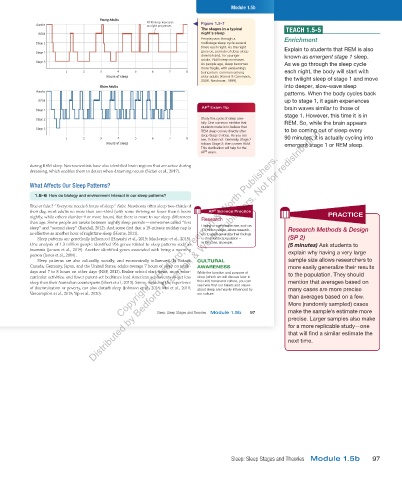
                   Awake                                as night progresses            Figure   1.5-7
                                                                           The stages in a typical   TEACH 1.5-5
                    REM                                                  night’s sleep
                                                                         People pass through a       Enrichment
                   Stage 1                                               multistage sleep cycle several
                                                                         times each night. As the night   Explain to students that REM is also
                   Stage 2                                               goes on, periods of deep sleep
                                                                         diminish and, for younger   known as emergent stage 1 sleep.
                                                                         adults, REM sleep increases.
                   Stage 3
                                                                         As people age, sleep becomes   As we go through the sleep cycle
                                                                         more fragile, with awakenings
                             1     2    3     4     5    6     7     8   being more common among     each night, the body will start with
                                           Hours of sleep                older adults ( Kamel & Gammack,   the twilight sleep of stage 1 and move
                                                                         2006 ;  Neubauer, 1999 ).
                                        Older Adults                                                 into deeper, slow-wave sleep
                                                                                                     patterns. When the body cycles back
                   Awake
                                                                                                     up to stage 1, it again experiences
                    REM
                                                                            AP  Exam Tip             brain waves similar to those of
                                                                           ®
                   Stage 1
                                                                                                     stage 1. However, this time it is in
                   Stage 2                                                 Study this cycle of sleep care-
                                                                         fully. One common mistake that   REM. So, while the brain appears
                                      Distributed by Bedford, Freeman & Worth Publishers. Not for redistribution.
                                                                         students make is to believe that
                   Stage 3                                                                           to be coming out of sleep every
                                                                         REM sleep comes directly after
                                                                         deep Stage 3 sleep. As you can
                             1     2    3     4     5    6     7     8   see, it does not. Generally, Stage 2   90 minutes, it is actually cycling into
                                           Hours of sleep                follows Stage 3; then comes REM.   emergent stage 1 or REM sleep.
                                                                         This clarification will help for the
                                                                           ®
                                                                         AP  exam.
                                               Copyright © Bedford, Freeman & Worth Publishers.
                 during REM sleep. Neuroscientists have also identified brain regions that are active during
                 dreaming, which enables them to detect when dreaming occurs ( Siclari et al., 2017 ).
                    What Affects Our Sleep Patterns?

                        How do biology and envir
                                                            ns?
                               1.5-6   How do biology and environment interact in our sleep patterns?

                               1.5-6
                                       onment interact in our sleep patter

                   True or false? “Everyone needs 8 hours of sleep.”  False.  Newborns often sleep two-thirds of
                 their day, most adults no more than one-third (with some thriving on fewer than 6 hours   AP  Science Practice
                                                                              ®
                 nightly, while others slumber 9 or more hours). But there is more to our sleep differences         Research      PRACTICE
                 than age. Some people are awake between nightly sleep periods — sometimes called “first
                 sleep” and “second sleep” ( Randall, 2012 ). And some find that a 15-minute midday nap is     Having a huge sample size, such as   Research Methods & Design
                                                                          1.3 million people, allows research-
                 as effective as another hour of nighttime sleep ( Horne, 2011 ).   ers to easily generalize their findings
                      Sleep patterns are genetically influenced ( Hayashi et al., 2015 ;  Mackenzie et al., 2015 ).   to the intended population —   (SP 2)
                 One analysis of 1.3 million people identified 956 genes related to sleep patterns such as   in this case, all people.     (5 minutes) Ask students to
                 insomnia  ( Jansen et al., 2019 ). Another identified genes associated with being a morning   explain why having a very large
                 person ( Jones et al., 2019 ).
                        Sleep patterns are also culturally, socially, and economically influenced. In Britain,       CULTURAL   sample size allows researchers to
                   Canada, Germany, Japan, and the United States, adults average 7 hours of sleep on work-  AWARENESS    more easily generalize their results
                 days and 7 to 8 hours on other days ( NSF, 2013 ). Earlier school start times, more extra-    While the function and purpose of   to the population. They should
                 curricular activities, and fewer parent-set bedtimes lead American adolescents to get less   sleep (which we will discuss later in
                 sleep than their Australian counterparts ( Short et al., 2013 ). Stress, including the experience   this unit) transcend culture, you can   mention that averages based on
                                                                        see here that our beliefs and values
                 of discrimination or poverty, can also disturb sleep ( Johnson et al., 2018 ;  Mai et al., 2019 ;   about sleep are heavily influenced by   many cases are more precise
                     Vancampfort et al., 2018 ;  Yip et al., 2020 ).    our culture.
                                                                                                      than averages based on a few.
                                                                                                      More (randomly sampled) cases
                                                           Sleep: Sleep Stages and Theories  Module 1.5b   97  make the sample’s estimate more
                                                                                                      precise. Larger samples also make
                                                                                                      for a more replicable study—one
                                                                                                      that will find a similar estimate the
         03_myersAPpsychology4e_28116_ch01_002_163.indd   97                              15/12/23   9:24 AM
                                                                                                      next time.


                                                                                   Sleep: Sleep Stages and Theories Module 1.5b   97


          03_HammerTE4e_47547_ch01_2a_163_4pp.indd   97                                                                         07/02/24   5:25 PM

