


Page 103 - 2024-bfw-MyersAP4e-TE
P. 103
Module 1.5b

                       Module 1.5b          Sleep: Sleep Stages
                                                                                                     INTRODUCE THE MODULE
                                          and Theories                                               Make It Meaningful

                                                                                                      (Out of class) Have students
                         LEARNING TARGETS
                                                                                                      calculate roughly how much of
                        1.5-3        Explain  sleep  as a state of consciousness.
                                                                                                      their lives they have spent sleeping.
                       1.5-4         Explain how our biological rhythms influence our daily functioning.
                                                                                                      First, have students interview their
                       1.5-5         Explain the biological rhythm of our sleeping and dreaming stages.      parents or caregivers to find out
                       1.5-6         Explain how biology and environment interact in our sleep patterns.      how many hours of sleep they
                       1.5-7        Explain sleep’s functions.                                        averaged when they were infants
                                                                                                      and toddlers. Then have them note
                                                                                                      their daily bedtimes and wake-up
                                                                                                      times during the school week.


                             1.5-3    What is  sleep?
                       What is

                             1.5-3
                           sleep?
                           sleep?


                       What is
                       What is
                                                                                                      Finally, ask them to keep track of
                                      Distributed by Bedford, Freeman & Worth Publishers. Not for redistribution.
                   We humans have about a 16-hour battery life before we lie down on our comfy wireless   the average daily amount of sleep

                 charging pad and slip into    sleep   While sleeping, we may feel “dead to the world,” but we are
                                    .

                 not. Although the roar of my [ND’s] neighborhood garbage truck leaves me undisturbed, my   they get on the weekend. Do the
                 child’s cry will shatter my sleep. Even when you are deeply asleep, your perceptual window   results surprise them?
                 is open a crack. You move around on your bed, but you manage not to fall out. You maintain
                 a sense of time, perhaps even awakening when you wish without an alarm. And when you
                 sleep, as when awake, you process most information outside your conscious awareness.
                          By recording the brain waves and mus-                                      INTRODUCE THE MODULE
                 cle movements of sleeping participants,
                 and by observing and occasionally wak-                                              Activate Prior Knowledge
                 ing them, researchers are solving some of
                 sleep’s deepest mysteries. Perhaps you can                                           (10 minutes) Begin class with this
                 anticipate some of their discoveries. Are the                                        activity, which asks students to
                 following statements true or false?
                                                                                                      decide if statements are true or false.


                      1. When people dream of performing
                    some activity, their limbs often move in                                          The statements tap into common
                    concert with the dream.                                                           beliefs and misconceptions about

                     2. Older adults sleep more than young                                            psychology. This activity will benefit

                    adults.                    Copyright © Bedford, Freeman & Worth Publishers.       students’ understanding of Module
                     3. Sleepwalkers are acting out their                                             1.5b as they read.


                    dreams.


                     4. Sleep  experts recommend  treating in-                                               M1.5b: Fact or
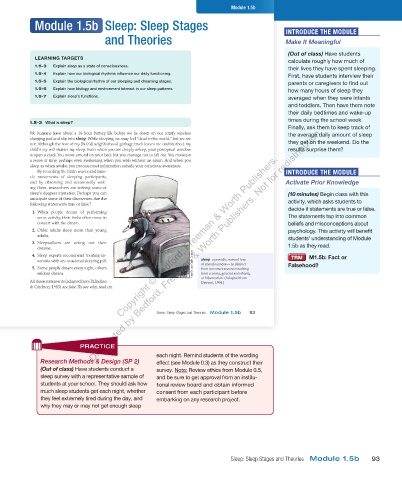
                    somnia with an occasional sleeping pill.           Angel Boligan/Cagle Cartoons        sleep       a periodic, natural loss
                                                                         of consciousness — as distinct


                     5. Some people dream every night; others            from unconsciousness resulting   Falsehood?
                    seldom dream.                                        from a coma, general anesthesia,
                   All these statements (adapted from Palladino          or hibernation. (Adapted from
                                                                          Dement, 1999 .)
                 & Carducci, 1983) are  false. To see why, read on.

                                                           Sleep: Sleep Stages and Theories  Module 1.5b   93
         03_myersAPpsychology4e_28116_ch01_002_163.indd   93                              15/12/23   9:23 AM
                                  PRACTICE
                                                           each night. Remind students of the wording
                     Research Methods & Design (SP 2)      effect (see Module 0.3) as they construct their
                     (Out of class) Have students conduct a   survey. Note: Review ethics from Module 0.5,
                     sleep survey with a representative sample of   and be sure to get approval from an institu-
                     students at your school. They should ask how   tional review board and obtain informed
                     much sleep students get each night, whether   consent from each participant before
                     they feel extremely tired during the day, and   embarking on any research project.
                     why they may or may not get enough sleep
                                                                                   Sleep: Sleep Stages and Theories Module 1.5b   93


          03_HammerTE4e_47547_ch01_2a_163_4pp.indd   93                                                                         07/02/24   5:24 PM

