


Page 104 - 2024-bfw-MyersAP4e-TE
P. 104
Biological Rhythms and Sleep
                                                             ®
                                                           AP  Science Practice
                                                                               Like the ocean, life has its rhythmic tides. Over varying time periods, our bodies fluctuate,
                             PRACTICE                          Research      and with them, our minds. Let’s look more closely at two of those biological rhythms — our
                                                           These studies on circadian   24-hour biological clock and our 90-minute sleep cycle.
                                                         rhythms were correlational:
                Data Interpretation (SP 3)               Researchers measured whether      Circadian Rhythm
                                                         participants were larks or owls,
                (10 minutes) Ask students                and then measured variables such         1.5-4   How do our biological rhythms influence our daily functioning?
                                                         as creativity and punctuality. As
                                                                                   How do our biological rhythms influence our daily functioning?

                                                                                    1.5-4


                to demonstrate their data                a result, they can’t conclude that
                                                         being a lark or an owl  causes  the
                interpretation skills by creating        reported differences. Drawing     The rhythm of the day parallels the rhythm of life — from our waking at a new day’s birth
                a histogram (or bar chart) of the        causal inferences would require   to our nightly return to what Shakespeare called “death’s counterfeit.” Our bodies roughly
                                                         random assignment.
                                                                             synchronize with the 24-hour cycle of day and night thanks to an internal biological clock
                finding that owls are more creative                          called the   circadian rhythm  (from the Latin  circa,  “about,” and  diem,  “day”). As morning

                than larks. You can have them do                             nears, body temperature rises; it then peaks during the day, dips for a time in the early after-
                this individually or in pairs. They                          noon (when many people take siestas), and begins to drop again in the evening. Thinking
                                                                             is sharpest and memory most accurate as we approach our daily peak in circadian arousal.
                should label the x-axis Larks and                            Have you ever pulled an all-nighter? You might remember feeling groggiest in the middle of
                Owls, and should label the y-axis                            the night, but gaining a sense of new alertness with the arrival of your normal wake-up time.
                                                                                     Age and experience can alter our circadian rhythm. Most 20-year-olds are evening-
                                                                             Eric Isselée/Shutterstock    older adults experience more fragile sleep and are morning-loving “larks.” For our ances-
                Amount of Creativity.                                        energized “owls,” with performance improving across the day (May & Hasher, 1998). Most
                                      Distributed by Bedford, Freeman & Worth Publishers. Not for redistribution.
                                                                             tors (and for today’s hunter-gatherers), a grandparent who awakened easily and early
                                                                             helped protect the family from predators ( Samson et al., 2017 ). By mid-evening, when the
                                                                             night has hardly begun for many young adults, retirement homes are typically quiet. After
               TEACH 1.5-4                                                   about age 20 (slightly earlier for women), we gradually shift from being owls to being larks
                                                                             ( Roenneberg et al., 2004 ). Night owls tend to be smart and creative ( Giampietro & Cavallera,
               Enrichment                                                    2007 ). Morning types tend to do better in school, take more initiative, be more punctual, and
                                                                                                               ,
                                                                                                                  ,
               Explain to students that there are                            be less vulnerable to depression ( Preckel et al., 2013 ;  Randler   2008  2009;  Werner et al., 2015 ).
               three types of body rhythms:                                               Sleep Stages
                                                                                    1.5-5   What is the biological rhythm of our sleeping and dreaming stages?
               •  Circadian rhythms occur once                                      1.5-5         What is the biological rhythm of our sleeping and dr eaming stages?
                 each day. Our circadian rhythm                                 Peter Chadwick/Science Source      Seeking sleep, we crawl into bed and fake it until we make it. Eventually, sleep overtakes
                 spans 24 hours and is responsible                           us, and consciousness fades as different parts of our brain’s cortex stop communicating
                 for our varying levels of arousal                           (Massimini et al., 2005). Sleep may feel like time-traveling a few hours into the future. Yet
                 throughout the course of a day.                             the sleeping brain remains active and has its own biological rhythm.
                                                                                 About every 90 minutes, you cycle through distinct sleep stages. This fact came to light
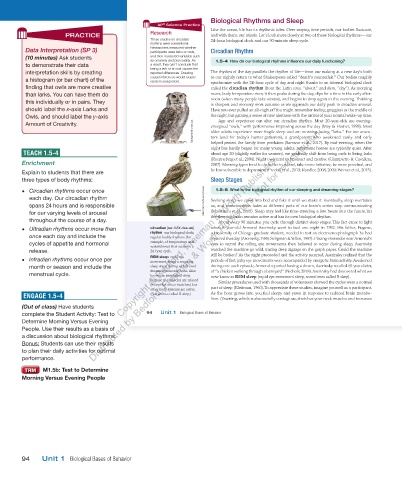
               •  Ultradian rhythms occur more than            circadian     [ser-KAY-dee-an]  when 8-year-old Armond Aserinsky went to bed one night in 1952. His father, Eugene,
                                                                             a University of Chicago graduate student, needed to test an electroencephalograph he had
                                                          rhythm   our biological clock;
                 once each day and include the  Copyright © Bedford, Freeman & Worth Publishers.
                                                         regular bodily rhythms (for
                                                                             repaired that day (Aserinsky, 1988;  Seligman & Yellen, 1987 ). Placing electrodes near Armond’s
                 cycles of appetite and hormonal         example, of temperature and   eyes to record  the rolling eye movements  then believed to occur during sleep, Aserinsky
                                                         wakefulness) that occur on a
                 release.                                24-hour cycle.      watched the machine go wild, tracing deep zigzags on the graph paper. Could the machine
                                                                             still be broken? As the night proceeded and the activity recurred, Aserinsky realized that the
               •  Infradian rhythms occur once per          REM sleep       rapid eye   periods of fast, jerky eye movements were accompanied by energetic brain activity. Awakened
                                                         movement sleep; a recurring
                 month or season and include the         sleep stage during which vivid   during one such episode, Armond reported having a dream, Aserinsky recalled 65 years later,
                 menstrual cycle.                        dreams commonly occur. Also   of “a chicken walking through a barnyard” ( Nichols, 2018 ). Aserinsky had discovered what we
                                                         known as  paradoxical sleep,
                                                                             now know as    REM sleep  ( r apid  e ye  m ovement sleep; sometimes called  R sleep ).

                                                         because the muscles are relaxed
                                                         (except for minor twitches) but         Similar procedures used with thousands of volunteers showed the cycles were a normal
                                                         other body systems are active.   part of sleep ( Kleitman, 1960 ). To appreciate these studies, imagine yourself as a participant.
               ENGAGE 1.5-4                              (Sometimes called  R sleep. )    As the hour grows late, you feel sleepy and yawn in response to reduced brain metabo-
                                                                             lism. (Yawning, which is also socially contagious, stretches your neck muscles and increases
               (Out of class) Have students
               complete the Student Activity: Test to   94   Unit 1  Biological Bases of Behavior
               Determine Morning Versus Evening
               People. Use their results as a basis of
               a discussion about biological rhythms.   03_myersAPpsychology4e_28116_ch01_002_163.indd   94                         15/12/23   4:30 PM
               Bonus: Students can use their results
               to plan their daily activities for optimal
               performance.
                      M1.5b: Test to Determine
               Morning Versus Evening People


               94   Unit 1  Biological Bases of Behavior


          03_HammerTE4e_47547_ch01_2a_163_4pp.indd   94                                                                         07/02/24   5:24 PM

