


Page 100 - 2024-bfw-MyersAP4e-TE
P. 100
bird’s color, form, movement, and distance. One of the grand ideas of today’s cognitive neu-
                                                           ®
                                                         AP  Exam Tip
                                                                             roscience is that much of our brain work occurs off stage, out of sight. Thinking, knowing,
                                                                             remembering, and communicating all operate on two independent levels — a conscious,
                                   ®
                 TEACHING THE AP  TIP                    Dual processing is another one of
                                                         those big ideas that shows up in   deliberate “high road” and an unconscious, automatic “low road.” The high road is reflec-
                                                         several units. Pay attention for the   tive, the low road intuitive — together creating what researchers call  dual  processing
                                                          ®
                                                         AP  exam!           (Kahneman, 2011; Pennycook et al., 2018). We know more than we know we know.
                (10 minutes) Dual processing                                   If you are a driver, consider how you move into the right lane. Drivers know this uncon-
                comes up repeatedly throughout                               sciously but cannot accurately explain it (Eagleman, 2011). Most say they would bank to
                the textbook, so take a moment to                            the right, then straighten out — a procedure that would actually steer them off the road. In
                ensure students understand it by                             reality, an experienced driver, after moving right, automatically reverses the steering wheel
                                                                             just as far to the left of center, only then returning to center. The lesson: The human brain is
                using an application card. On an                             a device for converting conscious into unconscious knowledge.
                index card, have students summa-                               Or consider this story, which illustrates how science can be stranger than science fiction.
                rize dual processing in their own                            During my sojourns at Scotland’s University of St Andrews, I [DM] came to know cogni-
                                                                             tive neuroscientists David Milner and Melvyn Goodale (2008). They studied a local woman,
                words. Then have them write one                              D. F., who suffered brain damage when overcome by carbon monoxide, leaving her unable
                example of dual processing from                              to recognize and discriminate objects visually. Consciously, D. F. could see nothing. Yet she
                their own lives. To make this a                              exhibited blindsight — she acted as though she could see. Asked to slip a postcard into a
                                                                             vertical or horizontal mail slot, she could do so without error. Asked the width of a block
                collaborative learning activity, ask                         in front of her, she was at a loss, but she could grasp it with just the right finger–thumb
                students to swap cards and discuss                           distance. Likewise, if your right and left eyes view different scenes, you will be consciously
                with a partner. Remember: Take                               aware of only one at a time — yet you will display some blindsight awareness of the other
                                                                             (Baker & Cass, 2013).
                time to address any misinformation                                                     How could this be? Don’t we have one visual
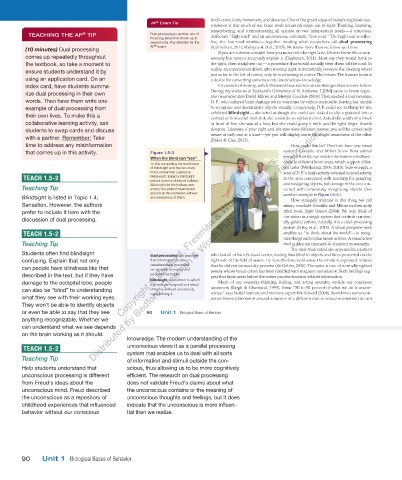
                that comes up in this activity.          Figure 1.5-3                               system? Goodale and Milner knew from animal
                                                         When the blind can “see”                   research that the eye sends information simultane-
                                                          In this compelling demonstration          ously to different brain areas, which support differ-
                                                         of blindsight and the two-track            ent tasks (Weiskrantz, 2009, 2010). Sure enough, a
                                                         mind, researcher Lawrence                  scan of D. F.’s brain activity revealed normal activity
               TEACH 1.5-2                               Weiskrantz trailed a blindsight            in the area concerned with reaching for, grasping,
                                                         patient down a cluttered hallway.
                                                         Although told the hallway was              and navigating objects, but damage in the area con-
               Teaching Tip                              empty, the patient meandered               cerned with consciously recognizing objects. (See
                                                         around all the obstacles without           another example in Figure 1.5-3.)
               Blindsight is listed in Topic 1.4,        any awareness of them.                        How strangely intricate is this thing we call
               Sensation. However, the authors                                                      vision, conclude Goodale and Milner in their aptly
               prefer to include it here with the                                                   titled book, Sight Unseen (2004). We may think of
               discussion of dual processing.                                                       our vision as a single system that controls our visu-
                                                                                                    ally guided actions. Actually, it is a dual-processing
                                                                                                    system (Foley et al., 2015). A visual perception track
               TEACH 1.5-2                     Copyright © Bedford, Freeman & Worth Publishers.     enables us “to think about the world” — to recog-
                                                                                                    nize things and to plan future actions.  A visual action
               Teaching Tip           Distributed by Bedford, Freeman & Worth Publishers. Not for redistribution.
                                                                                                    track guides our moment-to-moment movements.
                                                                                                       The dual-track mind also appeared in a patient
               Students often find blindsight
                                                         dual processing  the principle   who lost all of his left visual cortex, leaving him blind to objects and faces presented on the
               confusing. Explain that not only          that information is often   right side of his field of vision. He nevertheless could sense the emotion expressed in faces
                                                         simultaneously processed   that he did not consciously perceive (de Gelder, 2010). The same is true of normally sighted
               can people have blindness like that       on separate conscious and   people whose visual cortex has been disabled with magnetic stimulation. Such findings sug-
               described in the text, but if they have   unconscious tracks.  gest that brain areas below the cortex process emotion-related information.
               damage to the occipital lobe, people      blindsight  a condition in which   Much  of  our  everyday  thinking,  feeling,  and  acting  operates  outside  our  conscious
                                                         a person can respond to a visual
               can also be “blind” to understanding      stimulus without consciously   awareness (Bargh & Chartrand, 1999). Some “80 to 90 percent of what we do is uncon-
                                                         experiencing it.    scious,” says Nobel laureate and memory expert Eric Kandel (2008). Sometimes our uncon-
               what they see with their working eyes.                        scious biases (discomfort around someone of a different race or sexual orientation) do not
               They won’t be able to identify objects
               or even be able to say that they see     90   Unit 1  Biological Bases of Behavior
               anything recognizable. Whether we
               can understand what we see depends
               on the brain working as it should.
                                                 knowledge. The modern understanding of the                                         15/12/23   9:23 AM
                                                  03_myersAPpsychology4e_28116_ch01_002_163.indd   90
               TEACH 1.5-2                       unconscious views it as a parallel  processing
                                                 system that enables us to deal with all sorts
               Teaching Tip                      of information and stimuli outside the con-
               Help students understand that     scious, thus allowing us to be more cognitively
               unconscious processing is  different   efficient. The research on dual processing
               from Freud’s ideas about the      does not validate Freud’s claims about what
                 unconscious mind. Freud described   the unconscious contains or the meaning of
               the unconscious as a repository of   unconscious thoughts and  feelings, but it does
               childhood experiences that  influenced   indicate that the  unconscious is more influen-
               behavior without our conscious    tial than we realize.


               90   Unit 1  Biological Bases of Behavior


          03_HammerTE4e_47547_ch01_2a_163_4pp.indd   90                                                                         07/02/24   5:24 PM

