


Page 98 - 2024-bfw-MyersAP4e-TE
P. 98
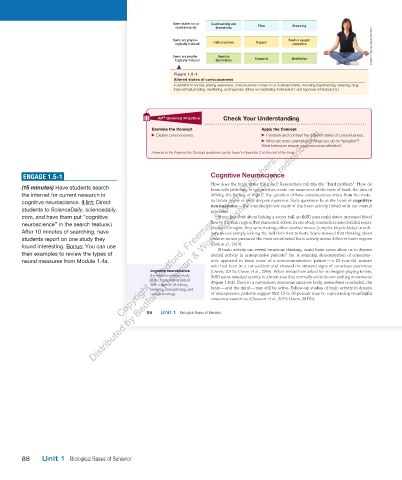
Some states occur  Daydreaming and  Flow  Dreaming
                                                                 spontaneously  drowsiness
                                                                                                                                 INSADCO Photography/Alamy Stock Photo
                                                                Some are physio-                      Food or oxygen
                                                                      logically induced  Hallucinations  Orgasm  starvation
                                                                Some are psycho-  Sensory
                                                                     logically induced  deprivation  Hypnosis  Meditation

                                                                Figure 1.5-1
                                                                Altered states of consciousness
                                                                In addition to normal, waking awareness, consciousness comes to us in altered states, including daydreaming, sleeping,   drug-
                                                                induced hallucinating, meditating, and hypnosis. (More on meditating in Module 5.1 and hypnosis in Module 5.5.)


                                                             ®
                                                           AP  Science Practice  Check Your Understanding
                                      Distributed by Bedford, Freeman & Worth Publishers. Not for redistribution.
                                                         Examine the Concept                 Apply the Concept
                                                         ▶ ▶Explain consciousness.           ▶ ▶Compare and contrast the different states of consciousness.
                                                                                             ▶ ▶What are some examples of things you do on “autopilot”?
                                                                                             What behaviors require your conscious attention?
                                                         Answers to the Examine the Concept questions can be found in Appendix C at the end of the book.


               ENGAGE 1.5-1                                                  Cognitive Neuroscience
                                                                             How does the brain make the mind? Researchers call this the “hard problem”: How do
               (15 minutes) Have students search                             brain cells jabbering to one another create our awareness of the taste of toast, the idea of
               the internet for current research in                          infinity, the feeling of fright? The question of how consciousness arises from the mate-
               cognitive neuroscience. (Hint: Direct                         rial brain is one of life’s deepest mysteries. Such questions lie at the heart of cognitive
                                                                             neuroscience — the interdisciplinary study of the brain activity linked with our mental
               students to ScienceDaily, sciencedaily.                       processes.
               com, and have them put “cognitive                               If you just think about kicking a soccer ball, an fMRI scan could detect increased blood
               neuroscience” in the search feature.)                         flow to the brain region that plans such action. In one study, researchers asked skilled soccer
                                                                             players to imagine they were making either creative moves (complex bicycle kicks) or ordi-
               After 10 minutes of searching, have  Copyright © Bedford, Freeman & Worth Publishers.
                                                                             nary moves (simply kicking the ball from foot to foot). Scans showed that thinking about
               students report on one study they                             creative moves produced the most coordinated brain activity across different brain regions
               found interesting. Bonus: You can use                         (Fink et al., 2019).
                                                                               If brain activity can reveal conscious thinking, could brain scans allow us to discern
               their examples to review the types of                         mental activity in  unresponsive  patients?  Yes. A stunning  demonstration  of  conscious-
               neural measures from Module 1.4a.                             ness  appeared  in  brain  scans  of  a  noncommunicative  patient — a 23-year-old woman
                                                                             who had been in a car accident and showed no outward signs of conscious awareness
                                                         cognitive neuroscience     (Owen, 2017a; Owen et al., 2006). When researchers asked her to imagine playing tennis,
                                                         the interdisciplinary study   fMRI scans revealed activity in a brain area that normally controls arm and leg movements
                                                         of the brain activity linked
                                                         with cognition (thinking,   (Figure 1.5-2). Even in a motionless, noncommunicative body, researchers concluded, the
                                                         knowing, remembering, and   brain — and the mind — may still be active. Follow-up studies of brain activity in dozens
                                                         communicating).     of unresponsive patients suggest that 15 to 30 percent may be experiencing meaningful
                                                                             conscious awareness (Claassen et al., 2019; Owen, 2017b).
                                                        88   Unit 1  Biological Bases of Behavior


                                                  03_myersAPpsychology4e_28116_ch01_002_163.indd   88                               15/12/23   9:23 AM


               88   Unit 1  Biological Bases of Behavior


          03_HammerTE4e_47547_ch01_2a_163_4pp.indd   88                                                                         07/02/24   5:24 PM

