


Page 93 - 2024-bfw-MyersAP4e-TE
P. 93
Module 1.4c

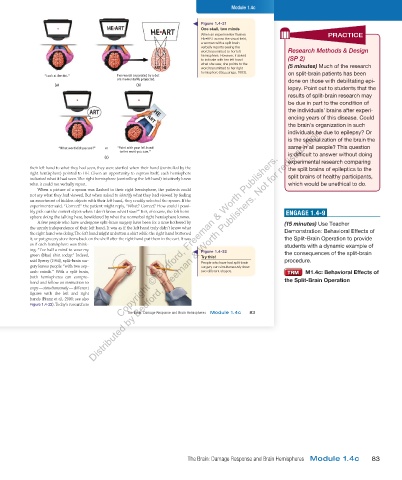
                                                                         Figure 1.4-21
                                                                         One skull, two minds
                                                                         When an experimenter flashes              PRACTICE
                                                                         HE•ART across the visual field,
                                                                         a woman with a split brain
                                                                         verbally reports seeing the
                                                                         word transmitted to her left   Research Methods & Design
                                                                         hemisphere. However, if asked
                                                                         to indicate with her left hand   (SP 2)
                                                                         what she saw, she points to the
                                                                         word transmitted to her right   (5 minutes) Much of the research
                                                                         hemisphere (Gazzaniga, 1983).  on split-brain patients has been
                      “Look at the dot.”      Two words separated by a dot
                                              are momentarily projected.                              done on those with debilitating epi-
                          (a)                       (b)
                                                                                                      lepsy. Point out to students that the
                                                                                                      results of split-brain research may
                                                                                                      be due in part to the condition of
                                                                                                      the individuals’ brains after experi-
                                                                                                      encing years of this disease. Could
                                                                                                      the brain’s organization in such
                                                                                                      individuals be due to epilepsy? Or
                                                                                                      is the specialization of the brain the
                           “What word did you see?”  or  “Point with your left hand                   same in all people? This question
                                               to the word you saw.”
                                               Copyright © Bedford, Freeman & Worth Publishers.
                                          (c)                                                         is difficult to answer without doing
                                                                                                      experimental research comparing
                 their left hand to what they had seen, they were startled when their hand (controlled by the   the split brains of epileptics to the
                 right hemisphere) pointed to HE. Given an opportunity to express itself, each hemisphere
                 indicated what it had seen. The right hemisphere (controlling the left hand) intuitively knew   split brains of healthy participants,
                 what it could not verbally report.                                                   which would be unethical to do.
                    When a picture of a spoon was flashed to their right hemisphere, the patients could
                 not say what they had viewed. But when asked to identify what they had viewed by feeling
                 an assortment of hidden objects with their left hand, they readily selected the spoon. If the
                 experimenter said, “Correct!” the patient might reply, “What? Correct? How could I possi-
                 bly pick out the correct object when I don’t know what I saw?” It is, of course, the left hemi-  ENGAGE 1.4-9
                 sphere doing the talking here, bewildered by what the nonverbal right hemisphere knows.
                    A few people who have undergone split-brain surgery have been for a time bothered by   (15 minutes) Use Teacher
                 the unruly independence of their left hand. It was as if the left hand truly didn’t know what
                 the right hand was doing. The left hand might unbutton a shirt while the right hand buttoned   Demonstration: Behavioral Effects of
                 it, or put grocery store items back on the shelf after the right hand put them in the cart. It was   the Split-Brain Operation to provide
                 as if each hemisphere was think- Distributed by Bedford, Freeman & Worth Publishers. Not for redistribution.
                                                                                                     students with a dynamic example of
                 ing, “I’ve half a mind to wear my                       Figure 1.4-22
                 green (blue) shirt today.” Indeed,                      Try this!                   the consequences of the split-brain
                 said Sperry (1964), split-brain sur-                    People who have had split-brain   procedure.
                 gery leaves people “with two sep-                       surgery can simultaneously draw
                 arate minds.” With a split brain,                       two different shapes.              M1.4c: Behavioral Effects of
                 both hemispheres can compre-
                 hend and follow an instruction to                                                   the Split-Brain Operation
                 copy — simultaneously —  different
                 figures with the left and right
                 hands (Franz et al., 2000; see also
                 Figure 1.4-22). Today’s researchers
                                                 The Brain: Damage Response and Brain Hemispheres  Module 1.4c   83


         03_myersAPpsychology4e_28116_ch01_002_163.indd   83                              15/12/23   9:23 AM


                                                                     The Brain: Damage Response and Brain Hemispheres Module 1.4c   83


          03_HammerTE4e_47547_ch01_2a_163_4pp.indd   83                                                                         07/02/24   5:23 PM

