


Page 90 - 2024-bfw-MyersAP4e-TE
P. 90
Module   1.4c        The Brain: Damage Response
               INTRODUCE THE MODULE

               Make It Meaningful                                               and Brain Hemispheres
                (10 minutes) The myth that some
                people are “right-brained” while                                    LEARNING TARGETS
                others are “left-brained” is still                                 1.4-8         Explain how a damaged brain can reorganize itself, and describe  neurogenesis.


                prevalent in popular media. Ask                                   1.4-9           Explain what split brains reveal about the functions of our two brain
                students if they have heard this                                    hemispheres.
                information presented as fact
                before and, if so, where and
                how. Use their responses to                                        Responses to Damage
                introduce what they will learn in
                                                                                          1.4-8   To what extent can a damaged brain reorganize itself, and what is
                this module: Although the brain                                           1.4-8   T       o what extent can a damaged brain r eorganize itself, and what is
                                                                              neurogenesis?
                has hemispheric specialization, the                           neurogenesis?
                                      Distributed by Bedford, Freeman & Worth Publishers. Not for redistribution.
                brain acts as a whole.                                         Earlier, we learned about  neuroplasticity —  how our brain adapts to new situations. What
                                                                             happens when we experience mishaps, large and small? Let’s explore the brain’s ability to
                                                                             modify itself after damage.
                                                                                 Most brain-damage effects described earlier can be traced to two hard facts: (1) Severed
                                                                             brain and spinal cord neurons, unlike cut skin, usually do not regenerate. (If your spinal cord
                                                                             seem preassigned to specific areas. One newborn who suffered damage to a temporal lobe
               INTRODUCE THE MODULE                                          were severed, you would probably be permanently paralyzed.) And (2) some brain functions
                                                                             area responsible for facial recognition was never able to recognize faces ( Farah et al., 2000 ).
               Activate Prior Knowledge                                      But there is good news: Some neural tissue can  reorganize  in response to damage.
                                                                                 Neuroplasticity may also occur after serious damage, especially in young children
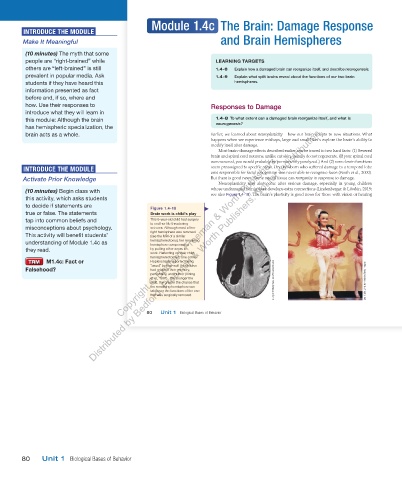
                (10 minutes) Begin class with                                whose undamaged hemisphere develops extra connections (Lindenberger & Lövdén, 2019;

                                                                             see also   Figure 1.4-18 ). The brain’s plasticity is good news for those with vision or hearing


                this activity, which asks students       by putting other areas to Freeman & Worth Publishers.
                to decide if statements are                        Figure   1.4-18
                true or false. The statements              Brain work is child’s play
                tap into common beliefs and              This 6-year-old child had surgery
                                                         to end her life-threatening
                misconceptions about psychology.         seizures. Although most of her
                This activity will benefit students’     right hemisphere was removed
                                                         (see the MRI of a similar
                understanding of Module 1.4c as          hemispherectomy), her remaining
                                                         hemisphere compensated
                                               Copyright © Bedford,                              Living Art Enterprises, LLC/Science Source  Joe McNally/Hulton Archive/Getty Images
                they read.                               work. Reflecting on their child
                       M1.4c: Fact or                    hemispherectomies, one Johns
                                                         Hopkins team reported being
                Falsehood?                               “awed” by how well the children
                                                         had retained their memory,
                                                         personality, and humor (Vining
                                                         et al., 1997). The younger the
                                                         child, the greater the chance that
                                                         the remaining hemisphere can
                                                         take over the functions of the one
                                                         that was surgically removed.
                                                        80   Unit 1  Biological Bases of Behavior

                                                  03_myersAPpsychology4e_28116_ch01_002_163.indd   80                               15/12/23   9:23 AM


               80   Unit 1  Biological Bases of Behavior


          03_HammerTE4e_47547_ch01_2a_163_4pp.indd   80                                                                         07/02/24   5:23 PM

