


Page 85 - 2024-bfw-MyersAP4e-TE
P. 85
Module 1.4b

                 the phantom ringing (“tinnitus”) sound experienced by people with hearing loss is — if
                 heard in one ear — associated with activity in the temporal lobe on the brain’s opposite side
                  ( Muhlnickel, 1998 ).
                                                                                                                   PRACTICE
                       Association Areas
                   So far, we have pointed out small cortical areas that either receive sensory input or direct   Argumentation (SP 4)
                 muscular output.  Together, these occupy about one-fourth of the human brain’s thin,   (Times vary) The “Developing
                 wrinkled cover. What, then, goes on in the remaining vast regions of the cortex? In these         association areas       areas of
                   association areas,  neurons are busy with higher mental functions — many of the tasks that   the cerebral cortex that are not   Arguments Questions” included
                 make us human.                                          involved in primary motor or   here are designed to enhance stu-
                          Electrically probing an association area won’t trigger any observable response. So, unlike   sensory functions, but rather
                 the somatosensory and motor areas, association area functions cannot be neatly mapped.   are involved in higher mental   dents’ argumentation skills, which
                                                                         functions such as learning,
                                                                                                                           ®
                 Does this mean we don’t use them — or that, as some 4 in 10 people agreed in two surveys,   remembering, thinking, and   will be assessed on the AP  exam.
                 “We use only 10 percent of our brains” ( Furnham, 2018 ;  Macdonald et al., 2017 )? (See the   speaking.    Students should be able to identify
                 Developing Arguments feature: Do We Use Only 10 Percent of Our Brain?)
                                                                                                      the reasoning behind claims and
                                                                                                      use scientifically derived evidence
                                                                                                      to support or refute conclusions.
                       ®
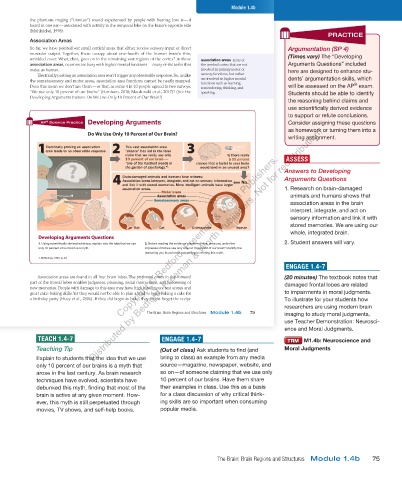
                     AP  Science Practice  Developing Arguments                                       Consider assigning these questions
                                      Distributed by Bedford, Freeman & Worth Publishers. Not for redistribution.
                                                                                                      as homework or turning them into a
                                    Do We Use Only 10 Percent of Our Brain?                           writing assignment.
                       Electrically probing an association  2  This vast association area  3
                    1 1 area leads to no observable response.    “silence” has led to the false
                                                 claim that we really use only    Is there really
                                                 10 percent of our brain —        a 90 percent       ASSESS
                                                 “one of the hardiest weeds in  chance that a bullet to your brain
                                                 the garden of psychology.” 1  would land in an unused area?  Answers to Developing
                                             4  Brain-damaged animals and humans bear witness:  No.   Arguments Questions
                                                Association areas interpret, integrate, and act on sensory information
                                                and link it with stored memories. More intelligent animals have larger
                                                association areas.                                   1.  Research on brain-damaged
                                                            Motor areas
                                                           Association areas                           animals and humans shows that
                                                          Somatosensory areas
                                                                                                       association areas in the brain
                                                                                                       interpret, integrate, and act on
                                                                                                       sensory information and link it with
                                                                                                       stored memories. We are using our
                                                                                     Human
                                                            Cat
                                                   Rat      Cat       Chimpanzee     Human
                                                            Cat
                                                                                     Human
                                                                      Chimpanzee
                                                                                                       whole, integrated brain.
                        Developing Arguments Questions
                    1. McBurney, 1996, p. 44.    Copyright © Bedford, Freeman & Worth Publishers.
                          1.   Using scientifically derived evidence, explain why the idea that we use     2.   Before reading the evidence presented here, were you under the   2. Student answers will vary.
                    only 10 percent of our brain is a myth.     impression that we use only around 10 percent of our brain? Identify the
                                                       reasoning you found most compelling in refuting this myth.
                    1. McBurney, 1996, p. 44.
                                                                                                     ENGAGE 1.4-7
                                 Association areas are found in all four brain lobes. The  prefrontal cortex  in the forward   (20 minutes) The textbook notes that
                 part of the frontal lobes enables judgment, planning, social interactions, and processing of   damaged frontal lobes are related
                 new memories. People with damage to this area may have high intelligence test scores and
                 great cake-baking skills. Yet they would not be able to plan ahead to  begin  baking a cake for   to impairments in moral judgments.
                 a birthday party ( Huey et al., 2006 ). If they did begin to bake, they might forget the recipe   To illustrate for your students how
                                                                                                     researchers are using modern brain
                                                        The Brain: Brain Regions and Structures  Module 1.4b   75  imaging to study moral judgments,
                                                                                                     use Teacher Demonstration: Neurosci-
                                                                                                     ence and Moral Judgments.
                    TEACH 1.4-7
         03_myersAPpsychology4e_28116_ch01_002_163.indd   75  ENGAGE 1.4-7                15/12/23   9:23 AM  M1.4b: Neuroscience and
                    Teaching Tip                            (Out of class) Ask students to find (and   Moral Judgments
                    Explain to students that the idea that we use   bring to class) an example from any media
                    only 10 percent of our brains is a myth that   source—magazine, newspaper, website, and
                    arose in the last century. As brain research   so on—of someone claiming that we use only
                    techniques have evolved, scientists have   10 percent of our brains. Have them share
                    debunked this myth, finding that most of the   their examples in class. Use this as a basis
                    brain is active at any given moment. How-  for a class discussion of why critical think-
                    ever, this myth is still perpetuated through   ing skills are so important when consuming
                    movies, TV shows, and self-help books.  popular media.


                                                                               The Brain: Brain Regions and Structures Module 1.4b   75


          03_HammerTE4e_47547_ch01_2a_163_4pp.indd   75                                                                         07/02/24   5:23 PM

