


Page 82 - 2024-bfw-MyersAP4e-TE
P. 82
stimulating parts of this region in the left or right hemisphere caused movements of specific
                                                                             body parts on the opposite side of the body. Fritsch and Hitzig had discovered what is now
               TEACH 1.4-7                                                   called the motor cortex.
               Teaching Tip                                                  Mapping the Motor Cortex  Luckily for brain surgeons and their patients, the brain has
                                                                             no sensory receptors. Knowing this, in the 1930s, Otfrid Foerster and Wilder Penfield were
               Walk through Figure 1.4-13 with your                          able to map the motor cortex in hundreds of wide-awake patients by stimulating different
               students. It features the sensory                             cortical areas and observing the body’s responses. They discovered that body areas requiring
               homunculus, the visual picture of                             precise control, such as the fingers and mouth, occupy the greatest amount of cortical space
                                                                             (Figure 1.4-13). In one of his many demonstrations of motor behavior mechanics, Spanish
               how much space in the motor and                               neuroscientist José Delgado stimulated a spot on a patient’s left motor cortex, triggering the
               somatosensory cortexes each part of                           right hand to make a fist. Asked to keep the fingers open during the next stimulation, the
               the body takes up. These diagrams                             patient, whose fingers closed despite his best efforts, remarked, “I guess, Doctor, that your
                                                                             electricity is stronger than my will” (Delgado, 1969, p. 114).
               show dramatically how much cortex
               is devoted to complex areas of the
               body such as the face and hands and                        Elbow Arm Shoulder  Torso  Hip  Hip  Torso  Neck  Arm Head
               how little is devoted to rather simple                Hand  Wrist    Knee         Knee        Elbow  Forearm  Hand  Fingers
               areas such as the leg and elbow. The           Fingers                Ankle       Leg
                                      Distributed by Bedford, Freeman & Worth Publishers. Not for redistribution.
               amount of space occupied on the               Thumb                              Foot                  Thumb
                                                                                                 Toes
               homunculus is directly related to each       Brow                     Toes      Genitals                 Eye  Nose
                                                             Neck
                                                            Eye                                                           Face
               area’s sensitivity.
                                                                      Output: Motor cortex           Input: Somatosensory cortex
                                                           Face
                                                                      (Right hemisphere section      (Left hemisphere section receives  Lips
                                                                      controls the body’s left side)  input from the body’s right side)
                                                          Lips
               TEACH 1.4-7                                                                                                 Jaw
               Enrichment                                  Jaw
               Share the following information with         Tongue                                                     Pharynx Tongue
               your students. Wilder Penfield, a               Swallowing                                         abdominal    Science Source/Macmillan
                                                                                                                   Intra-
               famous neurosurgeon, along with his
               colleague Herbert Jasper, perfected
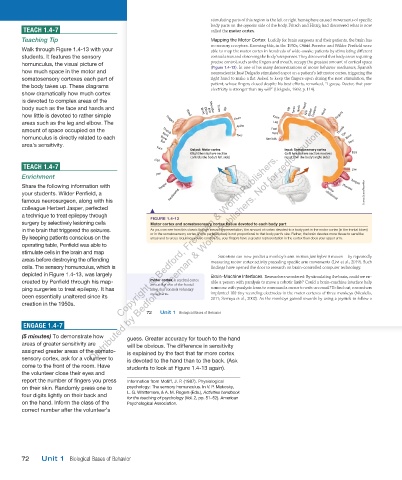
               a technique to treat epilepsy through     FIGURE 1.4-13
               surgery by selectively lesioning cells    Motor cortex and somatosensory cortex tissue devoted to each body part
               in the brain that triggered the seizures.   As you can see from this classic though inexact representation, the amount of cortex devoted to a body part in the motor cortex (in the frontal lobes)
                                                         or in the somatosensory cortex (in the parietal lobes) is not proportional to that body part’s size. Rather, the brain devotes more tissue to sensitive
               By keeping patients conscious on the  Copyright © Bedford, Freeman & Worth Publishers.
                                                         areas and to areas requiring precise control. So, your fingers have a greater representation in the cortex than does your upper arm.
               operating table, Penfield was able to
               stimulate cells in the brain and map
                                                                               Scientists can now predict a monkey’s arm motion just before it moves — by repeatedly
               areas before destroying the offending                         measuring motor cortex activity preceding specific arm movements (Livi et al., 2019). Such
               cells. The sensory homunculus, which is                       findings have opened the door to research on brain-controlled computer technology.
               depicted in Figure 1.4-13, was largely                        Brain–Machine Interfaces  Researchers wondered: By stimulating the brain, could we en-
               created by Penfield through his map-      motor cortex  a cerebral cortex   able a person with paralysis to move a robotic limb? Could a brain–machine interface help
                                                         area at the rear of the frontal
               ping surgeries to treat epilepsy. It has   lobes that controls voluntary   someone with paralysis learn to command a cursor to write an email? To find out,  researchers
               been essentially unaltered since its      movements.          implanted 100 tiny recording electrodes in the motor cortexes of three monkeys (Nicolelis,
                                                                             2011; Serruya et al., 2002). As the monkeys gained rewards by using a joystick to follow a
               creation in the 1950s.
                                                        72   Unit 1  Biological Bases of Behavior

               ENGAGE 1.4-7
               (5 minutes) To demonstrate how    guess. Greater accuracy for touch to the hand                                      15/12/23   9:23 AM
                                                  03_myersAPpsychology4e_28116_ch01_002_163.indd   72
               areas of greater sensitivity are   will be obvious. The difference in sensitivity
               assigned greater areas of the somato-  is explained by the fact that far more cortex
               sensory cortex, ask for a volunteer to   is devoted to the hand than to the back. (Ask
               come to the front of the room. Have   students to look at Figure 1.4-13 again).
               the volunteer close their eyes and
               report the number of fingers you press   Information from Motiff, J. P. (1987). Physiological
               on their skin. Randomly press one to   psychology: The sensory homunculus. In V. P. Makosky,
               four digits lightly on their back and   L. G. Whittemore, & A. M. Rogers (Eds.), Activities handbook
                                                 for the teaching of psychology (Vol. 2, pp. 51–52). American
               on the hand. Inform the class of the   Psychological Association.
               correct number after the volunteer’s


               72   Unit 1  Biological Bases of Behavior


          03_HammerTE4e_47547_ch01_2a_163_4pp.indd   72                                                                         07/02/24   5:22 PM

