


Page 77 - 2024-bfw-MyersAP4e-TE
P. 77
Module 1.4b

                 Paul Bucy surgically removed a rhesus monkey’s amygdala, turning the normally  ill-tempered
                                                                              ®
                 animal into the mellowest of creatures. So, too, with humans. People with amygdala lesions   AP  Science Practice
                 often display reduced arousal to fear- and anger-arousing stimuli (Berntson et al., 2011).   Research
                 One woman with an amygdala lesion, patient S. M., has been called “the woman with no   Notice the phrase, “other studies   PRACTICE
                 fear,” even if being threatened with a gun (Feinstein et al., 2013).  link criminal behavior with amygdala
                    What, then, might happen if we electrically stimulated the amygdala of a normally   dysfunction.” Because researchers
                 placid domestic animal, such as a cat? Do so in one spot and the cat prepares to attack, hiss-  cannot ethically manipulate the   Research Methods & Design
                 ing with its back arched, its pupils dilated, its hair on end. Move the electrode only slightly   variable of amygdala dysfunction,   (SP 2)
                                                                          they cannot draw causal conclu-
                 within the amygdala, cage the cat with a small mouse, and now it cowers in terror.  sions. This is an important point in   (10 minutes) Understanding that
                    These  and  other  experiments  have confirmed  the  amygdala’s  role  in  fear  and  rage.   psychology: Correlation does not
                 Monkeys and humans with amygdala damage become less fearful of strangers (Harrison   equal causation.  the correlational method does not
                 et al., 2015). Other studies link criminal behav-                                    allow for a cause-effect conclusion
                 ior with amygdala dysfunction (Dotterer et al.,                                      is important for students. Take time
                 2017; Ermer et al., 2012a).
                    But we must be careful. The brain is not                                          here to point that out. Ask students
                 neatly organized into structures that corre-                                         what the researchers would need
                 spond to our behavior categories. The amyg-                                          to do to infer causation. In this
                 dala is engaged with other mental phenomena
                 as well. And when we feel afraid or act aggres-                                      case, they would need to utilize
                 sively, neural activity occurs in many areas                                         the experimental method by
                                      Distributed by Bedford, Freeman & Worth Publishers. Not for redistribution.
                 of our brain — not just the amygdala. If you         GK Hart/Vikki Hart/Getty Images          randomly assigning participants
                 destroy a car’s battery, the car won’t run. But
                 the battery is merely one link in an integrated                                      to conditions of an independent
                 system.                                                                              variable and then measuring the
                                               Copyright © Bedford, Freeman & Worth Publishers.
                                                                                                      dependent variable. Sometimes,
                 The Hypothalamus                                                                     as is the case here, ethics would
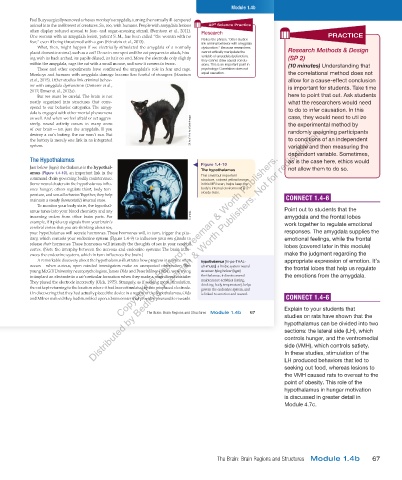
                                                                         Figure 1.4-10
                 Just below (hypo) the thalamus is the hypothal-         The hypothalamus             not allow them to do so.
                 amus (Figure 1.4-10), an important link in the          This small but important
                 command chain governing bodily maintenance.             structure, colored yellow/orange
                 Some neural clusters in the hypothalamus influ-         in this MRI scan, helps keep the
                 ence hunger; others regulate thirst, body tem-          body’s internal environment in a
                 perature, and sexual behavior. Together, they help      steady state.
                 maintain a steady (homeostatic) internal state.                                     CONNECT 1.4-6
                    To monitor your body state, the hypothal-
                 amus tunes into your blood chemistry and any                                        Point out to students that the
                 incoming orders from other brain parts. For          Diomedia                       amygdala and the frontal lobes
                 example, if it picks up signals from your brain’s                                   work together to regulate emotional
                 cerebral cortex that you are thinking about sex,
                 your hypothalamus will secrete hormones. These hormones will, in turn, trigger the pitu-  responses. The amygdala supplies the
                 itary, which controls your endocrine system  (Figure 1.4-9) to influence your sex glands to   emotional feelings, while the frontal
                 release their hormones. These hormones will intensify the thoughts of sex in your cerebral   lobes (covered later in this module)
                 cortex. (Note the interplay between the nervous and endocrine systems: The brain influ-
                 ences the endocrine system, which in turn influences the brain.)                    make the judgment regarding the
                    A remarkable discovery about the hypothalamus illustrates how progress in science often   hypothalamus [hi-po-THAL-  appropriate expression of emotion. It’s
                 occurs — when curious, open-minded investigators make an unexpected observation. Two   uh-muss]  a limbic system neural   the frontal lobes that help us regulate
                 young McGill University neuropsychologists, James Olds and Peter Milner (1954), were trying   structure lying below (hypo)
                 to implant an electrode in a rat’s reticular formation when they made a magnificent mistake:   the thalamus; it directs several   the emotions from the amygdala.
                 They placed the electrode incorrectly (Olds, 1975). Strangely, as if seeking more stimulation,   maintenance activities (eating,
                                                                         drinking, body temperature), helps
                 the rat kept returning to the location where it had been stimulated by this misplaced electrode.   govern the endocrine system, and
                 On discovering that they had actually placed the device in a region of the hypothalamus, Olds   is linked to emotion and reward.
                 and Milner realized they had stumbled upon a brain center that provides pleasurable rewards.  CONNECT 1.4-6
                                                                                                     Explain to your students that
                                                        The Brain: Brain Regions and Structures  Module 1.4b   67
                                                                                                       studies on rats have shown that the
                                                                                                       hypothalamus can be divided into two
                                                                                                     sections: the lateral side (LH), which
                                                                                                     controls hunger, and the ventromedial
         03_myersAPpsychology4e_28116_ch01_002_163.indd   67                              15/12/23   9:23 AM
                                                                                                     side (VMH), which controls satiety.
                                                                                                     In these studies, stimulation of the
                                                                                                     LH produced behaviors that led to
                                                                                                     seeking out food, whereas lesions to
                                                                                                     the VMH caused rats to overeat to the
                                                                                                     point of obesity. This role of the
                                                                                                     hypothalamus in hunger motivation
                                                                                                     is discussed in greater detail in
                                                                                                     Module 4.7c.


                                                                               The Brain: Brain Regions and Structures Module 1.4b   67


          03_HammerTE4e_47547_ch01_2a_163_4pp.indd   67                                                                         07/02/24   5:22 PM

